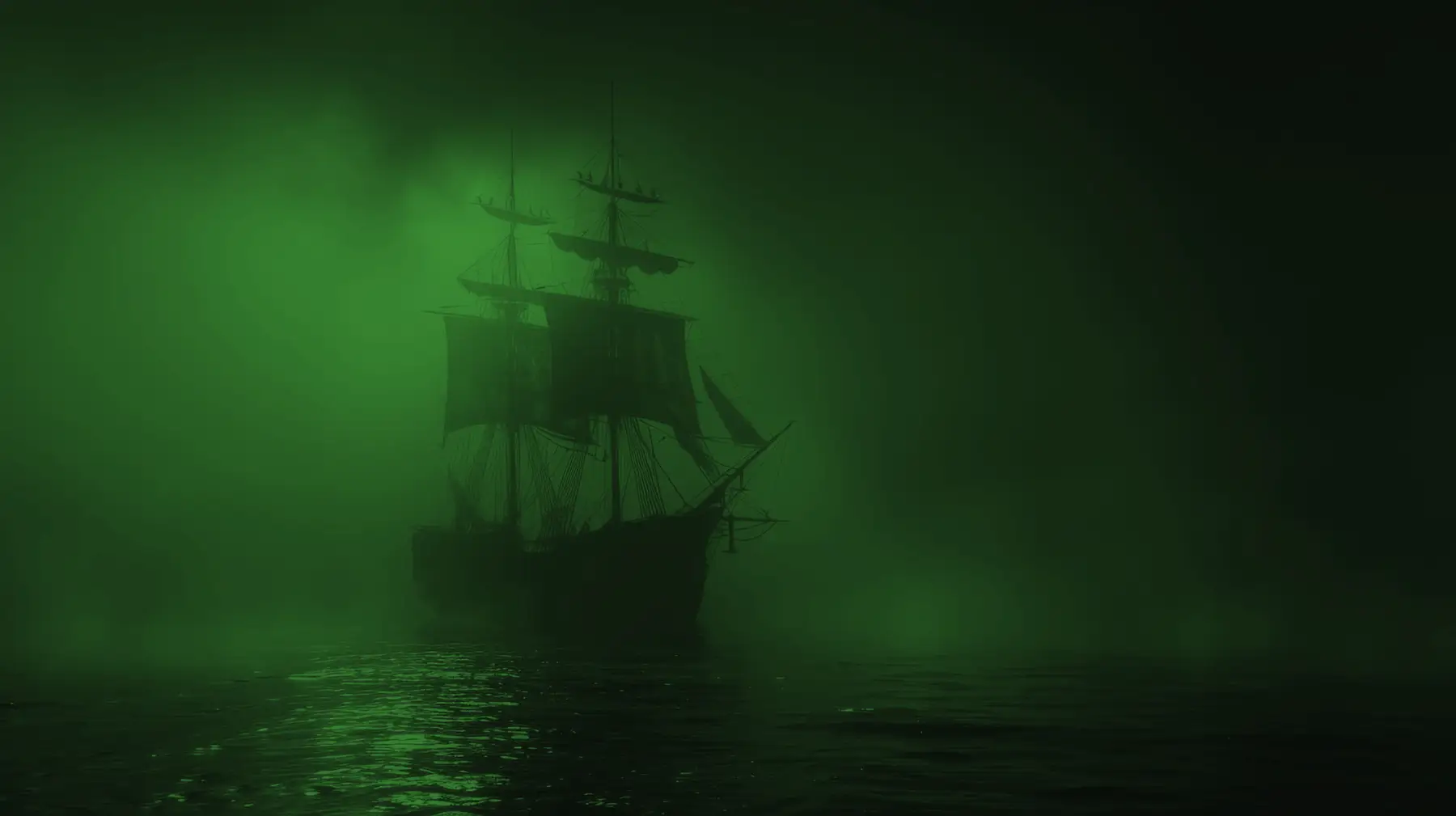
Off the island of Sumatra, a telegraph operator on a passing ship took down a desperate distress call from a Dutch steamer. All the officers were dead, the message said, and probably the whole crew. Then the Morse code turned to gibberish, and after it came two words and a terrible silence: "I die."
The ship was the SS Orang Medan. Nobody has ever settled what killed her crew. The bigger question is whether she ever sailed at all.
Room enough to vanish
Losing a ship is easier than it sounds. Water covers 71% of the planet, and UNESCO estimates that more than three million wrecks still lie undiscovered on the ocean floor. Humans have been heading out to sea for 50,000 years in soft bodies built for none of it.
Take the SS Waratah, a passenger ship so grand that people called her the Australian Titanic. She had elegant staterooms, a luxury music lounge and a machine that turned salt water into fresh. She had no radio, because ships weren't required to carry one until the Wireless Ship Act took effect in July 1911. In June 1909, on only her second voyage out of Sydney, she vanished off the coast of what is now South Africa with her crew and 211 passengers. An officer who knew her bow to stern swore that "nothing will convince me that the steamer has sunk until a piece of her wreckage is shown me." Families pointed to that desalination machine: the passengers had water, and they could catch fish.
In 1999, after 18 years of searching, Emlyn Brown announced he had found her. Two years later he took it back. The wreck was a cargo ship sunk by a U-boat in 1942. "I and all involved are stunned beyond belief and almost speechless at what was finally seen on the ocean floor," he wrote. After 116 years, not a scrap of the Waratah has turned up.
Dead at their posts
The Orang Medan's SOS had an odd shape. Her first message asked urgently for a doctor. When a nearby ship replied that medical help was on its way, her operator shot back: "cancel doctor, send warship."
In one account, the American merchant ship Silver Star raced 210 nautical miles to reach her and found her 50 miles or more off course. Her chimney gave off no smoke, nobody was on deck, and neither the horn nor a megaphone got an answer. A party of ten boarded her. "We could find no sign of a wound on any of them," an officer reported. "Death seemed to have taken them by surprise at their posts." The bodies were twisted as if each man had been fending off a blow. The ship's dog lay stiff, frozen mid-snarl. The radio operator still had his earphones on and one hand on the telegraph key. The log was missing, and a sharp, acrid smell hung in the air.
The boarders had counted 12 bodies when an explosion sent them rowing for their lives. By the next day the Orang Medan had burned out and sunk in water roughly 5,000 meters deep. In his log, the Silver Star's captain wrote that he suspected she'd been carrying chemicals and ammunition or explosives. One of her lifeboats was missing.
She was a shady lady to begin with: a rusty 5,000-ton cargo steamer about 40 years old that had changed owners and names at least a dozen times. She had a habit of slipping in and out of port after dark. Even her name, Malay for "man of Medan," broke the old sailors' rule that a ship is always a woman.
Fifteen thousand boxes
In June 1947, a lifeboat washed up on Taongi Island in the Marshall Islands with six dead men and one barely alive. The survivor said he was Jerry Rabbit, second officer of the Orang Medan. A missionary nursed him while he told his story. The captain had hired him in Shanghai without asking to see any papers. The crew loaded 7,000 boxes there and 8,000 more at a small harbor to the south, all headed for a handoff to another ship off Costa Rica, on a route that stayed clear of the usual shipping lanes.
On the tenth day the stokers, the men who shoveled coal into the boilers, started getting sick. When one died, the captain called it heat stroke. That was believable in a boiler room that ran 120 to 160 degrees Fahrenheit, but it didn't explain why every stoker was falling ill, or why the sickness spread to the engine room and left men doubled over with cramps. Rabbit went through the manifests and found cyanide, sulfuric acid and 20 canisters of nitroglycerin. He thought some of the seals had failed. The captain was offended that his second officer would question his authority and refused to change course. Rabbit and six crewmates fled in a lifeboat so fast they took no food or water. As they rowed away, they heard the steamer's engines go silent. Rabbit made it to Tongi and died a few days later.
Three different ships said they answered the Orang Medan's 1947 SOS, yet the same ship, the same bodies and the same explosions were already in a newspaper in 1940, and no registry shows she ever existed. Even so, in 1959 an assistant to the CIA's director was sure she held the answer to the sea's unsolved mysteries.
Three rescues, one ship
The other accounts don't match. In one, the Greek carrier Andressa answered the call. Her first officer found five officers dead around a table, "their eyes rolling in horror and their bodies locked in rigor mortis." The ship's doctor found no sign of disease, poisoning or suffocation. Nothing exploded in this version. The Orang Medan was towed to Jakarta, put under quarantine, ruled a death by misadventure, and eventually scrapped in Karachi. A U.S. Navy ship reported picking up the same call and boarding a ship flying no flag. Its crew counted 12 bodies on a ship that should have had about 40 men aboard.
A ship older than her own death
The Orang Medan doesn't appear in the big ship registries like Lloyd's of London. That would make sense for a smuggler. One possible customer is Unit 731, the Japanese Imperial Army's secret germ-warfare program, which experimented on humans and dropped plague bombs on Chinese cities.
Then there are the dates. Rabbit's story ran in 1948 in the Dutch-Indonesian newspaper The Locomotief. But a report published November 22, 1940, and tied to Trieste, where journalist Silvio Scherli was based, tells the same story: same ship, same bodies, same explosions, seven years early. Either someone made up a ripping good yarn, or something real happened in 1940 and later got a new date.
The CIA didn't laugh it off. On December 5, 1959, C.H. Marck Jr., assistant to the CIA's director, asked a correspondent, "do you think something from the unknown is involved?" He added: "I feel sure the SS Orang Medan tragedy holds the answer to many of these airplane accidents and unsolved mysteries of the sea." He linked it to centuries of reports of fiery spheres that he believed "come from within our planet."