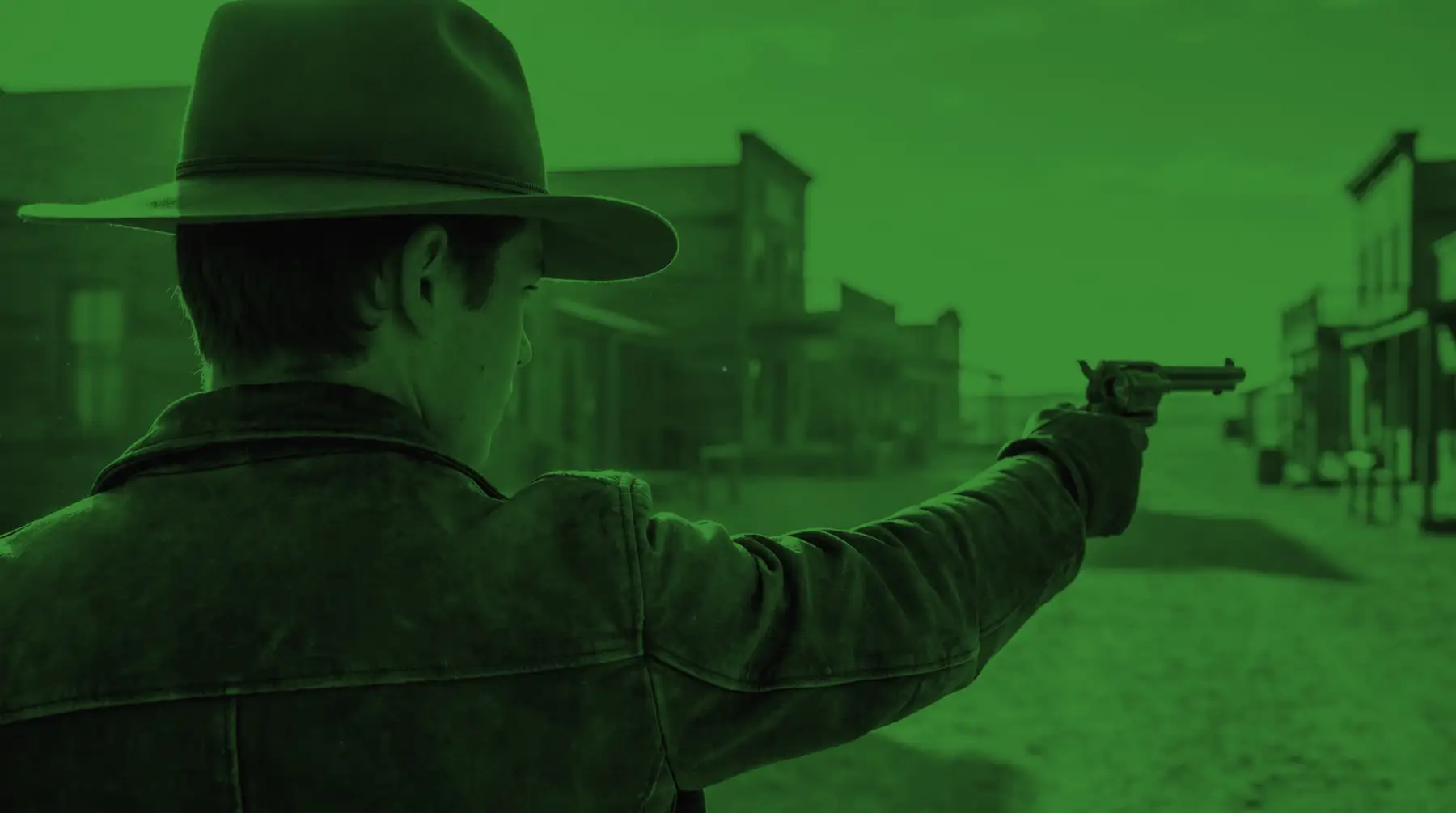
In February 1890, a pair of elderly caretakers vanished from a cattle farm outside Millard, Nebraska, and so did every animal they'd been minding. The man who hanged for it was a sharp-dressed rustler who went by Ed Neal, though that may not have been his name at all. Omaha still tells his story as a ghost story. What it leaves out is what his hanging turned a crowd into.
Caretakers on the Penny Farm
Millard was a speck of a town, 328 souls, founded by Ezra Millard, who laid its streets parallel to the Union Pacific tracks. Nearby sat the Penny Farm, owned by a Dr. Pinney of Council Bluffs, Iowa, and leased by Dennis Cadwalader. Short on help, Cadwalader asked his in-laws, Allen and Dorothy Jones, to look after the land and livestock until he could find a man to run the place. Allen was 71, Dorothy 60, at a time when a man could expect to live to about 45. The neighbors called them spry.
They made a point of knowing those neighbors. Young Charlie Root, from the next farm over, saw them nearly every day. So when days passed without a glimpse of Allen or Dorothy, or of the Penny cattle out grazing, or of the horses, Charlie went to his father. Around the same time, Dr. Penny started worrying that he couldn't reach his caretakers.
The sloppy dung heap
On February 13, the couple's grandson Frank Cadwalader rode out with a man named C.A. Phillips. The farmhouse was tidy, the bed made, the dishes washed and put away. The animals were gone. The men slept there, and on Valentine's Day they took one last look at the barn and noticed that the manure pile beside it looked sloppy, which was not like the Joneses at all.
They raked through it and found Allen. Dorothy lay under a heap of cornstalks, and rats had been at her. Both wore heavy winter coats. Allen had been shot in the back three times, Dorothy twice, the shots so tightly grouped that the killer must have stood almost directly behind each of them. Pails of cattle feed sat nearby, untouched.
The livestock was branded, and it turned up in South Omaha, happily eating its new owners' feed. The seller was a man named Neal. He'd sold nine of the ten horses for less than half their value, which got people talking. LJ Carpenter, who ran a livery stable nearby, remembered a stranger offering him horses at $10 apiece and hiring his foreman, Theodore Mott, to drive a herd to the stockyards. Mott and two other drovers landed in jail, all telling the same story: a man named Ed Neal had hired them.
A clerk with a cop's eye
Omaha Police Chief Webber Seavey got on the phone to prisons across the country. The Iowa State Penitentiary had released a C.E. Neal six weeks earlier after a stretch for grand larceny, and Kansas City had a Neal in a cell for stealing cattle, three gold watches in his pockets that he said he'd bought at an Omaha pawn shop.
That shop's 18-year-old clerk, William Schnell, missed nothing: the black derby, the high collar, a black curly lambskin coat he suspected was fake, and a customer who kept his right hand out of sight. "I didn't like the looks of him," Schnell said. When the man peeled bills off a fat roll, Schnell joked, "you must have made a big stake somewhere." Offered a revolver, the customer pulled out his own .38 Smith and Wesson: "My brother and I tried it just the other day and I want to tell you son, I am a good shot." His hand was shaking. "Mister, you seem sort of nervous," Schnell said. "Yes, a man is nervous sometimes."
The Joneses had been killed with a .38 Smith and Wesson.
Watching Ed Neal slowly strangle on the gallows didn't satisfy Omaha. That same night a mob lynched George Smith, an innocent man with an alibi, and the city went on to remember the whole thing as a cozy tale about Neal's ghost haunting the courthouse.
Liars, confessions and an alibi
Neal swore he was innocent and blamed an old cellmate, Joe Schellenberger, known as Simple Joe. Schellenberger denied it, then confessed in vivid detail: Neal pointing a revolver at his head and warning, "I'm gonna do some work tonight, and if you ever give it away, I will kill you deader than hell." The details didn't match the bodies, and the next day he admitted he'd lied. A third suspect, C.W. Sherman, blamed Schellenberger, then cut himself with a razor in jail and called it bloodletting for a headache. The truth landed from a sheriff one state over: Schellenberger had been sitting in his jail when the killings happened. Seavey, under enormous pressure to close the case, was later accused of engineering the false confession.
Neal's trial ran nine days. The jury agreed on guilt immediately but stretched deliberations to 17 hours to collect one more day of jury pay.
Seven thousand spectators, then a mob
On October 10, 1890, more than 7,000 people packed the streets around the Omaha courthouse, climbing rooftops and telegraph poles. On the gallows, Neal said: "I killed that poor old man and woman all by myself. No one helped me." The drop botched the job. A reporter wrote that "the drop failed to dislocate the neck and the life of the body ebbed away rather slowly." It took an hour for doctors to pronounce him dead.
The crowd wasn't finished. Days earlier, police had arrested George Smith, a 50-year-old Black porter, accused of raping a young girl. The Omaha World Herald ran vile racist copy, and that night another paper falsely reported, without checking, that the girl had died. By 9 p.m., five to ten thousand people surrounded the county jail. Police did nothing; even the governor-elect's pleas came too late. The mob spent nearly two hours breaking into Smith's cell, beat him senseless, dragged him through the streets by a rope around his neck, and strung him up on the telegraph wires in front of the opera house. The Omaha Bee wrote that he was probably already dead. Smith was innocent, with an alibi and witnesses to prove it.
Nobody seemed ashamed. The Eden Musee put up a life-size wax tableau of Neal killing the Joneses, a short stroll from wax British royals, promising "we expect the name Eden Musee to be in the mouth of everyone interested in the Penny Farm tragedy." And Neal, the story goes, never left. People have seen his hazy figure in the Douglas County Courthouse for years, and former clerk Clyde Sunblad said locked files in the vault kept turning up disturbed, with cigarette stubs among the papers. Omaha was still chuckling over the ghost in the 1950s. The man the mob killed rarely made it into the telling.