Long before anyone left a one-star review, the ancient Greeks settled their grudges on sheets of lead no bigger than a playing card. One of them turned up in 2003 in a young woman's grave near the port of Athens, and it reads: "Cast your hate upon Phanagora and Demetrios, and their tavern, and their property, and their possessions." The likeliest culprit was a rival tavern keeper who hired a curse writer to rain misery down on the competition.
The young woman in the grave probably had nothing to do with any of it. Her grave was just the mailbox.
Special delivery to Hades
A curse only worked if it reached the gods of the underworld: Hades, Persephone, Thanatos and that crew. The underworld was underground, so an open grave made the fastest shortcut. Curse tablets got chucked into graves on the regular. When no grave was handy, people dropped them down wells and cisterns or sneaked them into temples. Lead was the material of choice because Greece was rich in silver mines, and lead is a byproduct of silver mining. It was cheap, plentiful and reusable, so nearly any citizen could afford to commission a hex.
Nobody was safe. A tablet now in the Princeton University Art Museum goes after, of all people, a produce seller: "Strike, bind, bind together Babylas the greengrocer." In Roman Britain, a man whose animal had been harmed called on Mercury, guide of souls to the underworld, to "drive them to the greatest death." To bind someone meant attaching an outcome to them: love or victory, or sickness, poverty and death. Cursing was morally neutral and totally legal. You could throw every curse in the book at the greengrocer, but if he actually died, you might face murder charges. Curses don't kill people. People kill people.
Spirits in the Colosseum
By the Renaissance of the 15th and 16th centuries, magic had turned serious. It was less about curses and more about hidden knowledge: alchemy (the attempt to transform matter by magic, lead into gold and all that), astrology and divination. Science and magic worked out a weird truce. Science got reason, and magic got everything science couldn't explain. The mathematician John Dee could study math and also talk with angels, and nobody saw a conflict. In 1587, a medium named Edward Kelly told Dee that the angel Uriel had ordered the two men to share all their possessions, wives included. On May 22, 1587, Dee wrote in his diary that they had swapped wives as ordered. Nine months later, Mrs. Dee gave birth to a son they named Theodore, and Dee raised the boy as his own.
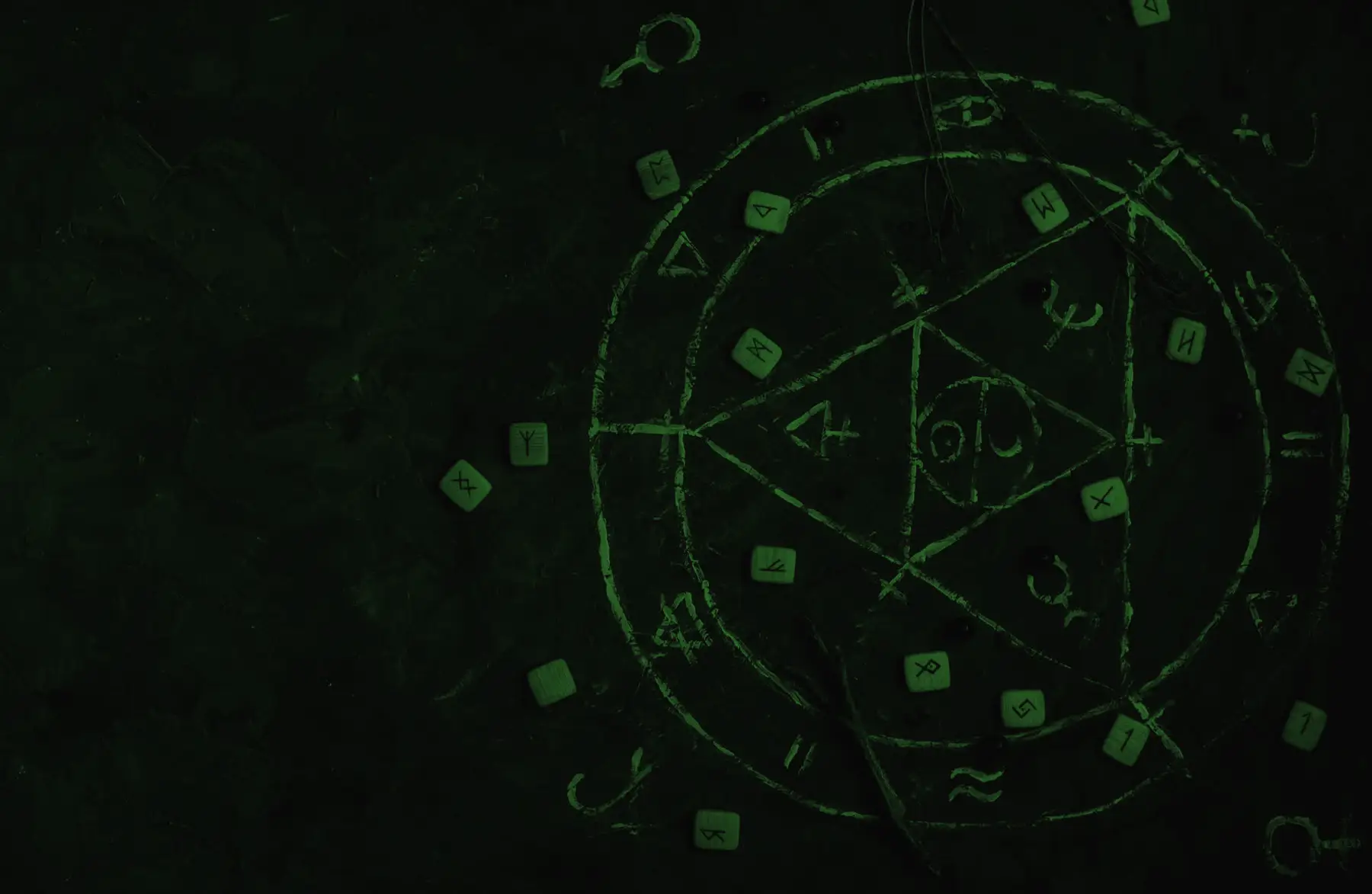
The sculptor Benvenuto Cellini was a duelist, a best buddy of Michelangelo and a man exiled from Florence again and again because he kept killing people. He also dabbled in necromancy, the summoning of the dead to predict the future. With a Sicilian priest and two assistants, he drew a huge magic circle on the empty grounds of the Roman Colosseum, and the place filled up with spirits. Cellini got to ask this army of the dead for anything, and he asked for help getting back together with a woman named Angelica. The spirits kept a dignified silence.
So they went back, this time with a 12-year-old shop boy to act as their oracle. Even more spirits came. The boy saw four giants creeping toward the circle, and then he saw the Colosseum engulfed in flames. The assistants raced to throw the herb asafoetida into the fire, and one of them got so scared that he literally crapped himself, loudly. According to Cellini, that sent the dead flying. One month later, a wild turn of events landed Cellini in Naples, back together with Angelica at last.
The wandering doctor
In Germany, Heinrich Cornelius Agrippa published Three Books of Occult Philosophy in 1533. It stayed influential for 500 years, and it describes sorceresses so skilled that "by giving cheese to men, they could presently turn them into working cattle."
That was the world of Johann Georg Faust. He shows up in the records in 1506 as a magician and astrologer, and you can follow him around Germany for the next three decades. He earned a divinity degree from Heidelberg University and practiced necromancy on the side. He was an itinerant magician who drifted from town to town. In Bamberg he cast horoscopes, and the local bishop was a customer. Ingolstadt banished him, and a low-ranking official turned him away from Nuremberg as the "great necromancer and sodomite." Meanwhile, respected scholars called him knowledgeable and a good physician.
Around 1540 or 1541, an explosion ripped through a hotel in Staufen am Breisgau, supposedly during an alchemy experiment gone wrong. Faust's body was found in the wreckage, badly mutilated. His enemies said that proved the devil was displeased with him. Then again, getting blown to bits would mutilate anyone, devil or no devil.
The man behind the Faustian bargain was a real traveling astrologer who probably died in an alchemy explosion. After the legends about him grew, the tale of a man the devil tore limb from limb ended up as an inspirational quote on coffee mugs and painted wooden signs.
Twenty-four years, signed in blood
The theologian Johann Gast took the story and ran with it. In 1548 he wrote that Faust traveled with a dog that sometimes turned into a servant, and that his corpse "would turn its face to the earth no matter how many times it was repositioned on its back." Another writer claimed Faust flew in Venice until the devil slapped him out of the sky. A book of Faust's spells, kept in a church in Zellerfeld, had to be locked down with an iron chain. Reading it forward summoned the devil, and only reading it backward sent him away.
The best legend came out in 1587. In it, Faust conjured the devil at a crossroads in a forest near Wittenberg and made a deal. The devil would serve him for 24 years, and then Faust would give up his body and soul. He signed the pact in his own blood. He got fine wines, beautiful women and even Helen of Troy. When the 24th year ran out, his students heard a storm and then his screams, getting weaker. At daybreak they found blood everywhere. "Bits of brain clung to the walls." His corpse lay on a manure pile, still twitching. The devil is the best salesman there ever was.
Some said Faust beat the devil anyway. In that version he told a servant: "After I have died, cut my body into small pieces, put everything into a tub, and press it all firmly together." The tub sat behind a red-hot stove for three days with every shutter closed. On the fourth day, the servant opened the door to see Faust climbing out of the tub in one piece. He "waved cheerfully to the servant as he climbed out of the tub intact and whole."
From hellfire to kitchen signs
Christopher Marlowe and later Johann Wolfgang von Goethe turned the legend into plays. That's why the man the devil tore limb from limb now lives on in coffee mugs, refrigerator magnets and painted wooden signs carrying Goethe's words: "Whatever you do or dream you can do, begin it. Boldness has genius, power, and magic in it." Goethe didn't even have to sell his soul for that. Pity poor Dr. Faust.