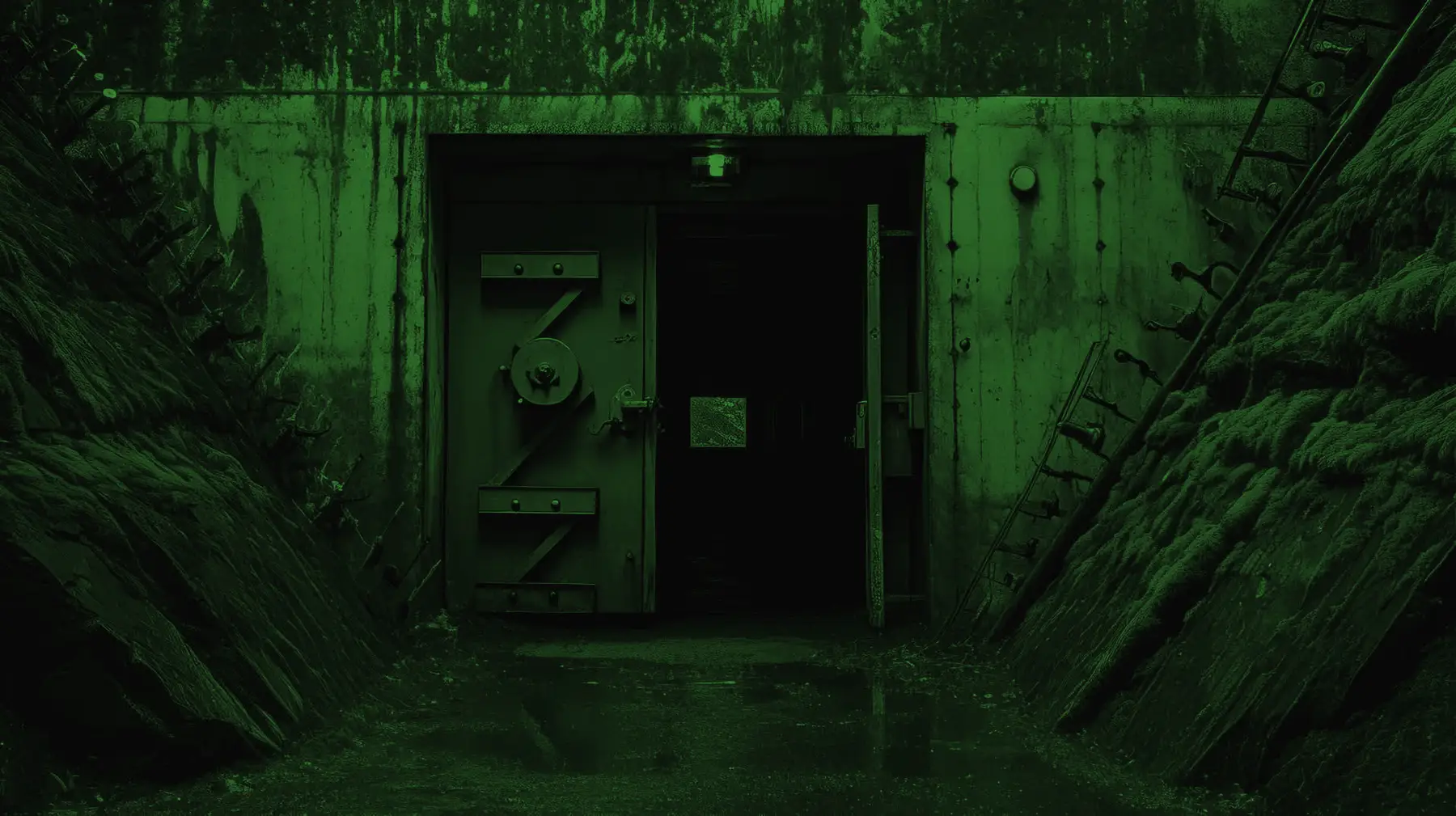


In June 2013, a librarian went down to the basement of a closing middle school in Watkins Glen, New York, to find a desk. What she found was the Cold War, sealed in cardboard and stamped 1962. And under a famous West Virginia resort, a far grander bunker had spent 30 years hiding in plain sight, built to keep the United States government running after the bombs fell.
Biscuits behind the boiler room
Maggie Field, the media specialist for the Watkins Glen High School Library, had spent nearly three months emptying the old school's library. The desk in the basement turned out to be a massive old thing, and the elevator was broken. Then the custodian, Lucy Soper, who knew that building as well as anyone, mentioned that a room down there used to be a fallout shelter.
Getting in took some doing. You wound through two small rooms into the boiler room, climbed a 10-foot homemade ladder, worked your way around a maze of pipes, and squeezed through a 42-inch-tall door. On the other side sat a dirt-floored crawlspace with six-foot ceilings, piled high with dozens of cartons and drums marked Civil Defense and dated 1962 or 1963. Some boxes held the Civil Defense All-Purpose Survival Biscuit, five pounds apiece for seven people, something like an unholy marriage between a graham cracker and a saltine. Drums built to serve 50 people held rolls of Scott toilet paper, iodine, sanitary napkins, a cheap plastic toilet seat ring and commode liners. Once you emptied a drum, the drum itself became the toilet. Each one also came with a can opener, for reasons nobody has ever explained.
Field saw teaching tools, artifacts that could bring the terror of the early atomic age into a history classroom. But not even Superintendent Tom Phillips knew there was a third forgotten shelter, tucked under the former technology room. Less than a century had passed, and the people who once knew had simply stopped mentioning it. Memory needs a keeper, and nobody got tapped for the job.
A survival guide packed in with the biscuits offered a cheerful vocabulary lesson ("Know your bomb.") and advice for anyone caught outdoors when the flash came: run inside, curl up, and "If possible, face a corner."
Concrete, and no questions
The government's own plan was far grander. The Greenbrier in White Sulphur Springs, West Virginia, has hosted 28 presidents and served as a military hospital during World War II. In the late 1950s, under a secret agreement with the hotel's owners, it was chosen as the place where Congress would ride out a nuclear war. The project was code-named Greek Island, and the program behind it was called Continuity of Government. The resort was a four- to five-hour drive from the Capitol, which planners figured was far enough to be outside the initial blast zone.
The bunker went up in plain sight, billed as a new West Virginia Wing. Randy Wickline, a plant manager for the Superior Supply Company, spent two and a half years pouring more than 50,000 tons of concrete into an unthinkably cavernous hole. His company had to buy more mixers. Bosses kept yelling at him to speed up, and money was never an issue. The finished structure had two-foot walls reinforced with steel and four steel doors, each 19 and a half inches thick, lowered into place by cranes. Then the whole thing disappeared under 20 feet of dirt. Workers were told it would house sensitive equipment.
A secret the whole town kept
The workers watched the news, and their kids practiced duck-and-cover drills at school. According to The Washington Post, so many locals knew what was going on that the government sent two unbriefed men to pose as hunters and find out how much was being said. They came back with so many details that they had to be given top secret clearance. Good jobs were scarce, so people kept quiet, though one contractor did wonder aloud why an exhibit hall needed 110 urinals. Wickline put it plainly: "They weren't building it to keep the rain off of them. I mean, a fool would have known."
To keep the cover, the government set up a fake company called Forsythe Associates, staffed by federal employees posing as hotel workers who maintained the Greenbrier's 1,100 televisions. The blast doors vanished behind fake walls, which was easy to pull off, since their wheel-shaped handles were only on the inside.
The top secret bunker meant to save Congress from nuclear war sat under a luxury resort, where it passed as a convention hall. So many locals knew about it that the undercover agents sent to check came back knowing enough to need top secret clearance themselves.
Behind the high-voltage door
The biggest room was never hidden. The exhibit hall, with ceilings close to 20 feet and a floor built to hold unlimited weight, was rented out to the public, and GM even held a car show there. Off the hall, a 470-seat auditorium was meant to serve as the House chamber, and a 130-seat room as the Senate. A bolted door led to a corridor that dead-ended at a sign warning of high voltage, and behind that lay the real bunker. Lawmakers would have stripped, showered, and changed into army fatigues while their own clothes were burned. Each got soap, a toothbrush and a tube of the grooming tonic Vitalis. Eighteen dormitories held 1,080 bunks, enough for every member of Congress plus one aide apiece. Spouses and children weren't on the list.
The bunker also had a cafeteria with false windows, stocked with food for 1,000 people for 60 days and restocked every six months for 30 years. There was a hospital, a pharmacy heavy on antidepressants, a small jail, a pile of straitjackets and a "pathological waste incinerator," which is a polite way of saying crematorium. A broadcast studio came with Washington backdrops that could be swapped to match the season. After the electromagnetic pulse from a nuclear blast, who exactly would be watching?
The bunker was finished in 1962, just in time for the Cuban Missile Crisis. Tip O'Neill, one of the few members of Congress briefed on it, doubted the plan would ever work. It would take hours to herd legislators 250 miles through traffic and weather, even with a runway built for bigger planes at the nearby Greenbrier Valley Airport. He also had no intention of going underground without his wife, and plenty of lawmakers and Cabinet members felt the same about their families. When the secret spilled in 1992, the government shut the bunker down. Today, hotel guests can play a round of golf, get a facial and take the tour.
The new walls
The bunkers haven't gone away. Now the ultra-rich are building them in places like Hawaii and New Zealand. Media theorist Douglas Rushkoff, who coined the term digital native, was once invited to speak to a group of tech executives and found himself alone with five men. They had one question: how best to prepare for an apocalypse that Rushkoff called one of their own making. They talked about hiring former Navy SEALs as guards, then worried about why those guards would stay loyal once money meant nothing. One admitted that armed hostiles didn't worry him. What scared him was "a mother holding a baby, standing at the end of his driveway and asking for food."