Case file 052Ghosts, Curses & the ParanormalCold War (1945–79)

Charlie No Face

Generations of teens hunted a monster on a Pennsylvania highway. He was Raymond Robinson, a blind, gentle man who walked at night so no one had to see him.

Feb 3, 202448 minRe-aired Aug 28, 2026 as Revisiting Charlie No-Face - The Tragic Truth Behind the Green Man Legend
00:00 / 48:04
Or listen to this episode onApple PodcastsSpotifyYouTube
Share this episode

In this episode

  • Twilight on the Wallace Run bridge, five boys, and a bird's nest just out of reach
  • The 1919 newspaper report on the accident, and the one word in it that jumps off the page
  • Why a blind man took his long walks only after dark
  • The Green Man, a tunnel on Piney Fork Road, and what a single touch was supposed to do to your car
  • How the hunts on Route 351 got big enough that the police had to step in

“The hideous monster with the blowtorched face who came out only at night turned out to be not the ugly one at all.”

The story

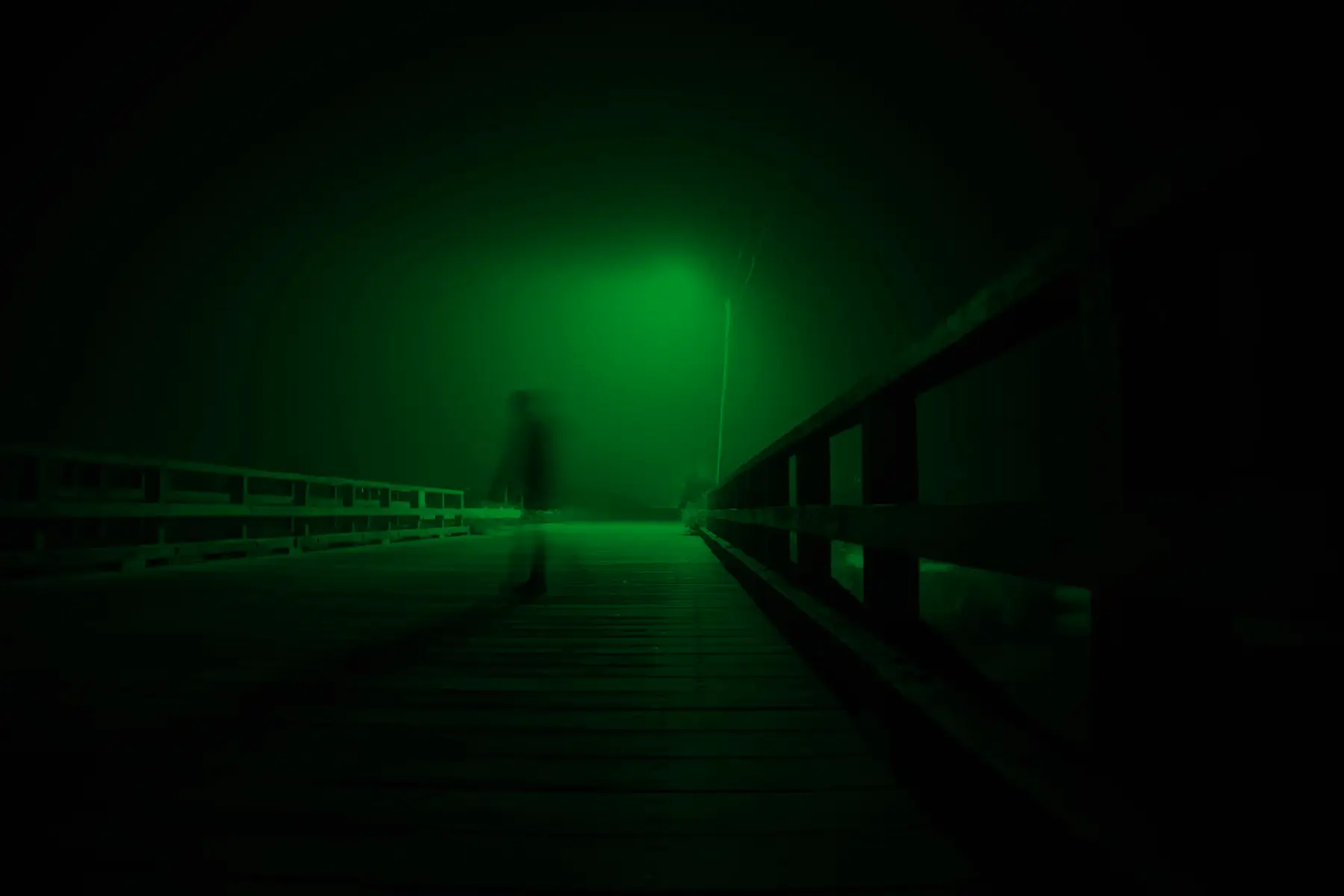
For fifty years, a man walked Route 351 in western Pennsylvania at night, one foot on the pavement and one crunching along the gravel shoulder. Carloads of teenagers hunted him for sport. They called him the Green Man, and later Charlie No-Face, and plenty of them swore he was nothing but a story made up to keep kids out of the woods. His name was Raymond Robinson, and he was as real as anyone who ever went looking for him.

A nest just out of reach

Raymond was born on October 29, 1910, in Beaver County, Pennsylvania. It was steel country, and the county has turned out Joe Namath, Mike Ditka and Henry Mancini. When Raymond was a boy, a massive wooden bridge spanned Wallace Run. It belonged to the Pittsburgh Harmony Butler and New Castle Railway Company, and it carried the Harmony Line trolley along with the power lines for two trolley systems: 1,200 volts of direct current and 22,000 volts of alternating current. The bridge begged to be climbed and raced across, and it was the most direct route to a favorite swimming hole on the Beaver River.

There had been a warning. In September 1918, an 11-year-old named Robert Littell touched one of those high-voltage lines while playing on the bridge, and it killed him. The boys knew the wires were off-limits. But they were eight years old, and they didn't really understand. Raymond had lost his own father just a year earlier.

In June 1919, at twilight, five boys were crossing the bridge on their way home from swimming when they spotted a bird's nest perched high on the arch. They argued over how many baby birds might be inside. Raymond volunteered to climb and shimmied up the girder. Before he reached the nest, the current tore through him. It burned his left arm off at the elbow, seared his torso and melted his face. His nose and both eyes were gone.

"Boys eyes burned out by electricity," the headline blared. The paragraph under it said Raymond was "probably fatally burned." Probably. Nobody accused that newspaper of tact.

In good humor

Raymond was rushed to Providence Hospital, where no one, his doctors included, expected him to survive. He did. He could still hear and speak. Reconstructive surgery had leaped forward treating the soldiers of World War One, but no skilled surgeon was within reach of a boy from a family of modest means in a remote corner of Pennsylvania. Just two months after the accident, the Daily Times reported: "Yet in spite of all his affliction, the boy is in good humor." He stayed that way.

His mother remarried, this time to her brother-in-law, and Raymond soon had six siblings. His family loved him and guarded him fiercely, and they also hid him away, as families of the era commonly did. He ate his meals alone, shut out even from his own family's table. Still, he learned some Braille, fell hard for baseball, and stayed up late with the family's Philco radio in the living room and his own shortwave set in his bedroom. Doctors eventually made him a prosthetic nose attached to a pair of dark glasses, which probably drew more stares than it deflected. When a man from a traveling freak show came by to offer Raymond a spot on the midway, the carnival's strip of sideshows and games, his family was furious and more determined than ever to keep him hidden.

One foot on the pavement

As an adult, Raymond moved into a small apartment built for him in the garage. As his siblings married and had kids, Uncle Ray was right in the thick of family life. He loved mowing the grass, blind or not, and when he missed a spot, someone quietly tidied it up later without a word. He made wallets and belts and wove doormats out of old rubber tires for a little income.

But he was restless. He longed for the woods and rivers of his childhood, and since his face frightened people, he went out only late at night, when he could count on being alone. With a walking stick, he navigated the woods behind the house by keeping one foot on the path and one off. In 1953, according to a nephew, a coal company damaged that land, and Raymond moved his walks to Route 351, the highway between Koppel and New Galilee. Sometimes he didn't come home until dawn. His family begged him to stay in, but short of barring the windows, there was no stopping him.

The weird part

The monster that generations of teenagers chased down Route 351 was a real, blind, gentle man who walked only at night so his face wouldn't frighten anyone. The hunts for him got so big that police had to direct the traffic.

The Green Man of Route 351

The legend grew up alongside him. First came the Green Man: struck by lightning, living in an abandoned railway tunnel on Piney Fork Road, his flesh turned green and still crackling with enough electricity to stall a moving car with a single touch. Kids drove into the tunnel with their headlights off, calling his name. He never showed, because he was out on 351 with his walking stick. Somewhere along the way, the Green Man became Charlie No-Face.

Hunting him turned into a rite of passage. Pennsylvania teenagers crossed into Ohio, where 18-year-olds could still legally buy beer, then cruised 351 as late as they dared. For years Raymond dove into the brush whenever he heard a car. What must it have been like to crouch blind in the dirt, heart pounding, while strangers laughed and hunted you?

Then some kid coaxed him out. Raymond accepted a beer, stayed for a cigarette, maybe talked a little about the Phillies or the Pirates. The word spread. Some kids were vile: they handed him a beer bottle filled with urine, or got him drunk, and more than once his family found him passed out by the road. Others became his friends. One of them, John Marinchak, remembered that they talked about the weather and baseball scores and never once about Raymond's face. The monster, it turned out, was just a lonely guy glad for the company.

Some nights the traffic on that stretch of 351 backed up bumper to bumper, and local police had to direct it. During the Vietnam War, soldiers from the area passed around photos of Charlie, and some of the men who saw them later traveled to Beaver County to find him. His family had kept him off the midway, but the carnival found him anyway.

Nine days short

Raymond Robinson died on June 11, 1985, at 75, nine days short of the 66th anniversary of the accident. By every account, he never complained and never turned bitter. As The Little Prince puts it, "It is only with the heart that one can see rightly. What is essential is invisible to the eye." He is buried in Grandview Cemetery in Beaver Falls, on a hill overlooking the spot where the Wallace Run bridge once stood.

The transcript

Chapters & full transcript7,179 words
Chapters
  1. 00:07Hunting Charlie on Route 351
  2. 03:28A bridge built for climbing
  3. 07:53The bird's nest
  4. 12:34A life hidden away
  5. 18:11The Green Man becomes Charlie No-Face
  6. 28:51Remembering Raymond

This transcript was generated automatically from the episode audio and may contain errors. Times are approximate, since ad breaks can shift them by a minute or two.

00:00

Hey, true weirdos at the end of this episode, stick around if you want for a little bonus content and conversation. It was a rite of passage for teenagers in that part of Pennsylvania. Drive over the state line into Ohio where an 18 year old could still legally buy beer, then start cruising route 351 between Koppel and New Galilee. The later the hour, the better your chances of spotting him. If you did see him you'd slow down, pulling over to the shoulder of the road. He might even talk to you in exchange for a few of those beers and maybe a smoke.

00:36

Some people called him a monster. Some said he wasn't even real, just something made up to scare kids into staying out of the woods late at night. But they were wrong. He was real, just as real as can be. And his story is one you'll never forget. Ever look back on your childhood and all those stupid reckless choices that could have ended in tragedy but somehow didn't? The time you took the dare to creep along the catwalk under the overpass and then jump into the river below. You could have hit your head or broken your neck or drowned. How about the time you and your buddy took his mom's car for a middle of the night joyride? You were 11. How in the world did you make it back home in one piece? That abandoned shack in the woods? Did it not occur to you that it might not be as empty as it looked? That there might be someone sheltering behind those battered walls. Someone who might see you as a plaything, something disposable. The countless bad decisions big and small that ended up with you getting stitches or detention or grounded for the rest of the summer. How many of those could have ended another way? A far more terrible way. I must have had a guardian angel you say laughing it off. And maybe you did. Seems like not every kid does though. Or being a guardian angel might be a union job with mandatory breaks. And some kids manage to have terrible timing when it comes to their foolishness. This is the story of an eight year old boy who wasn't as lucky as you. Whose only crime was following his curiosity who only wanted to count how many baby birds were in that nest. That nest perched just out of reach, the climb a short one. And then in one blinding, burning flash of light, that little boy fell out of childhood and into the world of urban legend. This is the story of Raymond T. Robinson. But you might know him better as Charlie No Face. Raymond was born on October 29, 1910 in Beaver County, Pennsylvania. Today, that's part of the greater Pittsburgh metropolitan area.

03:36

But even back in 1910, though, it was pretty well populated, which makes sense. What with both the Ohio River and the River flowing through the county. The Jones and Laughlin Steel Company opened a steel mill in 1905 that kept workers employed and families afloat right up through the collapse of the steel industry in the 1980s. A handful of legendary athletes hail from Beaver County, Pro Football Hall of Famers Joe Namath, Mike Ditka and Tony Dorsett, baseball player and manager Terry Francona. And the arts are represented too.

04:12

Composer Henry Mancini. And that iconic staple of 80s and 90s adult contemporary radio, Donny Iris. And that's just a few of Beaver County's best. A lot of talent came out of that part of the Keystone State. And back when Raymond Robinson was a boy, a massive wooden bridge connected Beaver Falls, a popular spot for him and his friends to Big Beaver. That bridge spanning Wallace Run had a lengthy name, the Pittsburgh Harmony Butler and New Castle Railway Company Bridge. A mouthful. The Harmony Line was a daily trolley service that connected Pittsburgh to Newcastle and made stops at a number of smaller towns in between. The Harmony trolley ran across that bridge terminating at the town of Murado, where passengers then had the option to transfer to the Beaver Valley Traction Company trolley, which served Beaver County. These trolley lines had wooden coaches, some with flush seating laboratories, and they were powered by electricity. The Harmony trolley ran on 1200 volts of direct current. The Beaver Valley trolley ran on 22,000 volts of alternating current. And the Wallace Run bridge carried the power lines for both. And that bridge was something to behold. It was huge, constructed of wood. It was a real draw for kids in the area. I mean, it just screamed out to be climbed on and raced across. And it was the most direct route for Raymond and his buddies to a popular swimming hole on the Beaver River. Are you getting some Stephen King stand by me vibes? It was exactly that kind of innocent fun, wholesome, but with just enough risk to make it exciting for a group of little boys. Except the risk wasn't so much the trolley cars themselves on the bridge. It was the electricity that powered them. And that was a risk that those little boys maybe didn't understand because it was invisible until it wasn't. Not that there hadn't been a warning. Not quite a year earlier in September 1918, an 11-year-old boy named Robert Littell was playing with his friends on that bridge. Robert touched one of the high voltage lines. He was killed. One of those awful freak accidents, the kind of thing no one expects to happen. The kind of thing that becomes part of the DNA of a place. The cautionary tale that gets told for a generation or two. So the boys knew that the electrical lines that powered the trolley were off limits.

07:02

They've been warned of the danger. But these are eight-year-olds we're talking about. They hear, but that doesn't mean they understand. And even Robert Littell's death must have seemed a bit unreal. Though the surprising truth is that death by electrocution looks like it might have been way more common back then than you'd guess. I found more than a dozen other boys that same year in Pennsylvania who lost their lives that same way. And let's also consider though that mortality is not a thing most eight-year-old children truly understand. Even Raymond Robinson, whose own father had passed away just a year earlier. How much did he comprehend? And besides, those boys had no intention of touching those power lines. That wasn't the plan at all. It was twilight when the five boys were crossing the bridge on their way home from the swimming hole. And that's when they spotted it perched high atop the arch structure of the bridge, a bird's nest. And was that a flutter of movement? The boys excitedly debated how many baby birds might be in that nest. Raymond was the first to volunteer to make the climb. He shimmied his way up the girder. But before he could reach the nest, it happened. Raymond Robinson was electrocuted. The voltage tearing through his small body. His left arm was burned completely off at the elbow. His torso seared and flayed. His face melted like candle wax, his nose and both eyes gone.

08:43

Boys eyes burned out by electricity blared the headline. The brief paragraph that followed read Raymond Robinson, the son of Mrs. Mary Robinson of Morado was probably fatally burned when he came in contact with a high tension wire. Wow, the use of the word probably in that sentence jumps out. But after that headline, you're not expecting much in the way of sensitivity. Raymond was rushed to Providence Hospital. His injuries were catastrophic. The child was on the verge of death.

09:14

No one expected him to survive, including his doctors. And if you're thinking, this poor kid, gruesomely, horribly burned and disfigured, whatever comes next in this story, I can't take it. I can't bear to see children and animals suffer. I'm out. I can't do it. Wait, this isn't a story about a monster or a freak. Though there were people who spun it that way. Because there are always people who are blind to anything but the ugly and awful. Don't give up just yet on Raymond Robinson, lying so still in that hospital bed, somehow, impossibly alive. They're about to call his survival a miracle. And it was. Despite the severity of his injuries, Raymond could still hear and speak. He convalesced over the months, cared for and protected by his family. His mother had remarried her brother in law, and Raymond soon had six siblings keeping him company. But the outside world, that was another story. Raymond's appearance provoked every kind of response, horror, fear, revulsion, pity. And there was very little to be done about it. Now, plastic surgery is an older art than you might think. Skin grafts were first performed in ancient India as early as 800 BCE. The ancient Romans devised surgical methods to reconstruct noses, lips and ears. And then came the fall of Rome, followed by the rise of mysticism and religion. Science was shoved into the shadows, so much so that one of the most powerful popes of the medieval age, Pope Innocent III, declared that surgery of any kind was a form of heresy, and therefore prohibited by church law. It took the Renaissance for the art of surgery to advance, though it was the catastrophic injuries suffered by soldiers in World War One that really inspired the enormous leap forward in reconstructive plastic surgery. And today, cosmetic surgeons can do extraordinary things with reconstructive surgery. Just one example, in March 2014, doctors at the Cleveland Clinic performed their first total facial transplant on a 21 year old woman named Katie Stubblefield. These kinds of procedures still feel miraculous, even as they become more commonplace. But a little boy from a family of modest means in a remote corner of Pennsylvania in the 1920s, apparently didn't have access to the kind of skilled surgeons that would have taken to even begin repairing the damage done by that high voltage electrical burn. Here's the thing that's almost impossible to believe.

12:13

Raymond Robinson powered through his recovery with the kind of positivity that sounds more like a preachy fable than the truth. Just two months after the accident, the Daily Times reported, Yet in spite of all his affliction, the boy is in good humor. And he stayed that way, unbelievable as that may be. The years passed, and Raymond Robinson grew up, managing as he could. Back then, there were few resources available for someone like Raymond. His home was a prison in many ways. He was sequestered away, hidden from the outside world. That was a common practice back then, this isolating of a family member with a debilitating condition or poor mental health or profound developmental delays or significant cognitive impairment or, like Raymond, a devastating, disfiguring injury.

13:10

Though his family cared for him and protected him fiercely. He was made to eat his meals alone and apart, unwelcome even at his own table. Shut away as he was, Raymond still managed somehow to thrive. He had accepted his terrible fate, understood that his appearance caused panic and even nausea and didn't complain, not about any of it, which is not only hard to believe, but makes everything that happened to him later, just all the more shameful. Raymond managed to learn a bit of Braille. He cultivated a lifelong passion for the game of baseball. He loved radio and spent hours listening to music and baseball games late into the night on the family's Philco in the living room.

14:07

And in his bedroom, he had his very own gateway to the wide world, a shortwave radio. Doctors did eventually create a prosthetic nose for him to wear. It was attached to a pair of dark glasses. I know what you're picturing, and you're not far off, but it was at least something. Although, truly, it might have done a better job of calling attention to Raymond's disfigurement than it did concealing it. His family, though, they grasped at any that might stop the endless gaping stares of neighbors and strangers alike. They hated the way people looked at Raymond, hated their open fear and disgust. One day, a man involved with a traveling freak show paid a visit, offering Raymond a spot on the midway. The family was frustrated and furious and more convinced than ever that Raymond must be shielded, protected and hidden away.

15:16

And then more years passed, and Raymond became an adult. He moved from his bedroom in the house to a small apartment that had been created for him in the garage. His siblings married and had children, and Uncle Ray was in the thick of it all. There were chores he especially enjoyed, like mowing the grass. But he was blind, you're thinking. He was. But being outside, the sun warm on his back, walking behind the push mower, the pleasure of a simple repetitive task. So what if he missed a spot here or there, someone in the house would go behind him later and tidy it up without ever saying a word. And though Raymond couldn't hold a conventional job, he still wanted to work. In his little apartment, he made wallets and belts and wove doormats out of old rubber tires, which brought him a little bit of income. Left to his own in the tiny garage apartment, Raymond had more independence than he had ever known. But he was restless. His life was one of confinement and isolation. He was ostracized, an object of curious horror. And he chafed against it. He craved freedom. He longed to be outdoors, back in the woods and along the rivers that have once been his playground as a child.

16:40

He began walking at night, always at night. It was nature he craved. And if he couldn't have the company of people, at least he could have that. He'd set out once the hour was late and he could be certain of his solitude. He had a good walking stick, and he devised his own way of navigating in the permanent darkness that was his world. With a stick to help guide him. Raymond would prowl the woods behind his family home for one foot on the path, and one foot off. He always found his way back home. Then, in 1953, according to a nephew, a coal company damaged the property behind the family home, and Raymond had to find a new place for his nighttime strolls. He began walking the highway that ran between the town of Koppel where he lived in New Galilee, the highway called Route 351.

17:35

With one foot on the pavement, and one crunching along the gravel shoulder, Raymond would walk and walk, sometimes not returning home until dawn. There were times when his family was frantic with worry, pleading with him to not stay out all night, worrying for his safety. But short of putting bars on his windows and a padlock on his door, there was nothing to be but to allow him this one small thing. These long nighttime walks through the countryside of Beaver County. And this is how and where the legend was born. The Green Man, Charlie No Face, a monster, a freak, a supernatural apparition, the Boogeyman. There were whole generations of people in that part of the world who grew up hearing the stories and telling the stories, most with no idea that there was a real person behind this urban legend. A real flesh and blood man, who once upon a time, had been a curious little boy who only wanted a peek at a bird's nest. How dearly he paid for that curiosity. Raymond Robinson walked those roads for 50 years from the 1930s right up through the early 1980s. It became a game to try to spot him. They first called him the Green Man.

19:08

And the story that went with that involved a lightning strike and a dwelling in the now abandoned railway tunnel atop Piney Fork Road. The lightning was said to have turned the man's flesh green, and the electricity from that lightning strike still coursed through his veins. One touch from the Green Man was all it would take to stall even a moving car, and then good luck escaping his wrath. To find the Green Man, all you had to do was drive into his tunnel, headlights off, calling out his name. Who knows what they thought would happen if the Green Man actually did appear. Of course he never did. Because the Green Man, aka Raymond Robinson, was slowly walking along Route 351, guidestick in hand. And somewhere along the way, no one seems to know exactly when or how, the Green Man got a new name, Charlie No-Face. And now there were those who were beginning to understand that Charlie No-Face wasn't a scary bedtime story. He was a real person. That knowledge didn't stop those carloads of teenagers. Most of them probably didn't believe a word of it anyway.

20:36

Don't worry about anything. Come on. He's not even real. Who even is Green Man? Who are y'all even looking for? You haven't heard about him? My God. So this like, weird man just walks down the road at night. He's just... Why are we trying to see a weird man walking down the road at Didn't believe it, that is, until the headlights picked Raymond out of the darkness on Route 351. And hearing the approaching car, he turned his face toward the sound.

21:09

What is that? What is that? He's right there! Oh my God, he's right there! Stop! We have to get out of here, please! We have to get out of here! People are capable of such thoughtless, casual cruelty. There were plenty who never once stopped to think that this man, who they stalked for a thrill, was a human being, a person, with a past and a present, with feelings. The very fact that Raymond only felt able to leave his garage apartment at night, knowing that his appearance caused distress and even terror, makes these hunts for Charlie No-Face that much worse. And the more the legend of the Green Man of Charlie No-Face grew, the harder it became for Raymond. For the longest time, he'd taken to hiding in the brush off the side of Route 351 at the first sound of an approaching car. Can you put yourself there? Blind, navigating by feel, crouched in the dirt with a racing heart, totally vulnerable, hiding your ravaged, melted face from the ones jeering and laughing as they hunt you down. We'll never know who it was that managed to change the game. Who was that first kid who coaxed Raymond out of the shadows? What did Raymond hear in that voice that made him step forward, shyly accepting the offered beer, staying long enough to have a cigarette, maybe commiserate a little about the fillies or the pirates? Small a thing as that seems, it was huge for Raymond. It was a moment of pure normalcy, something you and I take for granted. For Raymond, though, it was a moment of powerful human connection. As word got out that Charlie No-Face might stop in his wanderings and speak in exchange for a beer and a cigarette, kids doubled down in their efforts to find him. And some of them did foul things like filling a beer bottle with urine and giving him that to drink. Others plied him with alcohol. And more than once, his family found him passed out drunk on the side of the road.

23:27

Those are the extremes, the vile extremes. But something else was happening too. Some of those teenagers managed to befriend Charlie No-Face, learning that his real name was Raymond, and that he was kind and soft spoken and glad. So glad for the chance to talk to someone. Glad for the chance to strike up a relationship. However strange the circumstances. Now, one of these boys, John Marinchak, recalled his conversations with Raymond many years later. He said that once Raymond got to know you, he was very friendly. They never talked about anything major, you know, just the weather, baseball scores. He said that they never ever discussed Raymond's appearance or his disability. Marinchak had realized, as did many of the that the monster they were giving beer and cigarettes to wasn't a monster at all. He was just a lonely guy. Glad for a little bit of company. Here's how big those nighttime hunts for Charlie No-Face got. Some nights, traffic would be so heavy on that stretch of 351, bumper to bumper, brake lights as far as the eye could see, that local police had to manage the flow of cars. Raymond's family might have kept him off the carnival midway, but in a sick twist of fate, carnival found him anyway. And the legend of Charlie No-Face spread far beyond his home in Western Pennsylvania. During the Vietnam War, some soldiers drafted from the area, shared photos they'd taken of Charlie with their fellow troops. The legend spread and grew. And with each telling a new and ever more macabre detail was added. It was like going viral pre internet. Soldiers who'd seen the photos, and you can see a couple for yourself right now at TrueWeirdStuff.com. Those soldiers made the journey to Beaver County to find Charlie No-Face for themselves. It was a strange and weird and terrible kind of thing for Raymond Robinson. Not every urban legend has this kind of true story behind it. A grain of truth maybe, but so rarely anything like the case of Raymond Robinson. The little boy who was given up for dead in June 1919 instead lived a long and peculiar life. The hideous monster with the blowtorched face who came out only at night turned out to be not the ugly one at all. The ugliness was all to the faces of the ones who hunted him. By all accounts, Raymond Robinson was the furthest thing from dither. He was kind and compassionate, and had somehow accepted and made peace with his fate. He didn't complain. He didn't regret. And whatever he knew or thought about the stories and legends that were told about him, he kept to himself. People in made up stories are often far more noble, decent and wise than most of us can ever hope to be. This story isn't made up. Raymond Robinson was real. And knowing how dramatically different the real man was from the urban legend makes you think of that famous quote from the book, The Little Prince.

27:05

It is only with the heart that one can see rightly. What is essential is invisible to the eye. Raymond died at age 75 on June 11, 1985. Just nine days short of what would have been the 66th anniversary of the tragic childhood accident that forever changed his fate. His grave can be found at the Grandview Cemetery in Beaver Falls, Pennsylvania. And in either the most ironic or most poetic touch, his final resting place overlooks the site of what was once the Pittsburgh Harmony, Butler and New Castle Railway Company Bridge. Raymond is gone. But the legend of the green man and Charlie no face lives on.

27:59

Next time on true weird stuff. Do you believe in an eternal immortal soul? And if you do, what happens to that soul when you die? What if it comes back? What if reincarnation is real? We've got the story of one very special little boy who said he came back and he came to earth from somewhere else on the next true weird stuff.

28:29

We had some help on this episode. Let's shout them out. We want to thank our associate producer for this episode of true weird stuff, Elizabeth Jordan, who cast our joyriding teenagers, Ryan pool, Avery Gooddale, Hayden Jones, and Elizabeth herself contributing an excellent screen. Thank you guys so much for being part of true weird stuff. So Max, I was wondering how familiar you were with Raymond Robinson story since your family I mean, you grew up in Pennsylvania.

28:59

Part of my life. Yeah, I did grow up in Pennsylvania. And I have heard this story before I had heard Charlie no face and the but probably more about the fable and legend of this than the actual person. So I'm, it was nice to hear this story and kind of, you know, bring some truth to the story rather than you know, this kind of boogeyman kind of presence that he that he had. So I mean, I was I and you know, what always amazes me when I was listening to you tell this story, I was thinking about this man who was profiled maybe 25 years ago or so he worked for the Watkins company had cerebral palsy, and he became a really good salesman for them. And what he did was he because he didn't have use of one of his arms, he had to get some help in order to get his clothes button. So he lived by himself. And he would go down to this hotel and the the employees at the hotel would tie his shoes and button his coat and his shirt for him so he could go out and work. And I the reason that I'm saying this is the human spirit is able to adapt to whatever it is that seems to happen. And I'm always amazed that people don't use this in a situation like this to say, well, the world hates me, I'm going to withdraw. He did withdraw some, but he seemed to have this positive attitude about life.

30:30

Yeah, that's the heartbreaking reality. Like every account of his of the real Raymond Robinson's life was, and he has his family is living. Dude, he died in 1985. This didn't happen a million years ago, right? Um, they were like, Raymond was such a good guy. You know, he never, never complained. Never bitched moaned was not bitter. Why me? Why me? He just kind of got on with it.

30:57

I think about what, what, you know, what Raymond Robinson was able to do with a good attitude, he was able to do some things that maybe he might not have been able to do otherwise, you know, he didn't just stay home, he did go out now, granted, it was at night. And despite the fact that people did some awful things to him, it was the idea that, in the long run, people, people, he did befriend people, and people did want to be nice to him.

31:25

There, there were. So Raymond's family was very good to Raymond, don't get me wrong. But I will remind you that he was not allowed to eat at the family table, because his appearance was so distressing. So, you know, they were good. And, and yet, there was that. But we always have to have context and remember that at the time that all of this happened. This is how people treat it, even family members who had any sort of disfiguring or disabling impairment. It was just what was done. And Raymond was, Raymond lived his entire life at home with his family. He was never institutionalized, which was also very common.

32:12

He used to warehouse people, anybody that there was something they put them all together in the same place. Yeah. So while you know, his family, like, we always have to remember that you got to put your context goggles on. And, you know, before you lay too heavy a judgment. His family did really right by Raymond. And he did live independently in his own little apartment, he earned money on the things that he made with his hands. And he was determined to have his freedom, he wanted to go outside. And such was his character, that he understood that he that people couldn't look at him. And I can't imagine what that was to live with. I can't imagine what weight that was to carry. But he he said, Okay, I'm hard to look at, let me let me make it easier for you. I mean, it's staggering when you really sit back and take in the decisions and choices that Raymond made. And the idea that for 50 years, he navigated that highway one foot on the pavement, so that he knew he was on track and one foot off. But when I think about, so there are a lot of points in Raymond's story that bring me to the floor. I am as devastated, imagining him hiding in the dirt from these teenagers, as I am him coming out and and accepting an offered beer. Both of them break my heart equally for different reasons. And I'm thankful to the boys who decided that they were they were going to make friends, they were going to make friends with Charlie no face, they were going to find a way. Because um, so one of the things that was part of this whole teenage rite of passage to go hunting Charlie was, they would, they would bring girls. And, and all the boys said, like, Oh, yeah, at the thought of seeing Charlie, the girls would like cling to us. And so that's like, that's such a classic teenage thing, right? Like, Oh, my God, you know, this girl is gonna let me like, put my arm around her. So there was a lot of that going on. And again, you know, for a lot of these kids, they didn't really understand that the boogeyman was actually just a guy. And so there was cruelty, but some of it was the way like you might go into the Jersey Pine Barrens to look for the Jersey devil. You don't really expect to find the Jersey devil, do you? Right. And you certainly don't expect the Jersey devil to be this poor individual who was so horribly disfigured in a tragic accident that he can't come out in daylight. So I think for a lot of these kids, like, you know, they get a pass because they didn't, they didn't know that what they were chasing was actually real. So there's that.

35:05

And you think about what that must have been like for Raymond when that first began happening. I want you to picture that you, you are blind. It's 10 o'clock at night, you're all alone on the road. The first carload of kids come and screaming by and throwing stuff at you. Can you even imagine what that was like for him?

35:24

I can't. No, I simply can't. And I think the fact that perhaps that it happened to him at such a young age, maybe that helped him adjust to what his circumstances were. But you have to wonder, you know, we all have heroes in life, who is his hero that sort of guided him to not let this drag him down? Do you see what I mean?

35:48

Yeah, that's a good question. Because I don't know if there's a role model for this. I will say that one of the things you can think about when you look at Raymond Robinson's life is, we were born, you know, we're born who we are. Some people are just kind of they arrive in this world with the glass half full. Some people are more resilient than others. They're just born with more elasticity, and more positivity. Some people are just who's the Will Rogers, right? Isn't that the famous, like, you know, optimist, some people are just more able to roll with it. And clearly, this little boy was one of those people. And I do think that being at home with his family and being in the thick of babies being born and kids learning to walk and talk and Christmas and Thanksgiving and birthdays, I think that probably contributed powerfully to Raymond being as okay, as he was emotionally, what do you think about that?

37:00

Yeah, I'm sure that family played a big part of that and being able to have at least even though they were making him eat separately, at least to have some semblance of normal, in his life to be around some of that stuff. That because his story, like it kind of knocks you back in your seat. Because you're like, Oh, my God, the more you think about it, the more difficult it is to stand back up. Who among us Oh, my God, I did so many stupid things as a kid. Oh, and had so little adult, like growing up out in Wyoming, with, you know, in the middle of nowhere, with my parents checked out and, and and checked out sometimes because that was just the reality of scratching a living together. You know, they were just out, they were gone. But this the number of stupid, reckless, dumbass, things that should have ended badly and didn't, right? I mean, do you not get a cold sweat sometimes when you think about I do some of the circumstances that I put myself that the incredibly poor judgment that I had in certain situations. And, and, and it's just amazing to me that I survived through them.

38:12

I don't know how I didn't drown. I don't know how I used to pack a peanut butter and jelly sandwich and a book and hike up into the Grays River Range alone, how I wasn't eaten by a bear or abducted. I don't know. One of my favorite examples of my own grossly stupid kid decisions. I was probably in fourth grade. And so we lived in Star Valley, Wyoming, and the winters were a mother, like we would easily have eight feet of snowpack on the ground. And it would get so hard that you could ride a bike across the top of the freakin snowpack like this is winter folks like out of Game of Thrones. And the snowplow would come every once in a while and plow the road and you would have these enormous snow banks. By the time, you know, like February 14, by the time Valentine's Day hit, the snow bank out in front of our little rental house was getting close to the overhang roof of the porch, if you can picture a snow bank that tall. So I'm outside playing and the snowplow is coming and I can see the snowplow coming. And I get the idea that it will be really fun to stand on the snowbank and let the snowplow rain snow on me. Can you picture it? Right. Okay, well, here, here comes the snow plow. And the driver is blowing the horn and I'm waving like the pumpkin headed dimwit that I clearly was, right? My little mittens and the guy and he can't, he comes around the curve in the road and does not have time to stop and he's blowing and blowing. And and he just comes past me and my mother, it is by the grace of God, that my mother saw was looking out the window at the exact moment that the snowplow passed our house, because she had she came running out of the house with no shoes just in her socks and dug me out of the snowbank with her bare hands where I was suffocating.

40:20

Like, you know, people die in an avalanche. Yeah, the same thing can happen when you're a pumpkin headed dimwit. And you're covered up by that much snow. My mother pulled me gasping and choking and crying out of the snowbank. Sherry, I think about the time that when I was five years old, and my brother, the engineer was seven, and he wanted to get me up into this tree house. And I couldn't climb up there. He put a rope around me. So they could hoist me up into it. Right? He's seven. Oh, I'm five, five. My mother is doing the dishes and looks out the back window and suspended from a tree swinging back and forth, like something out of a Clint Eastwood spaghetti Western is her youngest son. She was a bit freaked out.

41:09

He just, you look back and go, Oh, thank God. I mean, thank God, because it could all end so badly. I don't even like to think about some of the stuff my own kids got up to it could all end so badly. And for Raymond Robinson, who just shimmied up the girder to count the baby birds. He paid a hell of a price for doing something that kids do a million times every day. At least they used to do when they went outside.

41:40

It's and hit for him to have any kind of positive attitude. It's kind of this a cliche. And that is it's, it's not what happens to you. It's how you react to it. Yeah. And I think this is this is a great example of that. I'm pretty sure you know, sometimes you, you hear a story like this, you're, you know, you see something on the news or whatever. And you say to yourself, I, you know what, I would, I would hate to have that happen to me. But I hope or I bet I would be every bit as resilient and positive and strong. We all do that. Right? Right. I look at Raymond's story and I know that I would not have been able to be who Raymond was.

42:33

How about you? Like I know that I know that. And my family would have would have given, by the way, my family, if the circus came calling, they'd have sold me to the circus. And I have no you know, my family, Max. Your, your father would have sold you to the circus and then stolen you and sold you to another circus. Yeah. He reminds me of that guy that was in charge of the elephant man in the movie if you ever saw that. Oh, yeah. John Merrick, who was from England who was born with this serious illness that made him look to fig disfigured and people would gasp when they saw him.

43:17

I just man I love Raymond. I love that little boy that I could never have known because he was born in 1919. I love that little curious eight year old boy. And I love the person that he became and I love I just I love how he lived the life he played the hand that he was dealt as gracefully as he could and he does have a kind of immortality as Charlie no face.

43:48

I don't know that it's the kind of immortality anybody wants. But there are people in that part of Pennsylvania who did know him. They're grown men. Some of these men are gone now. You know, they are. They were grown men when Charlie when Raymond I'm sorry when Raymond passed away in 1985. And some of them are gone now too. But but there were people who knew him that he counted as a friend, people that he talked about baseball with and people that he drank a beer with. And, and there's something so profoundly beautiful about Raymond Robinson. Like I said in the in the episode, he wasn't the ugly one in this story. Not by a million miles. And so to close, um, Raymond story reminded me of a poem that I read really long time ago. It's by the writer Sherman Alexie. And this poem spoke to me so deeply that I printed it out and I stuck it on my bulletin board where it still is today. And it's like the papers all like, you know, crumbly and stuff because I think it's probably had it there for I don't know, 15 years. But the poem is called Survivorman. It's really short. And I'm going to read it. Because when you hear it, you're gonna go Yeah, that's Raymond Robinson. So here it goes. This is Survivorman by Sherman Alexie. Here's a fact. Some people want to live more than others do. Some can withstand any horror, while others will easily surrender to thirst, hunger, and extremes of weather. In Utah, one man carried another man on his back like a conjoined brother and crossed 25 miles of desert to safety. Can you imagine the hurt? Do you think you could be that good and strong? Yes. Yes, you think. But you're probably wrong.

45:43

Oh, well, there was I was doing well to the end. But you know what? I take that. I know I'm I know I'd be that person who was wrong. Because I think when we talk about a man like Raymond Robinson, I think we have to give him that he was that good and that strong. And that so many of us probably could never ever be. And if his legacy has to be the boogeyman Charlie no face, let's add this to that legacy, that he was that good. And he was that strong. And he made something beautiful out of a life that everybody else thought was so ugly, that they turned away in daylight from looking at him. Thanks for listening to this episode of true weird stuff. We sure do appreciate you and we'll see you next week. And if you listen to us on Apple podcasts, hit the plus button in the top right corner. And now it helps an independent podcast like ours to get discovered. And we really appreciate it. If you subscribe rate and review true weird stuff, hit our website, true weird stuff.com for show notes and photos and videos when we have it and bonus content. Everything true weird is waiting for you at true weird stuff.com and follow true weird stuff on Instagram and Twitter. True weird stuff is a Now! Media production. Our executive producer is Anthony Garcia. The show is written and hosted by me Sheri Lynch, along with my deeply weird director Max Sweeten. Our equally odd producer is Kary Bowser. Additional production by the mysterious Stephen Call our digital witch and social media cult leader is Heather Furr original graphics by Kevin Nash original artworks by Olivia Axland. True weird original music composed and performed by Jack Griffin and Zane Nash. Copyright 2024 Now! Media all rights reserved. All wrongs remembered.

48:02

Transcribed by https://otter.ai

Creative Co-Conspirators

Special thanks

One new weird tale a week.

The strangest true stories in history, in your inbox.

Unsubscribe anytime. Privacy policy.