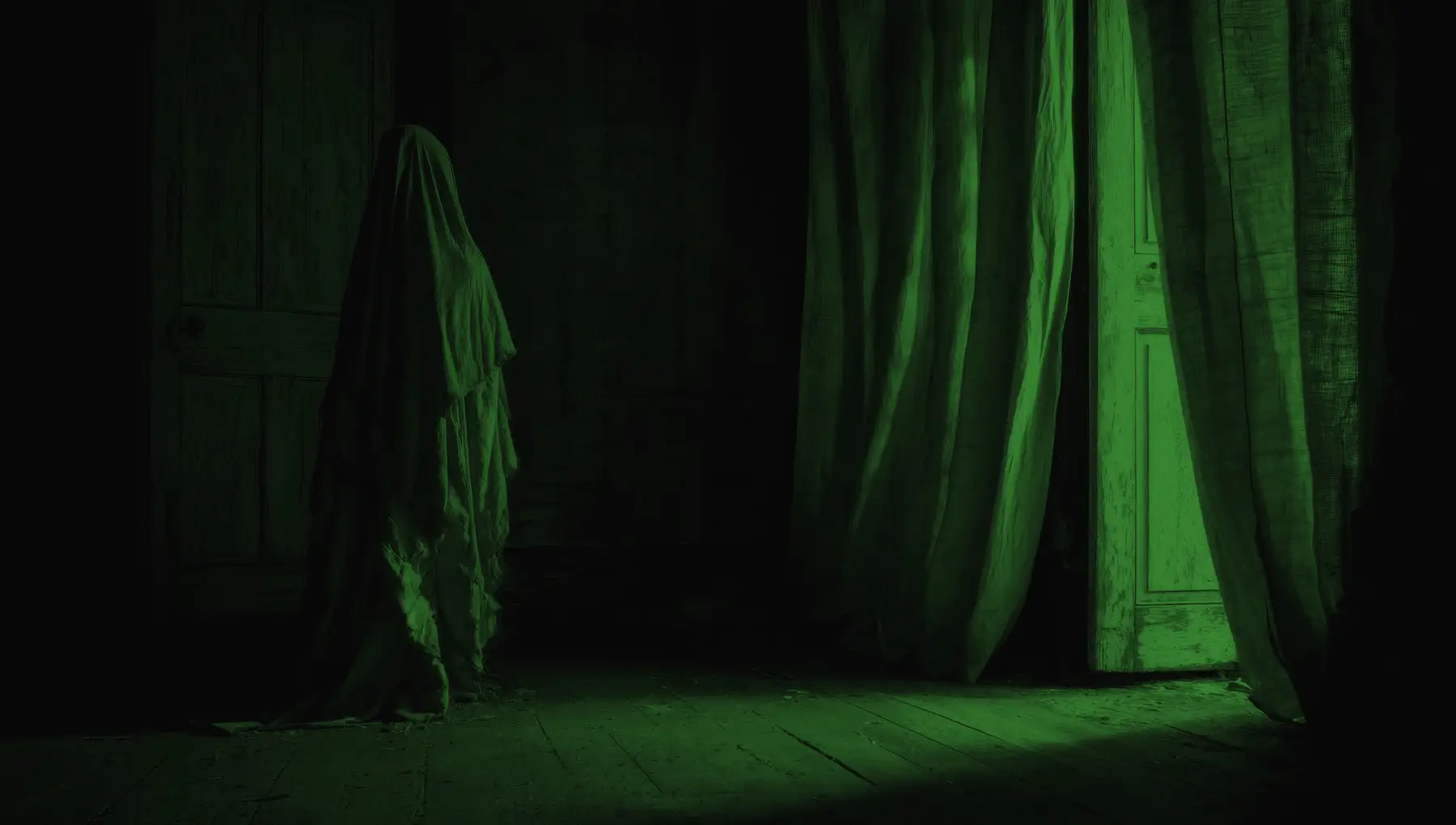
Case file 031Ghosts, Curses & the ParanormalModern (1980–today)

Don’t Let Them In

In 1996, two boys with solid black eyes begged a reporter to let them into his car, then vanished. A legend was born, and it follows a very old vampire rule.

Aug 11, 202330 minRe-aired Apr 11, 2025 as Reliving The Black Eyed Kids
00:00 / 30:25
Or listen to this episode onApple PodcastsSpotifyYouTube
Share this episode

In this episode

  • A buck-fifty movie theater, an unpaid internet bill and a tap on the driver's side window
  • The moment Brian Bethel realized his own hand was already unlocking the door
  • Why a 1997 Google group post turned a working reporter into the reluctant father of a legend
  • A 3 a.m. knock on a motorhome near Elmira, and the thing that made the girl laugh
  • The ancient rule every vampire obeys, and why the black-eyed kids seem to follow it too

“Until you’ve been on the receiving end of those terrible, dark eyes filled with hate and torn from the very depths of night and time, I’m not sure you can understand.”

The story

In 1996, a newspaper reporter sat in his car in an Abilene strip-mall parking lot, writing a check for his internet bill, when two boys tapped on his window. They wanted a ride. More than that, they wanted him to let them in, and they told him they couldn't get in until he did.

A tap on the window

Brian Bethel had been a staff writer at the Abilene Reporter-News since April 1995. He was a reporter's reporter, more interested in telling stories than in being one. Sometime between 9:30 and 10 p.m. he pulled into a shopping center to use his internet provider's after-hours drop box. He parked near the Westwood Theater, where movies cost a buck fifty. While he wrote under the glow of the marquee, he never saw the two boys walk up. Then came the tapping on the driver's side window.

He rolled the window down a crack. The boys looked somewhere between nine and fourteen, with average builds, baggy clothes and hoodies. One had brown hair and an olive complexion, and the other was pale with light red hair. Nothing about them was unusual. Still, a soul-wracking fear flooded Bethel, along with a strange certainty that it was already too late to escape whatever came next.

The boy doing the talking said they wanted to see Mortal Kombat but had forgotten their money at home and needed a ride. Then the story shifted: "Come on, mister. We just want to go to our house and we're two little boys." Bethel glanced at the marquee, then at his dashboard clock. The last show had started an hour earlier. When he looked back, the boys were somehow closer, standing motionless with their arms hanging at their sides. His peripheral vision hadn't caught them moving at all.

Eyes like holes

"Just let us in your car. It won't take long." Bethel realized his hand was on the lock. He was already opening the door. He came back to himself and yanked his hand away. Then he looked the taller boy full in the face and saw that the child's eyes were completely black. There was no color and no white, "just two deep black holes."

As he later told a radio host named Rudy Fernandez, "the boys kept staring at me with those cold, cold black eyes." The older boy sensed his fear and started pounding on the glass, insisting that they couldn't come into the car until Bethel invited them. The engine had been running the whole time. Bethel threw the car into reverse and peeled out of the lot. Maybe two seconds later, he swung his head around and jammed the gear shift into drive. The parking lot was deserted and the sidewalk in front of the theater was empty. Two kids couldn't have run and hidden that fast. They had simply vanished.

A story that got loose

In August 1997, Bethel posted a write-up of the encounter in a Google group and expected little response. The flood that followed first surprised him, then overwhelmed him. The story went viral before anyone had the word for it. Some people credit his account as the first report of the black-eyed kids and the spark for the stories that came after. Skeptics call it creepypasta, internet slang for horror legends passed around online, and accuse him of getting rich off a tall tale. But Bethel is still covering the news in Abilene, not counting piles of money at an island retreat. As he told author David Weatherly for the revised second edition of The Black Eyed Children, "I've not made a dime from this incident."

He can't say what the kids are, but he's sure of one thing: "What I do know about them is they are predators and we are the food." He has theories about what they want, too: "Perhaps they make more of their kind this way, or perhaps they just steal the light within us."

The weird part

The black-eyed kids can't simply take what they want. They have to be invited in, the same rule that has kept vampires on the doorstep for thousands of years.

Pale, silent and patient

More people have come forward since then, and it turns out these beings don't always look like children. The reports sound alike. Their skin is pale, anywhere from a washed-out olive to a pasty gray. Their hair is shaggy. Their clothes are loose and old-fashioned, sometimes Victorian, sometimes a bit Amish, always slightly off. Their arms hang still and their voices stay flat, yet witnesses say they felt almost hypnotized. The beings show up where no child should be, like a country house set far back from the road. They can be six feet away one moment and six inches away the next, and nobody hears a single footstep.

A Redditor staying in a motorhome at an old truck stop near Elmira, New York, heard a knock around 3 a.m. in pitch-black rain. A teenage girl in a hoodie asked to come in. The camper said no, asked where her parents were and dropped a lunch sack with $20 inside out the window. The girl said nothing. Then "she looked at my dog who was next to me and chuckled." Only when the dog went crazy did the camper notice she was pale as a ghost and had strange black eyes. The camper grabbed a revolver and watched her walk off along the old railroad tracks.

The oldest rule there is

Pale skin, sudden movement, a hypnotic voice and no way across a threshold without an invitation: that describes a vampire. Not the seductive caped count, but the older kind. That vampire might be a demon, an evil spirit or a revenant, a ghost that holds a grudge against the living, and it's tormented by a hunger that almost never lets up. The ancient Mesopotamians feared Lamashtu, who craved the blood and flesh of newborn babies. In Albania, the striga drank babies' blood. Madagascar's Ramanga, a sort of zombie vampire, feasts on blood and nail clippings, but only from people of noble birth. Every version obeys the same law: it can't come in unless someone invites it.

Folklore has always helped people explain what they couldn't understand. The Romans blamed volcanoes on Vulcan working at his forge. Icelanders believed the volcano Hekla was an entrance to hell, and nobody dared climb it until 1750. Maybe the black-eyed kids are just the newest version of a very old story. Or maybe Albert Einstein had a point: "It is entirely possible that behind the perception of our senses, worlds are hidden of which we are unaware." Either way, whatever knocks on the window still follows the old rule, and it's still asking to come in.

The transcript

Chapters & full transcript4,272 words
Chapters
  1. 00:00A child asks for help
  2. 03:14The parking lot in Abilene
  3. 05:53Pale, silent and patient
  4. 08:19The story goes viral
  5. 10:54How legends get told
  6. 21:17The vampire's rule

This transcript was generated automatically from the episode audio and may contain errors. Times are approximate, since ad breaks can shift them by a minute or two.

00:00

A child you've never met, a complete stranger, approaches you and asks for help. What would you do? Come on, it's a child, small, powerless, frightened, it's a kid, do you refuse? Do you turn away? Do you slam the door? Probably not. We're learning that the human brain seems to be hardwired for compassion, for empathy, And even the stoniest adult with zero patience for nonsense typically softens when a child is in distress.

00:32

That's a good thing. That's how we keep the species going. But what if that child standing before you, asking for help, isn't really a child at all? Then what? Brian Bethel is a senior staff writer at the Abilene Reporter-News. He's been working at the paper since April 1995. I've known a lot of print journalists over the course of my own career, and Brian strikes me as a reporter's reporter, meaning he loves the work, loves the nuts and bolts of ferreting out the story, loves being wired into the community.

01:34

And like many reporters, he's way more interested in telling the story than in being the story. Reporters like this are an endangered species because local newspapers are in the fight for their very lives. Did you know that the U.S. has lost more than 25% of its local papers since 2005? Did you know that by 2025, it's predicted that this country will have lost a third of its newspapers?

02:03

It's bad for the people who work for newspapers, bad for the communities those papers serve, and frankly, it's just really grim for all of us. Because while the national news outlets are fighting for clicks and likes by pandering to whatever foaming at the mouth divisive story is riling up readers and viewers, local journalists are doing the far less sexy job of holding people and institutions accountable at the grassroots level, which is where you feel it most, right?

02:33

Your roads, your schools, your safety, strong, healthy local newspapers help create a shared community, and they're critical to a functioning democracy. I'm not saying that newspapers do a perfect job or that all reporters are icons of objectivity, but I can promise you they are not there for the money or for the fame.

02:57

They're there out of a sense of deep purpose. They're committed, like Brian Bethel, who's been telling Abilene stories now for three decades. What Brian didn't anticipate is how it feels to become the story. It happened in Abilene in 1996. Brian had a bill to pay for his internet services, and the company offered an after hours drop box at a strip shopping center.

03:24

It was somewhere between 930 and 10 p.m. when he pulled into the lot, parking right near the Westwood Theater, showing movies for a buck fifty. As he sat in his car writing out a check under the lights of the theater marquee, he didn't notice two young boys approach the vehicle. He was startled by a tap tapping on the driver's side window.

03:49

Rolling it down slightly, Bethel took in the two kids and described feeling a sudden soul wracking fear, something he couldn't even understand at the time. It's a strip mall parking lot and two kids. What in the world would inspire a reaction as intense as that? Looking at the boys, Bethel guessed their ages to be somewhere between nine and fourteen years old.

04:18

Initially, nothing about them seemed at all unusual. Average build, baggy clothes, hoodies. One boy had brown hair and an olive complexion. The other had pale skin and light red hair. Yet even as Bethel had the thought that the two boys were probably about to ask him for money, something odd happened. Bethel described it as being a change in perception, a feeling he suddenly had that it was already too late to escape whatever was coming next.

04:55

One of the boys said that they want to go to the movies to see Mortal Kombat, but have forgotten their money at home and needed Brian Bethel to drive them there. Was it the strangeness of the situation? Something not quite right about the two kids. Something in the smile of the boy who was speaking. What was it that made Bethel not just nervous, but fearful, fearful in a way that made no sense?

05:26

Bethel swallowed against the cold apprehension flooding his body. Come on, mister. We just want to go to our house and we're two little boys. He flicked his gaze to the movie theater marquee, then at the clock on his dashboard. The last showing of the night had already started an hour earlier. Just let us in your car.

05:50

It won't take long. How are the boys suddenly so much closer to the car? How had he not seen the move? He'd only glanced at the marquee. His peripheral vision should have caught the movement. Yet there they were standing motionless beside the vehicle, their arms hanging at their sides. Come on, mister. Let us in. We can't get in your car till you let us, you know, just let us in and we'll be gone before you know it.

06:19

Bethel's hand was on the car door's lock. He was in the act of unlocking and opening the door. When he suddenly came back to himself and yanked his hand away. It was then that he made full eye contact with the taller of the two boys and realized the sickening jolt that the child's eyes were utterly and completely black.

06:44

No iris, no sclera, just two deep black holes. Brian later told a radio host named Rudy Fernandez, the boys kept staring at me with those cold, cold black eyes. My fear must have been easily detected because the older of the two boys that had been doing all the talking started pounding on my window, stating, we can't come into your car until you invite us in.

07:12

You have to let us in. Bethel's engine had been running the entire time and now thoroughly frightened. He reached for the gear shift. Come on, mister. We won't hurt you. You have to let us in. And threw the car into reverse. We can't come in unless you tell us it's OK. Let us in. Part racing, Brian Bethel peeled out of that shopping center parking lot in reverse.

07:45

And just a few seconds later, maybe all of two seconds when he swung his head back around and yanked the gear shift into drive, the two boys were gone. The parking lot deserted the sidewalk in front of the movie theater empty. It didn't seem possible that two children could simply vanish. No way they could have run and hidden that quickly.

08:11

No way. And yet the two boys were gone. It was August of the next year, 1997, that Bethel posted a document he'd written about the experience in a Google group. He'd already shared the story with a handful of people close to him and didn't expect much response after putting it online. What happened next first surprised and then overwhelmed him.

08:40

Today we'd say Bethel's story went viral, but the term didn't yet exist back in 1997. Some people say that Brian Bethel's is the first ever account of these peculiar black eyed children and was the spark for the extraordinary flood of stories that soon followed. Some have disputed the truth of the tale, saying that Bethel's story is just creepypasta, slang for horror legends or stories or content posted on the Internet.

09:09

Skeptics and debunkers argue that Bethel's just having a laugh and getting rich off his tall tale. But Bethel is still working his new speed in Abilene, not counting piles of money in an island retreat. Nothing about that weird encounter with those two boys just let us in your car. It won't take long, made his life easier or made him rich or famous.

09:37

In fact, as he told the author David Weatherly in the revised second edition of Weatherly's book, The Black Eyed Children, that this was a story initially meant for just a few people. He said he understands now why it captured so much attention. And he also said, I've not made a dime from this incident. And in fact, it's exactly the sort of thing a professional journalist normally wouldn't talk openly about.

10:01

If you ask Bethel what these kids are, he'll tell you very simply that he just doesn't know whether at least book quotes Bethel is saying. And get ready, because the eerie factor here is right off the charts. What I do know about them is they are predators and we are the food. I don't think they eat us in any literal sense, but they do want something from us.

10:26

These are beings that have no light within them, soulless and eternally hungry. I know they mean their victims irreparable harm. Perhaps they make more of their kind this way, or perhaps they just steal the light within us. Until you've been on the receiving end of those terrible, dark eyes filled with hate and torn from the very depths of night and time, I'm not sure you can understand.

10:54

Urban legend? Maybe. One of the more charming things about human beings is how much we love a good story. We like to hear them and we like to tell them. Urban legends are just stories that we tell each other. Sometimes funny, sometimes shocking, sometimes scary. The trick to a good urban legend is the personal connection.

11:17

You know, something like my cousin's boss has a neighbor who, or I went to high school with this kid who's older sister, or this dude I used to hang out with has an ex-wife that. It's this personal touch that gives the urban legend a little extra dusting of credibility. And even when you don't buy a particular story, there's a part of your brain that still might cling to the notion of a grain of truth.

11:45

I mean, think about it. Will we even have all these wild stories of a man with a hook for a hand hiding in the backseat of the car if it hadn't happened for real at least once, somewhere, to someone? You can see the way these stories work on our imaginations. We want to believe. Urban legends are a kind of folklore. And folklore is basically just knowledge that's been passed through the community and down the generations by word of mouth, typically often in the form of stories.

12:17

The invention of the printing press transforms some of those stories into the written word. The invention of the internet allowed stories to bypass the gatekeepers who decide what gets published and disseminated. Now, suddenly, we have a new kind of fireside tale, the teller unseen. And instead of the fire's embers, we gather around a screen of glowing pixels.

12:43

Fairy tales, fables, myths, they're all types of folklore. Think about the story of the Pied Piper. It's a pretty dark take on greed. The story goes, the Pied Piper comes to town and agrees to rid the people of their plague of vermin. The Piper strikes a deal with the mayor for payment. When the mayor reneges, the Pied Piper lures all the village children away, never to be seen again.

13:09

Yikes. The moral of that story is, keep your word and pay your bills, or risk the most tragic consequences. Then, there's the myth of Icarus and his wings crafted from wax and feathers. Wings that would help he and his father escape from the High Tower, where they had been imprisoned by the king. The father, Daedalus, warned his son to be careful.

13:33

Fly too close to the surface of the sea, and his wings will become too wet. Fly too close to the sun, and the heat would melt the wax. But Icarus, young and brimming with confidence, was thrilled to be soaring across the sky, flying higher and higher, laughing at the goals, unable to hear his father's warning cries. And you know how that one ended, Icarus plunging into the sea and drowning.

14:02

The moral of that story is, don't get cocky. Hubris! Go a thing before a deadly fall into the ocean and all that. So, folklore is a way to transmit values, to share information, and to teach. Let's talk about volcanoes for a minute. Thousands of years ago, people didn't have the understanding of geology and seismology that we do now.

14:25

So how did they account for the earth periodically and unpredictably, rumbling and splitting and belching fire and vast rivers of molten rock? The ancient Romans were like, oh, that? That's just Vulcan, the god of fire, doing some metal work in his god forge. The Chinese have the dragon Long Wang, who lives in the mountains of northern China and has dominion over the forces of the earth, including volcanoes.

14:51

And in Iceland, it was believed that the top of the volcano Hekla offered one of many entrances to hell. Other Icelandic volcanoes were said to also have gateways. And here's how deep the superstition about Hekla went. No one dared even climb the volcano until 1750. It was apparently a huge relief to all when the first two climbers to summit Hekla didn't find Satan's welcome mat waiting for them at the top.

15:19

So what makes folklore fascinating is that these stories and myths and legends and allegories are often rooted in truth and reality. There are scholars who study the myths of dragons, for example, to compare the fables of the fire-breathing beast to the known geological record in hopes of matching the tales of dragons to the dates and places of actual volcanic eruptions.

15:43

Biblical scholars cross-pollinate with archaeologists on the regular. And while historians do tend to give folklore a little bit of the side eye, these oral histories and community tales can tell us a lot about the people who lived inside the hard date of history. Yeah, here's the battle, the siege, the famine. But it's the folklore around those events that give us a glimpse into who those people were who fought and struggled and starved.

16:13

Folklore is like a little taste of time travel. With it, we get to see how people of another era use their knowledge of the world, the knowledge they had, to make sense of the world. So let's take a look at these black-eyed kids, although it would be more accurate to call them black-eyed entities, since not every encounter involves a child.

16:35

As more and more people have come forward to share their experiences with these mysterious beings, it's become clear that they also manifest in adult bodies. But what are they? I mean, if we take these reports at face value, it starts seeming unlikely that these are just regular people playing a prank. Let's consider what we know.

16:57

One, the black-eyed kids are almost always described as very pale. Sometimes it's a washed-out olive complexion, sometimes more of a pasty gray, and their hair is often described as shaggy, almost like they're way overdue for a trim. The clothing is typically described as loose, shapeless, unusual, or old-fashioned in a way that those encounter them struggle to pin down.

17:23

Hoodies are a common feature in these stories, but you'll also find witnesses who describe the clothing as Victorian or kind of Amish, or just slightly off. Just enough to trip your instinctive sensors that something here is not quite right. The body language is always passive, arms hanging at their sides, no weapons visible, very little movement.

17:51

The voices are flat, monotone, as blank and matter-of-fact as their words, and even as the encounter escalates, their delivery loses none of its flatness. Yet despite that flat, emotionless tone, witnesses report feeling almost hypnotized. Look at Brian Bethel's account. His hand was reaching to unlock the car door, even as panic, fear, and adrenaline flooded his body.

18:21

Just let us in. It won't take long. Just let us in. It won't take long. These entities often appear in places where an unaccompanied child is unlikely to be, the kinds of places that don't seem at all safe for a kid, like that strip mall parking lot where Brian Bethel heard that tap-tapping on his driver's side window, or like this isolated camping spot in upstate New York where a Redditor named xolore had this encounter.

18:55

It was in upstate New York near Elmira at the old Lackawanna Trail truck stop. I was staying in my motorhome with my dog and got a knock on the door just around 3 a.m. It was completely pitch black, raining out. What I noticed was a teenage girl with a hoodie on and a backpack, and she asked if she could come in. I said no, and I asked, where are her parents?

19:18

She didn't reply. I asked her if she was hungry or thirsty, and I dropped a lunch sack out my window for her with 20 bucks inside. I made a comment about her safety and her well-being, but again she stayed quiet, but this time she looked at my dog who was next to me and chuckled. It wasn't until my dog started going crazy did I realize this young girl was pale as a ghost and had strange black eyes.

19:42

I immediately closed my window, shut, grabbed my revolver, and watched her walk onto the old railroad tracks along the highway. Story after story recounts how these kids just appeared on the doorstep of a house in the country, set well back from the road, no neighbors, or standing on the side of a light, not a house or a building anywhere in sight.

20:08

So yeah, they turn up in odd and unexpected places, but even more troubling, how they can somehow disappear in an instant, leaving no trace behind. Equally puzzling is the way they move. People who have had encounters report that these children could be standing six feet away in one instant and six inches away in the next, yet these witnesses claim to have not seen any physical movement nor heard anything suggesting movement, not footsteps on the porch, not the rustling of leaves, not the sound of sneakers pounding pavement.

20:53

Pale beings who arguably have the ability to appear and disappear at will, with a hypnotic quality to their voices, their insistence on being invited in, it all sounds kind of familiar, doesn't it? Seems like, seems like we've heard something like this before. Could it be in the legends and stories of vampires? Like the black-eyed entities vampires are described as pale, as capable of stunning an unexpected movement, of possessing hypnotic powers, and of being unable to cross a human threshold without an invitation.

21:39

And they're hungry, so hungry every moment for the only food that can sustain them, blood, the very essence of human life and vitality. Legends and tales about vampires have existed for thousands of years all around the world and across nearly every human culture. Today we're pretty fixated on the vampire as defined by European culture, which explains Count Dracula, the vampire Lestat, Count Chocula, and even the Count on Sesame Street.

22:17

Our modern version of the vampire is also highly sexualized. Drac needs the blood for sure, but our undead boy also really loves the ladies too. The modern vampire seduces as much as he or she slays. But the old legends, the ancient stories, the original folklore of the vampire, not a dashing man in a black cape, but an evil force bent on consuming its victims.

22:48

Sometimes a demon, sometimes a malevolent spirit, sometimes a revenant, which is basically a ghost, but revenants the kind of ghost who holds a grudge against the living. A revenant ain't here to be the friendliest ghost you know. Whatever form the vampire takes, the legends all agree that a raging, near insatiable hunger torments every moment of the creature's existence.

23:17

And the vampire cannot enter any living person's home without an invitation. That is the ancient, eternal time-honored rule, a rule that's being very carefully honored today in our modern technological world by the black-eyed kids. Which makes you wonder, maybe these black-eyed entities are nothing new. Maybe this is just the way we, the people of our time, make sense of whatever these beings are, pale, hungry, concealed in the shadows, a flicker at the edge of your vision.

24:03

Maybe humanity has always shared this world with mythical creatures who aren't mythical at all. Creatures that are here and always have been, unknown to us and mostly unseen, though when our separate realities touch, it would appear that humans seldom have the upper hand. And as superstitious an animal as we are, we cling super tightly to the idea that our five senses give us all the information we need to survive and dominate our environment.

24:38

But even a genius as singular as Albert Einstein wondered about the very real limitations of those five human senses. He once said, It is entirely possible that behind the perception of our senses, worlds are hidden of which we are unaware. Skeptics roll their eyes, eyes that are limited by their size and how much light they can collect, eyes that can see only visible light, while all around us, there's so many other kinds of light, gamma rays and x-rays, ultraviolet light, infrared, even radio waves are a form of light, but all invisible to us.

25:19

And our hearing, impressive as we think it is, doesn't let us eavesdrop on all that much of reality. When it comes to hearing, dogs have us beat. So do cats and elephants and even pigeons. Whatever these hungry, frightening entities are, they may have been walking beside us all along. The ancient Mesopotamians called them by names like Lamashtu, the dark god who craved the blood and flesh of newborn infants.

25:52

The poor wheat things were no safer in Albania, where the striga drank their blood while they And then there's that hero of undead class warfare, Madagascar's Ramanga, a sort of zombie vampire who feasts on blood and nail clippings of all things, but only from those of noble birth. Way to fight the power, Ramanga. Now that the U.S. Congress has pried open the Pandora's box that is the whole UAP UFO, are we alone in the like non-human intelligence and non-human biologics?

26:33

And this planet isn't ours. Chirpy stuff. So who's to say what the black eyed kids really are? Ghosts, aliens, hybrids, interdimensional tourists, complete fiction. One thing's for sure. What do you need to get that we can pause? Oh, God, hang on. My my husband. Well, let's just let's just keep rolling. Where am I? Where am I picking this up?

26:59

OK, you just said one thing's for sure. OK, OK. One thing's for sure. Kev, can you get that? Kev. I'm sorry, Max. I think maybe he went somewhere. Kevin, can you hang on? It's probably just the delivery. Hang on. I'm so sorry. Let me go get that. Here we go. Hang on. Hang on. Oh, hey. Did you walk all the way up our driveway all by yourself?

27:43

We want to come inside. Sherry, are you there? Can you hear me? Can you hear me? Honey, I think you're a little lost. Does anybody know where you are? I want to come into your house. You have to let me in. You have to let me in. You have to let me in. Hang on. I'm going to call your cell. What? Oh, oh, my God. Oh, my God.

28:21

Honey, your eyes. What happened to your... What happened? It won't take long. You have to let me in. Just let us in. You have to let us in. Let us in now. Let us in. Let me in now. Let me in. Let. Us. In. Next time on True Weird Stuff. Forced to work in a brothel as a young girl, Pearl Heart rebelled and ran away. She broke all the hearts and she broke all the rules.

28:54

And once she even broke out of jail. And then she got an idea. Let's rob a stagecoach. And if you listen to us on Apple Podcasts, hit the plus button in the top right corner. And now it helps an independent podcast like ours to get discovered. And we really appreciate it. If you subscribe, rate and review True Weird Stuff.

29:16

Hit our website, True Weird Stuff dot com for show notes and photos and videos when we have it and bonus content. Everything True Weird is waiting for you at True Weird Stuff dot com and follow True Weird Stuff on Instagram and Twitter. True Weird Stuff is a Now! Media production. Our executive producer is Anthony Garcia.

29:37

The show is written and hosted by me, Sheri Lynch, along with my deeply weird director, Max Sutton. Our equally odd producer is Kary Bowser. Additional production by the mysterious Stephen Call. Our digital witch and social media cult leader is Heather Furr. Original graphics by Kevin Nash. Original artworks by Olivia Axland.

29:58

True Weird original music composed and performed by Jack Griffin and Zane Nash. Copyright 2023. Now! Media. All rights reserved. All wrongs remembered. We want to thank our voice performers who joined us in this episode today. Ryan Poole, Emma Grace Smith, Zoe Hartwell and Sadie Stilley. They're regular human children.

30:21

We think.

One new weird tale a week.

The strangest true stories in history, in your inbox.

Unsubscribe anytime. Privacy policy.