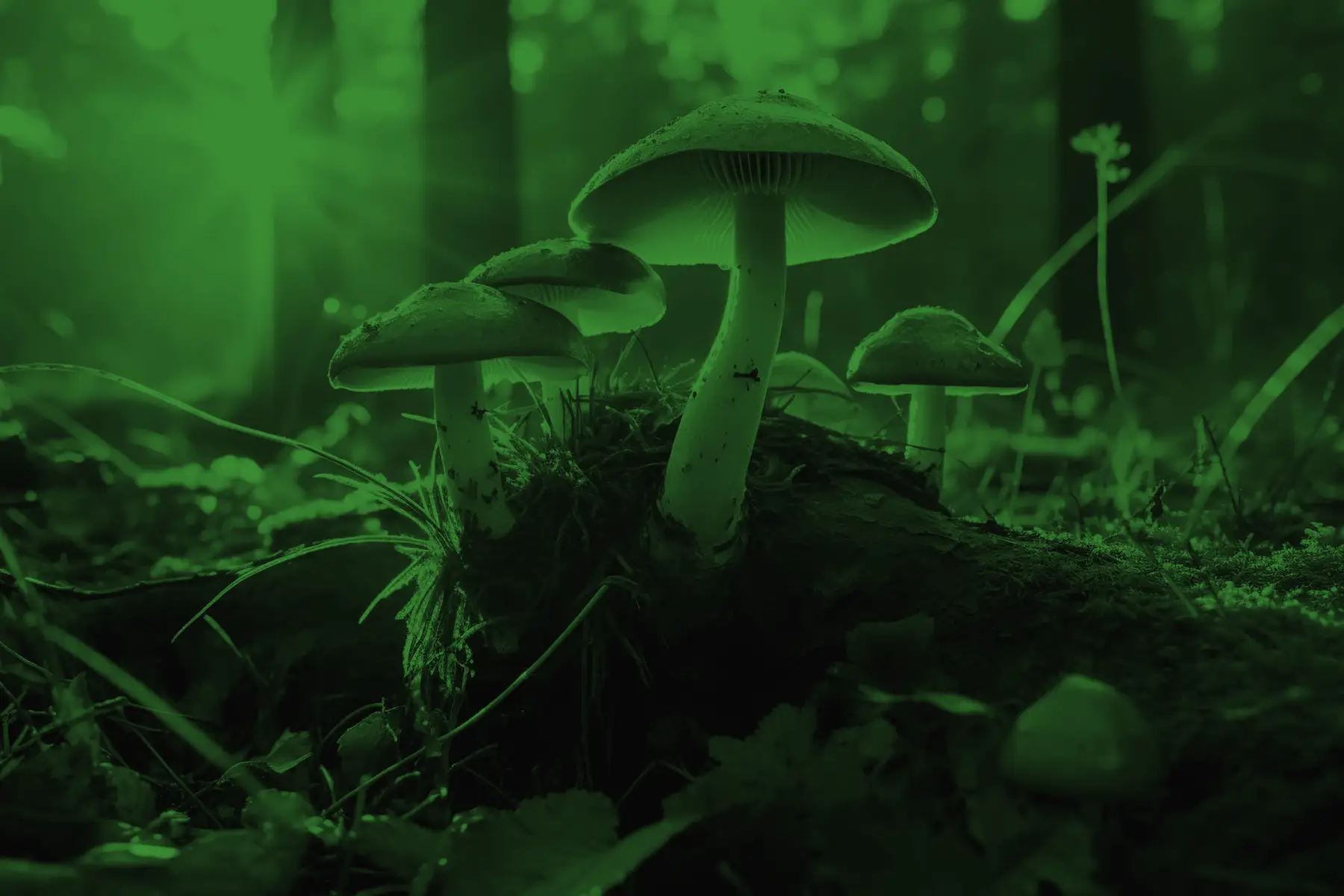


In 1927, a pair of newlyweds went walking in the Catskills and had a fight about dinner. She was a Moscow-born pediatrician who dropped to her knees in front of wild mushrooms like they were relics. He was a New York banker convinced that eating them would kill her before morning. Three decades later, the argument they started that afternoon had put psychedelic mushrooms into the pages of Life magazine — with the CIA quietly covering the airfare.
A fight about dinner
Valentina Pavlovna Guercken was born in Moscow and came to the United States with her family during the Russian Revolution. She met and married Gordon Wasson, an up-and-coming finance man with the U.S. Army, Columbia and the London School of Economics behind him and the Guarantee Trust Company ahead of him. On their honeymoon, fresh out of medical school, she went foraging. "Suddenly my bride spied wild mushrooms in the forest," Gordon wrote, and she knelt in poses of adoration before one cluster after another. That night she cooked every one of them. He wouldn't touch a bite, and pleaded with her not to either, declaring that if she did, he would surely wake up a widower.
She knew exactly which ones were safe. What could have ended in an eyeroll ended instead in a theory: their disagreement was cultural, not factual. Her Slavic world treated wild mushrooms as everyday food. His Anglo-Saxon world treated them as poison and witchcraft. So what if the warnings were a smokescreen — propaganda hiding something older? The ancients had eaten mushrooms in sacred ceremonies. Why had that knowledge been locked away?
They kept their day jobs — she published research on rheumatic fever and childhood sinusitis, he clocked in at the bank — and spent decades writing letters to anthropologists, missionaries and linguists, calling themselves ethnomycologists. One letter went to the British novelist Robert Graves, whose 1934 bestseller I, Claudius described the emperor's death by poison. In 1949 Valentina floated a better theory: Claudius was served the delicious amanita caesarea, and then an assassin hired by his wife — who was also his niece — slipped the deadly amanita phalloides into the dish. Not the only argument against marrying your own kinfolk, but a persuasive one. Graves became a devoted correspondent, and in September 1952 he mailed the Wassons an article by Dr. Richard Alan Schultz, who had found that an Aztec practice survived among indigenous peoples in Mexico: the ingestion of mushrooms the Aztecs called the flesh of the gods. Gordon raced to the phone and called Harvard.
Thirteen pairs, counted in the dark
In the Mazatec highlands of southern Mexico, the Wassons found what they'd been writing letters about for twenty-five years. Gordon and a society photographer, Alan Richardson, sat in a room with twenty people while a curandera cleaned mushrooms, prayed over them and passed them through resin incense smoke at an altar decorated with the child Jesus. The mushrooms were always counted in pairs. She reserved thirteen pair for herself, thirteen for her daughter, and handed Gordon six in a cup. "I was on a tiptoe of expectancy," he wrote. Richardson took six too, having promised his wife Mary not to let those nasty toadstools touch his lips. He broke that promise.
Just after midnight the candles went out and the visions started. "We were never more wide awake and the visions came whether our eyes were open or closed in vivid color, always harmonious." Valentina and their eighteen-year-old daughter Masha arrived the next day and ate theirs in sleeping bags; Valentina saw a ball at the Palace of Versailles, period costumes, a Mozart minuet. In May 1957, Life magazine — read by one American in four — gave Gordon fifteen pages. "Richardson and I were the first white men in recorded history to eat the divine mushrooms," he announced, and in the same breath, called his hosts backward Indians.
The fund that did not exist
The Wassons had company they didn't know about. Years earlier, an officer in the CIA's technical services division had been daydreaming about Agrippina and her mushrooms. "Let's get to the technology of assassinations," reads the declassified memo. Under Sidney Gottlieb, MKUltra had already been dosing unwitting people with LSD; Morse Allen thought hallucinogenic mushrooms might work even better for interrogation. "Essential that the peculiar qualities of the mushrooms be explored."
The mushroom hunt got the very bland name Subproject 58, a budget worth about $20,000 today, and a civilian: a young chemist named James Moore, whose salary the agency paid while he moved to the University of Delaware — one of 44 schools already quietly working for MKUltra. Moore's own trips to Mexico turned up nothing. Then he heard a story about a banker in New York who had found the flesh of the gods and eaten it. He wrote to Wasson, mentioned a scientific expedition, and produced a fortunate grant from the Geschichter Fund for Medical Research, which did not exist. They went to Huautla together in 1956. "We damn near starved to death and I itched all over," Moore said later. Wasson thought his companion was a bust — "He was like a landlubber at sea" — and took several more trips on the government's dime without ever knowing whose dime it was.
Psilocybin arrived in American culture because a Manhattan banker spent thirty years relitigating a honeymoon argument about dinner — and when he finally reached the Mexican highlands to eat the flesh of the gods, the CIA was secretly funding the expedition through a research foundation that didn't exist.
What the gods charged
Valentina died of cancer in 1958, a year after Life. Six days after her husband's article, her own account ran under the title I Ate the Sacred Mushroom, predicting the compound might one day help alcoholics, addicts, people in terminal pain and people with mental illness — half a century before Johns Hopkins built a $55 million psychedelics program on very nearly that list.
The healer paid more. Gordon had called her Eva Mendez in print to protect her, but he'd lied to her face about why he came, claiming he was frantic to find a missing son. She agreed to one photograph only if he kept it private. He gave it to Life along with the name of her village. María Sabina's neighbors blamed her when the world arrived — Dylan, Jagger, Lennon, beatniks, hippies, thousands of strangers at her door. She was ostracized, jailed, her house burned, her son murdered. She died alone, impoverished and full of regret. Wasson got a mushroom species named after him and an obituary calling him the reluctant American father of hallucinogenic psychedelia.
Closer to us than plants
The largest organism on Earth is a fungus in Oregon's Blue Mountains, sprawled across more than 1,665 football fields. There are somewhere between 2 and 5 million species of fungi, and over 90% are unknown to science. Every one of us carries between 9 and 23 strains right now. Humans share more than 50% of our DNA with fungi — mushrooms are closer kin to us than they are to plants.
Which loops back to the question two newlyweds started asking over a suspicious dinner: in the far mists of time, was it the mushroom people worshipped? The mushroom that showed them God?