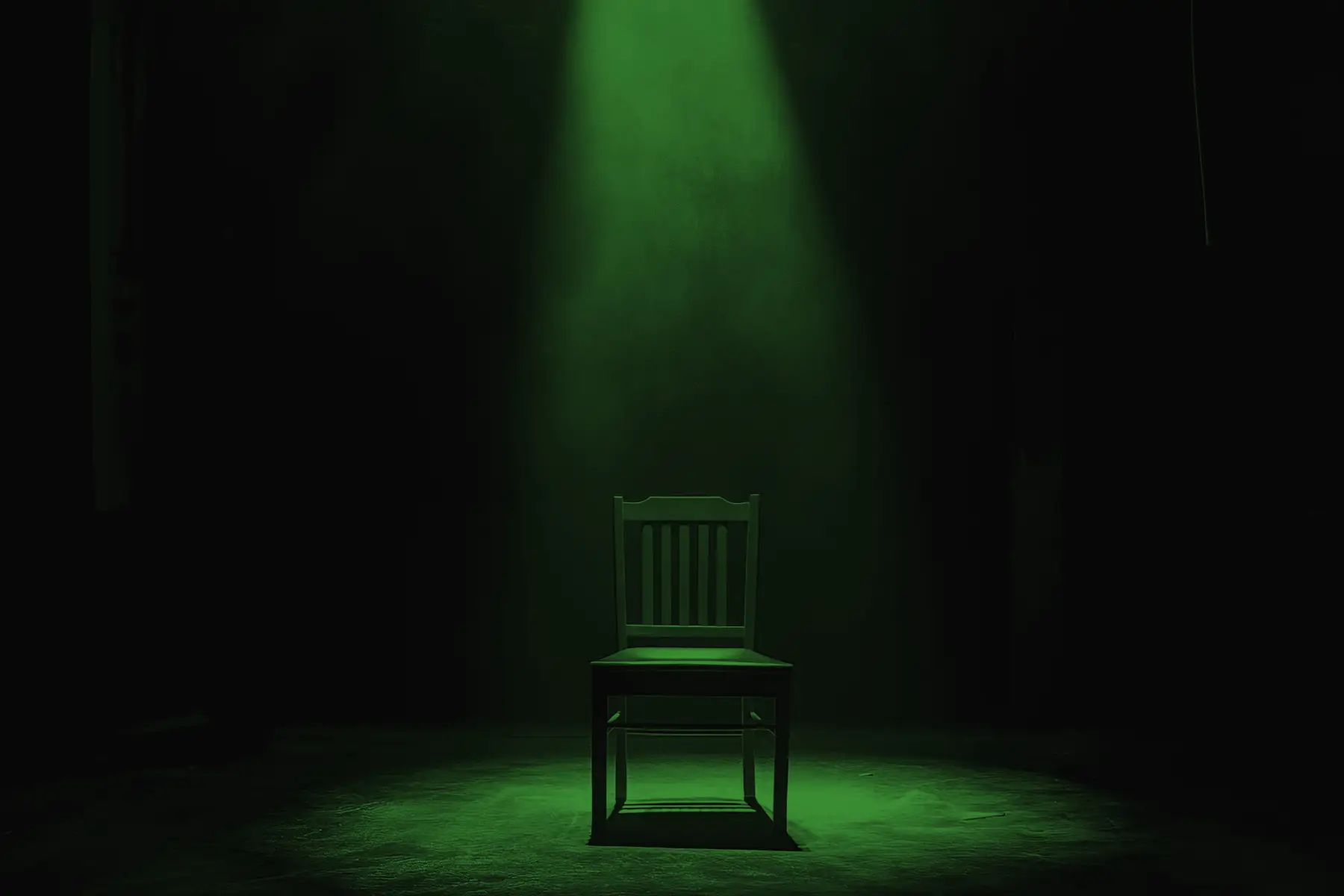
On a June evening in 1768, Owen Parfitt's sister and a neighbor named Susannah Snook carried him out to his chair on the front porch, because Owen could no longer take a single step on his own. Fifteen minutes later, with a wild summer storm whipping up out of nowhere, his sister hurried out to bring him inside. The chair was empty. Owen Parfitt has never been seen again.
People still vanish this way. In 2006, medical student Brian Shaffer showed up clearly on the security video at the Ugly Tuna Saloona in Columbus, Ohio. That same video never showed him leaving, and more than 19 years later, there's still no sign of him. But for sheer impossibility, few cases match an old tailor who couldn't walk.
A chair facing the turnpike
Owen had served in the British Army in Africa, come home and become a tailor, described by all who knew him as a quiet and sober man. Then one day, walking away from his sister's cottage, he stumbled and fell heavily on the path, most likely felled by a stroke. He never walked again. He had to be carried up and down stairs and lifted into his chair.
The cottage was no lonely cabin in the woods. It sat at the edge of Shepton Mallet, a village of three to four thousand people, and the porch faced the busy Turnpike Road. It was mowing time, and the fields across the way were full of workers. Owen weighed more than 15 stone, about 210 pounds. Nobody saw a horse or a wagon on any road nearby. Nobody heard a sound.
The search was ferocious. Searchers combed rivers, ponds, wells, old pits, woods and hedgerows for weeks, with every villager, children included, pitching in. Police in Bristol questioned every seafaring man they could find. Magistrates, the local judges, took sworn statements from witness after witness. Nothing turned up.
The devil and a green light
Shepton Mallet already had a reputation for witchcraft, and neighbors remembered Owen's tales of the wizards and magicians he'd met in Africa. That sudden storm looked like proof that "the prince of the power of the air" (the devil himself) had come to collect. Jehoshaphat Stone, who knew Owen well, said that was the general opinion.
Thirty miles away, Hugh Pearson, a dispensing chemist (what Americans would call a pharmacist) and an eager amateur astronomer, had been watching Mars that night when a greenish light streaked across the east. He wrote that "it was moving too fast to obtain a clear view," and that "it was not a meteorite or a shooting star." A local newspaper printed his account and got nearly a dozen letters from people who'd seen it too. Soon the village was whispering about the man in the moon.
Other theories came and went. Spontaneous combustion was ruled out: there were no scorch marks, and Owen didn't drink. A sudden recovery that sent him wandering off made no sense with the fields full of mowers. In 1813, 45 years later, a human skeleton turned up in the garden right beside the porch. It belonged to a young woman.
Owen Parfitt couldn't take a single step, and he disappeared from his own porch in under fifteen minutes, in daylight, facing a busy road and fields full of mowers. After 257 years, nobody has found a single trace of him.
A tailor with pirate money
The police wanted an ordinary, earthly answer, and they arrested two people. One was Job Lee, rumored to have shared "nefarious practices at sea" with Owen. The other was a widow named Lockyer, who hinted that she knew Owen's secrets and was the main heir in his will.
It turned out the quiet tailor had a past. As a restless young apprentice hungry for money, Owen had simply stopped showing up for work, and word came back that he'd gone to sea. The Royal Navy had no record of him, so the town decided he'd been a privateer, a pirate licensed by the crown to raid enemy ships in wartime and keep a cut of the loot. The gossip fit. Owen did very little tailoring but was never short of money, and a rough-looking seaman visited him from time to time and left the village right after. One man claimed Owen had told him about an island with "diamonds bigger than the eggs of ducks," and warned that others who knew the secret might kill or kidnap him someday.
Police also questioned a retired sea captain named Hall, said to be as brutal as Blackbeard. Once Owen had been gone 173 years, a lurid version took shape. In it, Hall had crimes to hide, and Owen, Lee and a sailor named Lockyer were blackmailing him, with Owen running the scheme from his big chair. "The insatiable leech had to be eliminated." Three men supposedly rolled up in a light trap, a small horse-drawn carriage, at dinnertime, when "There is no desert so lonely as the English countryside at the sacred hour of dinner." They gagged Owen and killed him at the widow's cottage. There wasn't a scrap of evidence, a drop of blood or a single witness to back it up.
Slipping through the cracks
In the UK today, most missing adults turn up within two days, and only 1% are still missing after a month. Owen has been gone 257 years, and that leaves room for stranger ideas, like a time slip, the sensation of falling out of your own time.
In 1996, an off-duty police officer on a busy Liverpool street felt suddenly disoriented. When he looked up, the cars and clothes were straight out of the 1950s, and Dylan's bookstore had turned into a shop called Crips. A minute or two later, the city snapped back. He found out afterward that the bookstore really had been called Crips in the 1950s. A young woman in '90s clothes had been just as confused. In October 2024, Sebastian Garrido, on his way to see his dying grandfather, met a younger version of the man on the street, who told him "Tell your dad I'll be fine" and vanished. At the hospital, his grandfather said: "I saw you in a dream."
Physics doesn't close the door on any of this. Relativity says clocks on satellites keep different time than clocks on the ground. And cosmic inflation, a real theory about how the universe expanded after the Big Bang, allows for endless universes piled up like soap bubbles. Folklore has long tied violent storms to rips in reality, just as Doc Brown needs lightning in Back to the Future. Maybe a summer storm opened a gap, and a paralyzed old man was sitting in exactly the wrong spot. Or maybe a whole village lied, which seems even less likely. And if Owen did fall through, it may have felt to him like no time at all.