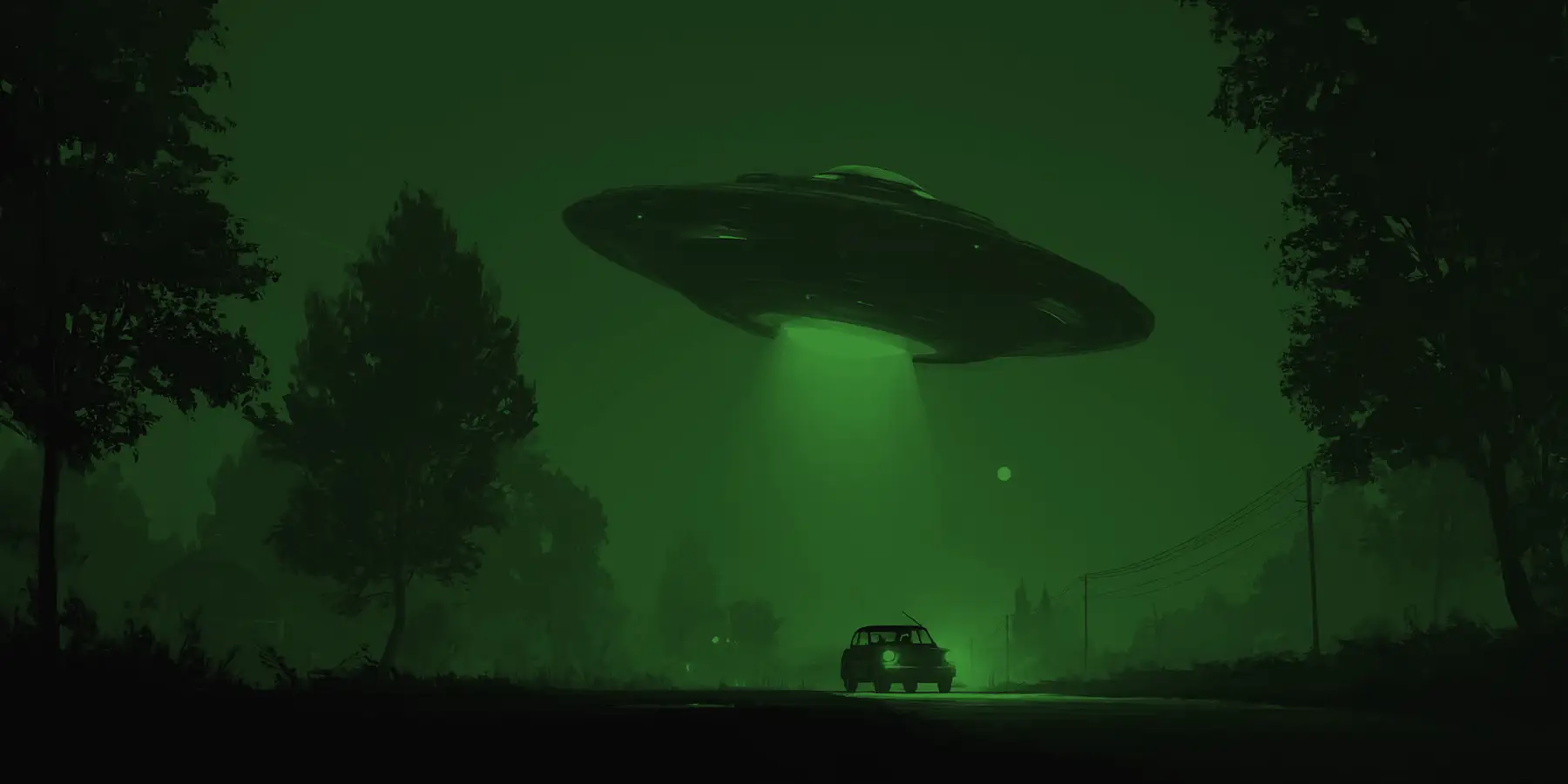
It is dark on the Teton Pass in a way that people from cities do not have a word for. No streetlights, no neon, no other headlights for miles — just switchbacks, elevation, and a drop-off on one side where a guardrail ought to be. In the late 1970s, a family of five was climbing that road at night in a Chevy Malibu, because the pass was a shortcut and gas cost money they did not have. Then, way up ahead, a light came on so bright it turned the inside of the car white.
A cowboy from South Philly
The family had left South Philly for Wyoming because the father wanted to be a cowboy — which, as his daughter puts it, is your first clue about the man. Out west they had no relatives, no cushion, and no money. Christmas was coming and there was no plan and no dollar to make one with, so the parents loaded three kids into the Malibu and drove 2,200 miles east to spend the holiday with family. It was magical. It is still one of her best memories.
The drive back was the usual: coffee, chain-smoking, No-Doz, Johnny Cash on the 8-track, two parents trading the wheel to cover the distance in a day and change, and three kids poking and pinching in the back seat. She was nine, in fourth grade, stuck in the middle seat, and already the kind of anxious child who is wired that way by a violent, unpredictable house where nobody could be sure there would be food. At the Wyoming line, her father announced he was taking the pass. Shorter. Cheaper. He knew the roads were open. Every cell in her nine-year-old body went to alert.
Just a sign that says think
Climbing a mountain pass at night is up and over and up and over, and she was a kid prone to motion sickness, so she followed her mother's rules — window cracked, cold air on her face, eyes locked on a point on the horizon, do not look down. In that part of the country there are no guardrails. There is the cliff, and occasionally a sign that says think. That is your protection. Suggest to a Westerner that a streetlight might be nice and you will be told you are weak.
But the sky out there is the compensation. No light pollution, more stars than a city kid can imagine, shooting stars, planets if you know where to look. In a place like that it is easy to believe in a lot of things.
The light up ahead
Her parents were talking in those low night-driving voices adults use when they think the kids are asleep — how much gas was left, whether the pass ahead might be closed, what happens if they have to double back with a tank that will not cover it. Then the light. Her mother: "George, what is that? Is that like a police car, an ambulance?" Her father figured a wreck — "maybe there's been a wreck" — and started slowing down, and then panicking, because the Malibu had no registration and no insurance and quite possibly no valid license behind the wheel. "Jesus Christ, Franny, they're gonna arrest me and take me to jail," he told her mother. Her daughter suspects her mother, deep down, was rooting for the troopers.
From the back seat, the questions started — are we in trouble, are they going to take you away — and her mother shushed her and told her to go to sleep. The car slowed and slowed. The light poured in and lit everything: the junk piled in the back seat, her brother Mark asleep with his head against the window, her other brother George out cold, her mother's fluffy hair turned into an auburn halo.
That is the last thing she remembers for a long, long time.
Five people lost the same block of time on the same mountain road — including whoever drove the Snake River Canyon in the dark to get everyone home — and woke up sick, shaky and anesthesia-level sleepy in a house they don't remember reaching. The family's official explanation was a leaky old car they then drove for years without ever fixing.
A little touch of carbon monoxide
Her next memory is the gravel road down to the rented house in Star Valley — the sound of the tires, the color of the sky, the little door lock stick under her fingers, pulling it up and pushing it down. She was no longer sitting where she had been sitting. Her mother shoved all of them through the front door, and the whole family slept for something like an entire day.
The explanation came afterward: "you're fine, we're all fine. We just had a little touch of carbon monoxide poisoning." It's an old car. But this was a nine-year-old in the gifted program who knew exactly what carbon monoxide poisoning was, and who wanted to know why nobody was taking the Malibu to Jorgensen's — the Conoco in a town of 496 people, where Dick Jorgensen did the auto repairs. (Years later her mother would divorce her father and marry Dick's brother Ted, who became the stepfather she loved. That is all far in the future.) She kept asking. Her mother finally said that is enough.
They never took the car in. They kept driving it. And the carbon monoxide poisoning never happened again.
Calling Mark
She couldn't ask her mother, who left when she was 12 and wasn't seen again until she was 28. She couldn't ask her father, by then deep into crank. So not long ago she called her older brother at work — five years older, thirteen going on fourteen that night, old enough to have clear memories. He remembered the gamble on the pass well enough. "he was always ready to risk his family," Mark said. A roadblock? Sort of. Kind of.
Then she pushed — don't you remember how bright the light was, and then we were home and we were sick — and her brother said, "I don't like this." And: "Sheri, there were so many terrible things that happened to me at that age, that if I remembered all of them, I wouldn't be able to function." Before they hung up, he told her he didn't know why she liked living in these past stories, because none of them were good. She told him she loved him.
What people carry
Maybe it really was a state trooper roadblock, and her father talked his way out of having no paperwork, and a scared kid slept hard, and an old car leaked and then somehow stopped leaking. Maybe. But the ground they covered between that light and that gravel driveway includes the Snake River Canyon in the dark, a drive that still puts her in the fetal position in the passenger seat as an adult. She woke up in a different seat. And how do you account for five people sick and shaky and so sleepy it felt like coming out of anesthesia — count backward from ten, wake up in a different room?
She has no answer, and says so plainly. What she does have is the thing itself: a small, hard, cold object carried around in the pit of the stomach, and no way to know whether it stays sealed because it is unknowable, or because opening it would be worse.