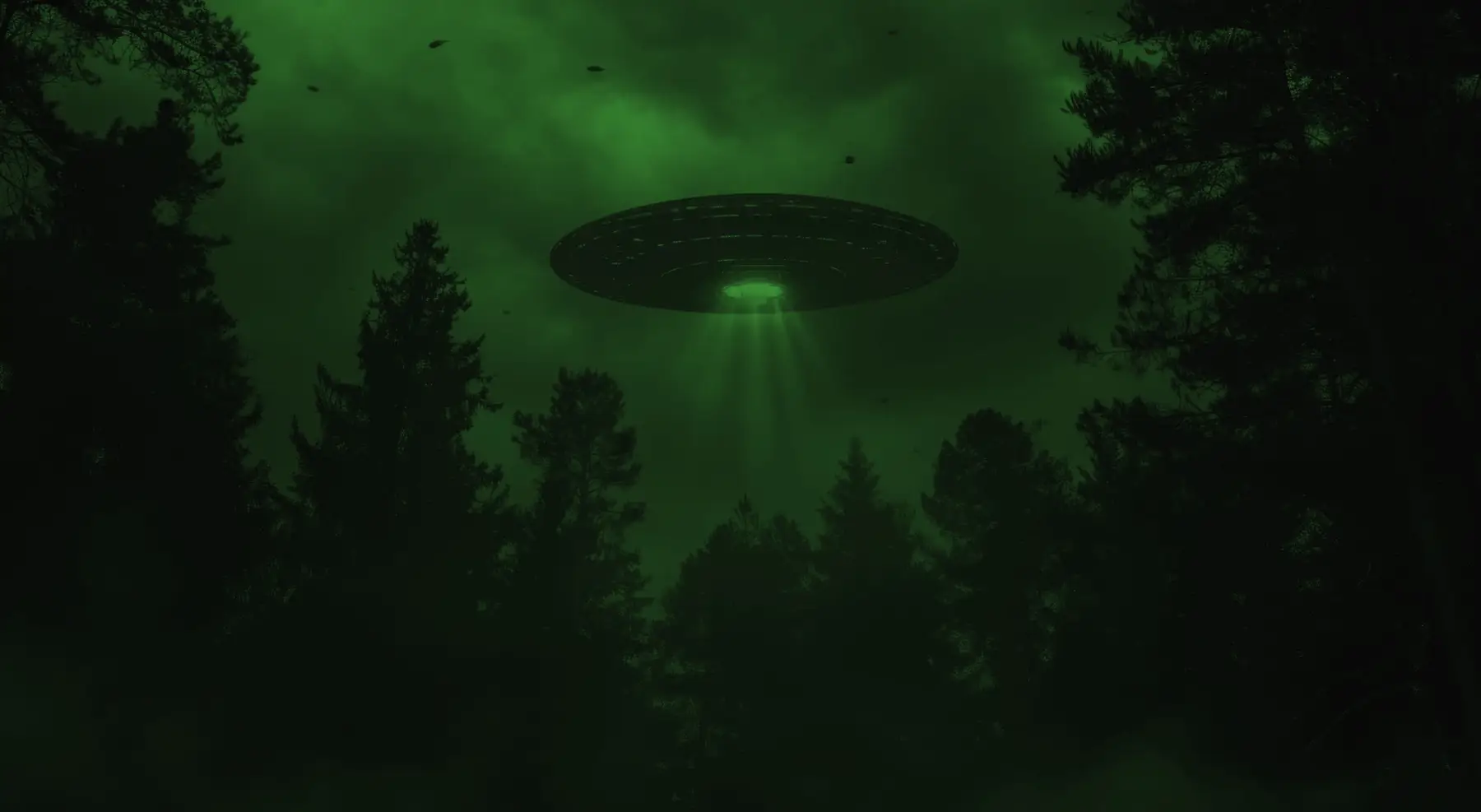
Case file 082Conspiracies, Hoaxes & FraudsTimeless / Spans the Ages

Beavers on the Moon

Bat-people, unicorns and upright, fire-building beavers: how the New York Sun sold America a lunar civilization — and why Apollo 11 still gets called fake.

Oct 4, 20241h 13mRe-aired Apr 24, 2026 as Revisiting Beavers On The Moon
00:00 / 1:12:44
Or listen to this episode onApple PodcastsSpotifyYouTube
Share this episode

In this episode

  • Why a struggling two-year-old newspaper printed six days of moon monsters — and what it did to circulation by that same afternoon
  • Fire-building beavers that walk upright and carry their young in their arms — and the creatures the Sun described walking into the woods behind them
  • Edgar Allan Poe's furious debunking, and the petty grudge that had to be settled before he'd call it genius
  • A physicist ran the numbers on 400,000 people keeping one secret — how long he says it would have held
  • The Stanley Kubrick confession still circulating online, and the single date that collapses it

“There was just enough truth in the story to help carry the lies.”

The story

On August 25, 1835, the New York Sun began telling its readers that the moon was occupied. Not merely alive — civilized. Unicorns grazing, zebras the size of dogs, horned bears, winged people with glossy copper-colored hair, and beavers that walked upright on two legs, carried their young in their arms, and built huts with smoke curling out of them. America believed every word.

The first great moon hoax in American history landed 123 years before NASA existed, and nobody has ever topped it.

A telescope with a 24-foot lens

The setup was almost too good. The Sun ran a six-part series crediting the discoveries to Sir John Herschel — a genuinely renowned astronomer, and the son of the even more renowned William Herschel, who had discovered Uranus. The paper said the findings came from a supplement to the Edinburgh Journal of Science. Herschel, it explained, was in South Africa, working with a vast new telescope built on an entirely new principle, its lens measuring 24 feet across.

Every load-bearing detail was true enough to hold weight. Herschel really was in South Africa. He really was scanning the sky, watching for Halley's Comet, which was due sometime in 1835. And it was an age when the impossible arrived on a schedule: the raincoat in 1823, toy balloons in 1824, the electromagnet in 1825, the microphone in 1827, Braille in 1829, the sewing machine in 1830, the mechanical calculator in 1835. A lens that could pick out rivers and livestock on the lunar surface was not, in that decade, an outrageous thing to imagine.

Batman, in Latin

The prose is thick and Victorian and, read today, a slog — but the inventory is glorious. Nine species of mammal. Thirty-eight species of forest tree. A small kind of reindeer, the elk, the moose, the horned bear, and the biped beaver, which resembled the earthly beaver in every respect except its missing tail and its invariable habit of walking upright on two feet. It carries its young in its arms like a human being and moves with an easy gliding motion, the account said, and from the smoke in nearly all of its huts, there is no doubt of its being acquainted with the use of fire.

Then came the residents. Four feet tall, furred everywhere but the face, with membrane wings folded against their backs from shoulder to calf. The author named them Vespertilio Homo — Latin for bat man. Watching three parties of them walking toward a small wood, the narrator observed that these creatures were evidently engaged in conversation, hands and arms moving with emphasis, and concluded: We hence inferred that they were rational beings.

Fire-using, tailless, bipedal beavers with unicorns for neighbors. Honestly, who wouldn't want that to be real?

Everybody bought it

Papers across the country reprinted the story within a week. The Philadelphia Inquirer told readers on August 29 that if these things were seen, we must believe that there is indeed more in the universe than is dreamt of in our philosophies. Religious groups started working out how to get missionaries up there. A delegation of scientists from Yale traveled to New York hunting for the original journal articles and got walked office-to-office by Sun employees until they gave up and went home to New Haven, never realizing they'd been played.

The real author was a British writer named Richard Adams Locke, who published without a byline. He claimed he'd meant to mock the public's gullibility, not exploit it — but once the thing took off, the Sun had no interest in confessing. The paper had been selling around 8,000 copies a day. By the afternoon of August 25 you couldn't find an unsold copy anywhere; by the end of the run, circulation had doubled. The Sun packaged the series as a pamphlet and sold that too, then, since neither had illustrations, sold lithographs. One of them, titled Lunar Animals, sits in the Library of Congress.

Edgar Allan Poe was the loudest debunker, sputtering that not one person in 10 discredited it and that a professor of mathematics at a Virginia college had assured him he had no doubt of the truth of the whole affair. Poe's outrage may not have been entirely pure. He first had to satisfy himself that Locke hadn't lifted his own story about a man who flew to the moon by hot air balloon. Once satisfied, he called Locke's work genius.

Publisher Benjamin Day never admitted the hoax. Three weeks later he ran an editorial arguing it hardly mattered whether the moon story was true, since it had usefully distracted a public torn up by the fight over the abolition of slavery. And Sir John Herschel, unreachable in South Africa, had no idea he'd become the most talked-about man in America.

The weird part

In 1835 Americans were told the moon held unicorns, winged bat-people and two-legged beavers who built huts and lit fires — and believed it so completely that Yale sent scientists to New York to track down the source. Today, as many as one in five Americans refuse to believe two men in spacesuits stood on that same moon.

One skeptical dude at Rocketdyne

A century and a half later, the direction of belief reversed. The modern moon hoax theory traces to one man: Bill Kaysing, a Navy officer in World War II who worked at Rocketdyne from 1956 to 1963, the company behind the Saturn V engine. He wasn't an engineer or a physicist. He was a technical writer — head of the department — with access to Mercury, Gemini, Atlas and Apollo documents. He said colleagues told him a crewed mission to the moon was possible but bringing that crew home alive was not. A hunch bloomed into conviction, and watching Neil Armstrong step onto the surface on July 20, 1969, only hardened it. In 1976 he self-published We Never Went to the Moon, America's $30 billion swindle. It inspired the 1978 film Capricorn One and a theory that anywhere from six to 20 percent of Americans hold today. Kaysing later claimed NASA murdered the Challenger crew to keep them quiet.

The counterarguments never land, because they're not really arguments. The physicist David Robert Grimes calculated that a hoax involving 400,000 people would have cracked in under four years. There are no stars in the photos for the same reason there are none in space shuttle or Mir imagery — the sun never switches off, and starlight can't compete. The flag was mounted on a rod so it wouldn't droop; what looked like fluttering was the pole vibrating as the astronauts let go. Armstrong's boot print holds because moon dust has sharp edges that stick, and there's no weather to smooth it away.

What we'll believe, and what we won't

Out past the neon, in the Mojave scrub around Las Vegas, tourists point at a stretch of desert and say that's where it was filmed. Online, a clip circulates of Stanley Kubrick confessing he shot the whole thing — an interview dated May 1999, two months after Kubrick died on March 8. It's an actor, from a movie called Shooting Stanley Kubrick.

Apollo got squeezed between American optimism and the sour years that followed — Vietnam, Watergate, the energy crisis — and then we stopped going in 1972 and didn't return for 50 years, which reads to a cynic like an admission. So we'll accept moon Nazis, a hollow moon that rings like a bell, an artificial moon watching us. Just not two men in 1969 standing on it.

It really is a shame about the beavers.

The transcript

Chapters & full transcript10,492 words
Chapters
  1. 00:07Neon, then nothing
  2. 02:30One skeptical dude
  3. 06:21Where the stars went
  4. 10:46A telescope with a 24-foot lens
  5. 19:22The byline that wasn't there
  6. 28:30Squeezed between two Americas

This transcript was generated automatically from the episode audio and may contain errors. Times are approximate, since ad breaks can shift them by a minute or two.

00:00

Hey, true weirdos at the end of this episode, stick around if you want for a little bonus content and conversation. The 135 square miles that make up the city of Las Vegas are sprawled across the floor of the Mojave Desert surrounded on all sides by mountains. Vegas is all lights and noise and people 24 7. It's a sensory explosion, but like a dream. It ends abruptly. One minute pulsing neon, the next a fast parched desert seemingly empty for miles and miles. But tourists have found something in all that wide open dusty landscape. Something they say is proof that one of humanity's most staggering achievements is a lie. They say they found the spot where NASA faked the 1969 Apollo moon landing.

01:03

Yes, indeed. They've got the flag up now and you can see the stars and stripes on the lunar surface. Beautiful, just beautiful. And they got a small beam of light. When it comes to the NASA moon missions, people have three basic takes. Number one, we went to the moon on a wing and a prayer and found only a dusty, lifeless rock. Number two, we went to the moon and found nothing. We went to the moon and found it already occupied by some hyper advanced extraterrestrial race. We got kicked off and banned from returning for 50 years. Number three, we never went to the moon at all. It was a giant hoax, a lie perpetrated by the US government as part of their effort to win the propaganda battle against the Soviet Union during the Cold War. That last one, the conspiracy theory about the moon landing being fake has been around for so long now that you might not even realize that it all started with one guy, literally just one skeptical dude by the name of Bill Kaysing. Now if you're picturing some basement dwelling conspiracy troll, think again.

02:44

Kaysing was an officer in the US Navy and served during World War Two. He went on to play a role in the US space program, even if it was just a very small role. Between 1956 and 1963, he was employed by Rocketdyne. That's the company that helped in the design of the critically important Saturn V rocket engine. Kaysing wasn't an engineer or a physicist or a rocket scientist of any kind. He was a technical writer, the head of that department. In fact, in his position at Rocketdyne, Kaysing had access to documents from the Mercury, Gemini, Atlas and Apollo mission programs. Kaysing disagreed that one had to be a scientist or engineer to understand that there was something very off about those materials. He claimed that co-workers at Rocketdyne shared with him that while it was possible to get a crewed mission to the moon, there was no way, no way to bring that crew safely back to Earth. Kaysing famously said that what began as a hunch or an intuition soon bloomed into a true conviction that the entire US space program was one epic hoax. And watching astronaut Neil Armstrong step on to the moon on July 20, 1969, did nothing to change Kaysing's mind.

04:22

The more he thought about it, the less convinced he was. So he wrote a book and self published it in 1976, titled, We Never Went to the Moon, America's $30 billion swindle. Kaysing's book inspired a 1978 movie called Capricorn One, and launched a moon hoax conspiracy theory that thrives to this day. Anywhere between six and 20% of Americans firmly believe that no human has ever landed on the moon. And believe me when I tell you that this kind of impact is a self published author's wet dream.

05:04

There is no arguing with moon hoaxers. There's no evidence you can present that even makes a dent. You can say, yeah, but there were like 400,000 people who spent a solid decade working on the Apollo mission. What are the chances that you could get every single one of these people to keep a secret that big? Max, this is going to be painful. But can you please be the moon hoax guy? Like the one we used to work with? Remember him? Oh, yeah. They stayed quiet because they knew the government would disappear them along with their whole families. Really, though, that doesn't seem both super mellow, dramatic and also highly unlikely. What's that old saying? Two people can keep a secret as long as one of them is dead. But you think nearly half a secret that huge. The physicist David Robert Grimes politely disagreed. He calculated that a moon landing hoax involving over 400,000 people would be exposed in less than four years. Now I know that he's just some random physicist, and not your cousin Donnie Wayne, who's been doing his own research. But still, how come you don't see any stars in any of those photos from the Apollo mission? I'll tell you why. NASA didn't put those stars in those pictures because they knew that like astronomers will be able to tell right away that the pictures have been taken from right here on Earth, not the moon. Oh, you got me there.

06:38

Maybe there are no stars in the Apollo footage for the same reason you don't see stars and photos from the space shuttle missions, or Russia's old Mir space station. And that reason is the sun. The sun never turns itself off. And light from the sun in space is as bright or brighter than the sunlight that we see on Earth at high noon on a clear day. And the stars bless their hearts can't compete. The brightness of the sun outshines the dimness of the stars. You can't see the stars during the day on Earth. But you know, they're still there, right? Every human landing on the moon took place during the lunar daytime, with the sun reflecting brilliantly off the moon's Explain why the backgrounds in these so called moon photos are identical. Even when the pictures were taken miles apart.

07:31

The only explanation that makes sense is that those backgrounds were painted like a movie set, because that's what it was. The backgrounds in those photos aren't identical at all. Similar? Yeah. A couple of things to consider. First, there aren't many objects on the moon that make it easy to judge distance, right? No trees, no buildings. Second, the moon has no atmosphere, none of the haze we have here on Earth. So everything appears much clearer and much closer, which I know you just heard as a bunch of blah, blah, blah, like we could keep going and going and going.

08:12

Like, how could human beings even survive a trip to the Van Allen radiation belt? The astronauts were shielded from that ambient radiation by the aluminum poles of the spacecraft. And besides, the total amount of radiation they received was equal to what a person living at sea level for three years will be exposed to.

08:31

It's hardly enough to fry them to a crisp. The flag, the flag, the flag fluttered yet there is no wind on the moon. So that had to be fake. Fake. No, the flag didn't flutter. It was mounted on a rod so that it didn't droop. Did it seem to flutter as the astronauts moved it into position? Yeah, it did. But that was the flagpole vibrating ever so slightly as the astronauts released their grip on it.

09:00

I guess you'd expect me to believe Neil Armstrong's footprint is still there in the dust after all this time. The moon is dead dry. So how? How? No atmosphere on the moon. So no wind or weather to erase the footprint. Plus, the soil on the lunar surface is very different from the soil here on Earth. It hasn't been pounded by the elements, hasn't been worn smooth. Moon dust particles have sharp edges. They stick together, making it possible for Armstrong's boot print to hold its shape in the lunar vacuum.

09:34

See how it goes. You can argue with moon hoaxers till you lose your voice, but I don't recommend it. You just won't get anywhere. When it comes to the moon, people can be kind of nuts. As for Bill Kaysing, the grandfather of it all, there was nothing harmless about the moon hoax conspiracies he promoted. He claimed that NASA faked the Space Shuttle Challenger tragedy, murdering the entire crew to keep them from blowing the whistle on Apollo 11. That's pretty twisted. And also pretty unlikely, given the number of people who'd have to be complicit and keep that sick secret. What are the odds of not one person, not one having an attack of conscience spilling the story?

10:26

Here's the exciting bit. Apollo 11 isn't even the first moon hoax. And they couldn't blame the very first moon hoax on NASA, because it happened in 1835, 123 years before NASA was even found it. It all began on August 25, 1835, when the New York Sun newspaper published the first article in a six part series, detailing the discovery of not just life on the moon, but an entire civilization thriving there. The headline read, great astronomical discoveries lately made by Sir John Herschel. In smaller print, the paper added from a supplement to the Edinburgh Journal of Science. Okay, the basic premise was that a respected astronomer named Sir John Herschel was in South Africa, working with a remarkable advanced new telescope. It was huge, too, with a lens that measured 24 feet in diameter. Through it, he witnessed the most extraordinary things. There was life on the moon. And it was incredible. There were some familiar animals like bison and zebras, though the zebras were miniatures, like dog sized. There were goats, but sporting only one horn, like unicorns, which were also plentiful on the moon. There were great big beavers that walked on two legs and humanoid like creatures with wings. The author said that these creatures looked like humans crossed with bats and dubbed them Vespertilio Homo. That's Latin for Batman. Now it's all written in the flowery style of the day. The articles themselves are a little tiny bit excruciating for us modern readers. We will state at once that by means of a telescope of vast dimensions and an entirely new principle, the younger Herschel and his observatory in the southern hemisphere has already made the most extraordinary discoveries in every planet of our solar system, has obtained a distinct view of objects in the moon fully equal to that which the naked eye commands of terrestrial objects at the distance of 100 yards, and has affirmatively settled the question whether this satellite be inhabited and by what order of beings. Wow, that really was an amazing telescope. Listen to what else Herschel saw. In the center of this delightful valley, we found a large branching river abounding with lovely islands and water birds of numerous kinds. Near the upper extremity of one of these islands, we obtained a glimpse of a strange amphibious creature of a spherical form, which rolled with great velocity across the pebbly beach and was lost sight of in the strong current. And this, Dr. Herschel has classified not less than 38 species of forest trees and nearly twice the number of plants of animals. He classified nine species of mammal and five of oviparia. Of the former, there is a small kind of reindeer, the elk, the moose, the horned bear and the piped beaver. The last resembles the beaver of the earth in every other respect than in its destitution of the tail and its invariable habit of walking upright on two feet. It carries its young in its arms like a human being and moves with an easy gliding motion. Its huts are constructed better and tighter than those of many tribes of human savages. And from the appearance or smoke in nearly all of them, there is no doubt of its being acquainted with the use of fire.

14:19

Okay, wait, just stop. Are you telling me that people back then could be persuaded to believe that the moon was occupied by intelligent fire using tailless bipedal beavers who had unicorns? Because I freaking love it. I'm all in for the moon beavers. Are you kidding? And you know who else was all in for readers of the sun? Why wouldn't they be? Sir John Herschel was a renowned astronomer and the son of the even more renowned astronomer who discovered the planet Uranus, Dr. William Herschel. So that checked out. Plus, this was a time of discovery. 1823, the invention of the raincoat.

15:09

1824, the invention of toy balloons. 1825, the invention of the electromagnet. 1827, the invention of the microphone. 1829, the invention of Braille. 1830, the invention of the sewing machine. 1834, the invention of the corn planter. 1835, the invention of the mechanical calculator. See what I mean? It wasn't all that far fetched in 1835 to imagine a telescope that could spot lakes and rivers and sheep on the But even more important was the simple fact that people want it to believe. That's the one thing you need for fake news or a hoax to really take off. If the people want to believe it badly enough, they'll find a way to skim past the parts that feel maybe a little ridiculous to get to that one piece of evidence that confirms what they already feel to be true. You can see that dynamic in action every second of every day on social media. And then there's the bandwagon effect. If enough people are saying it, then there just might be something to it, right? It wasn't just people who jumped on the story of Dr. Herschel's findings on the moon. It was also the press. Within a week of the Sun publishing the series, other papers all around the country ran the story. As fantastical as it seemed, it had a real air of credibility. It was a real scientist doing real science. Plus, it was a known fact that Sir John Herschel was in South Africa at the time. He was there studying the skies in search of Halley's Comet, which was due to make an appearance at some unknown point in the year 1835. There was just enough truth in the story to help carry the lies. And again, people want it to believe. Why shouldn't there be an alien race living on the moon? We counted three parties of these creatures of the 12, 9 and 15 and each walking erect toward a small wood near the base of the eastern precipice. Certainly they were like human beings for the wings had now disappeared and their attitude and walking was both dignified and erect. We had a perfectly distinct and deliberate view. They averaged four feet in height were covered except on the face with short and glossy copper colored hair and had wings composed of a thin membrane without hair lying snugly upon their backs from the top of the shoulders to the calves of the legs. The face which was of a yellowish flesh color was a slight improvement on that of an orangutan being more open and intelligent in its expression and having a much greater expansion of forehead.

18:03

The mouth, however, was very prominent, though somewhat relieved by a thick beard upon the lower jaw and by the lips far more human than any of those simian species. These creatures were evidently engaged in conversation, the various actions of their hands and arms appeared impassioned and emphatic. We hence inferred that they were rational beings.

18:27

They say that if you're gonna lie, keep it as straightforward and simple as you can. The more elaborate the lie, the harder it is to keep track of all the details. And as you can see, this was about as elaborate a lie as you can tell. People bought it. When the Philadelphia Inquirer ran the story on August 29 1835. The editors included this statement, We publish today a document which is fitted to excite as wonder in both the learned and the ignorant world. If these things were seen, we must believe that there is indeed more in the universe than is dreamt of in our philosophies.

19:09

So these astonishing discoveries on the moon were attributed to Sir John Herschel. But he wasn't the author of the story, which was published without a byline. Anonymously. The real author was a man named Richard Adams Locke. Locke was a British writer who took a job at the New York Sun, a baby newspaper just two years old and struggling to find readers. Locke said he never meant to trick people. He meant to mock them, you know, poke fun at their gullibility. But when the story took off, the New York Sun wasn't about to spill that tea. The paper was only selling about 8000 copies per day, which was nothing compared to their competition. Locke's moon story changed everything. The paper ran it for six days, then packaged it as a pamphlet and sold that too. The pamphlets like the newspaper story itself had no illustrations. So the New York Sun got busy selling lithographs. And one of those titled Lunar Animals is in the Library of Congress now. Meanwhile, not everyone felt for it. One of the biggest and loudest debunkers was none other than Edgar Allan Poe. As eager readers lapped it up and religious groups began strategizing how they might send missionaries to the moon. Poe was like, be serious, please. Like whoever wrote this has some skill, no doubt. But how in the world can you believe a word of it? Poe wrote, not one person in 10 discredited it. A grave professor of mathematics in a Virginia college told me seriously that he had no doubt of the truth of the whole affair. They say that Poe's outrage wasn't exactly honest, that he didn't care so much that the press would print a ridiculous hoax, as he was ticked off that Locke had stolen his thunder. It took some doing for Edgar Allan Poe to be convinced that Locke hadn't plagiarized his story about a man traveling to the moon in a hot air balloon. Once Poe was satisfied that Locke hadn't ripped him off, he had nothing but praise for the man. He described the work as genius. The publisher of the New York Sun was a 25 year old guy named Benjamin Day. Did he know that Locke's story was a work of fiction? Maybe, maybe not. All we have to go on is the unsigned editorial note that was featured in the first edition.

21:55

Great astronomical discoveries. We this morning commenced the publication of a series of extracts from the new supplement to the Edinburgh Journal of Science, which have been very politely furnished us by a medical gentleman immediately from Scotland in consequence of a paragraph which appeared on Friday last from the Edinburgh Current. We are necessarily compelled to omit the more obtrusive and mathematical parts of the extracts, but even the latter cannot fail to excite more ardent curiosity and afford more sublime gratification than could be created and supplied by anything short of divine revelation from heaven. Now indeed, it may be said that we live in an age of discovery.

22:40

The bat people and the fire building moon beavers might have been fake, but the impact the story had on the New York Sun's bottom line was very, very real. By the afternoon of August 25 1835, you could not find a single unsold copy of the paper anywhere. By the end, after the last installment had been published, the Sun circulation had doubled. It was a media sensation, the first in American history that had nothing to do with politics or war. Publisher Benjamin Day never admitted that the surmercial moon story was a hoax. He took another path. In an editorial published just three weeks later, Day explained that it didn't even matter whether the moon story was true or false. It had served its purpose in distracting a population troubled by the painful strife and discord that was the abolition of slavery. I guess it's either weirdly comforting to learn that our mass media isn't any worse now than it's ever been, or super depressing, or terrifying, or some horrible combination of And before you make fun of the people who fell for it, you should know that a delegation of scientists from Yale University traveled to New York in search of the original journal articles that the Sun had allegedly taken the story from. What happened next was a madcap comedy of Sun employees sending the Yale group from office to office until at last the scientists gave up and headed home to New Haven with no idea that they had been played. And neither did Sir John Herschel. Working away in South Africa, he didn't have the first clue that he was the talk of the town. As unreachable as he was respected, Herschel turned out to be the perfect Patsy for Locke's hoax and the unwitting main character in the world's fake news palooza.

25:01

What is it about the moon? That glowing silvery orb that hangs in our night sky? Silent and cold and possibly distant and yet tantalizingly close. It's no wonder that we project stories and fables and fantasies and dreams onto it. It's an interesting little coincidence that the nursery rhyme, The Man in the Moon, was published for the first time in 1833, just two years before Locke's moon hoax story made its way to the sun's front page. We are obsessed with the moon. We make up monsters who are controlled by the moon. Hello werewolves. We blame the moon for our moods and sometimes our worst behavior. And after we thought that there were no bat people or tiny zebras on the moon, we said there were secret Nazi bases up there. A British tabloid ran a story in the 1980s about the discovery of a World War Two bomber plane on the moon. We say the moon is hiding the ruins of an extraterrestrial civilization on its far side, or an alien mining operation or a top secret military encampment.

26:22

We say that the moon is not a natural thing at all. But an artificial object placed in orbit to keep an eye on us. We say it's hollow and rings like a bell when it's thumped. Poems and stories and songs have been written about the moon going all the way back to the most ancient times. It's like we're willing to believe just about anything when it comes to the moon.

26:53

Except for the idea that two American astronauts stepped onto its surface in July 1969. We copy you down Eagle. Okay, everybody stand by for T1. Tranquility Base here, the Eagle has landed. Roger Tranquility, we copy you on the ground. You got a bunch of guys about to turn blue. We're breathing again. Thanks a Thank you.

27:18

You're looking good here. We're gonna be busy for a minute. The reason so many people don't believe that the Apollo 11 mission was real, that we never went to the moon much less walked on the lunar surface might be 100% NASA's fault. Well, and the US government's fault. Because after 1972, there were no more moon missions. We didn't go back. And by the 1970s, people's faith in government and institutions was badly bruised. paranoia, mistrust, suspicion, who could believe anything a politician said. It was just easier to believe that the Apollo moon landing was the same bull as everything else that NASA had hauled some astronauts to the desert outside Las Vegas, that Hollywood had jumped in to help.

28:16

That a gullible world swallowed what was clearly not just fake, but painfully, obviously fake in the most rinky dink ways. The poor Apollo mission found itself squeezed right between the golden heyday of American optimism, and the sour disappointment of Vietnam, Watergate and the energy crisis. Any country that could put a person on the moon ought to be able to fix the problems right here on Earth as the thinking went. And if the government couldn't fix the issues at home, there was no way they were convincing anyone that they launched a flimsy tinfoil contraption into space. astronauts on the moon, give me a break as if. And now we have the internet and social media where disinformation, misinformation and conspiracy theories propagate at just about the speed of light. The number of people who believe we never went to the moon is growing. Now 10% of Americans think it's BS. It's one in 10 people. There are debates on Twitter about why aren't there more high res photographs of the moon? What is NASA hiding? Old obscure film and video clips get dug up and circulated. Like this 1965 interview with a scientist named R. Foster.

29:49

Well, it is by now rather more than this theory. 10 or 11 years ago, I stated to various scientists that the moon is not a piece of rock. But it is plasma, plasma phenomena, cosmic plasma. And that this fact will eventually be confirmed. I made certain predictions which were already confirmed in 1958. And the situation now is coming close to a complete confirmation.

30:17

What will be the result if you are proved to be correct in your theories? The result will be profound and decisive because it will give proof that a complete reinvestigation of the laws of nature is necessary because if the moon is a plasma, no man will ever land on it. The soft landing attempts will all fail. Or how about this interview with filmmaker Stanley Kubrick? You know, 2001 A Space Odyssey, Full Metal Jacket, The Shining. An interview that went down in May 1999.

30:50

I perpetrated a huge fraud, which I am now about to detail. Involving the United States government and NASA. All right. And I'm sure you've heard the rumors. The moon landing? That's right. That the moon landing was fake. The moon landing, moon landings all were fake. And I was the person who filmed it. You're serious? Okay.

31:27

I'm serious. I'm dead serious. The conspiracy theorists were right on this, on this occasion. Ooh, couple big problems with this one. Starting with the fact that Stanley Kubrick died on March 8, 1999. Making an interview two months later, kind of hard to schedule. The footage is actually an actor playing Kubrick for a movie called Shooting Stanley Kubrick. Of course, you'd have to know all of that to know that the clip you just watched on whatever social media site is fake. It's tricky because it's presented as real. And if you really, really, really want to believe, wow, you just might.

32:13

The moon has its eyes on you. So be careful of what you do. Every time you go strolling with your lady love, means the moon is watching from above. Big eyes way up in the sky. So be wise. Don't let him surprise. Don't try to tease. Go way up through the trees. The moon has its eyes on you. What's sad isn't that people don't trust their government.

32:52

Authority should always be questioned. Everything is go here. We're just waiting for the cabin pressure to bleed to low enough pressure to open the hatch. It's about 0.1 on our gauge now. Neil, this is Houston, over. Roger, we're showing a relatively static pressure on your cabin. Do you think you can open the hatch at this pressure about 0.12 psi?

33:27

We're gonna try it. What is sad is when we doubt that human beings are capable of astounding, amazing, breathtaking, transcendent feats. Because we are. Even though we're pretty terrible a lot of the time and stupid beyond belief more than seems safe and also hateful and territorial on top of everything else. But we do have our moments of glory, and goodness and grace.

34:03

Put your left foot to the right a little bit. Okay, that's good. Okay, Houston, I'm on the porch. Roger, Neil. Columbia, Columbia, this is Houston. One minute 30 seconds till all systems go over. Neil Armstrong on the porch at 109 hours, 19 minutes, 16 seconds. Houston, this is Neil. Radio check. Neil, this is Houston. Loud and clear. Break, break. Buzz, this is Houston. Radio check and verify TV circuit breaker in.

34:50

Roger, TV circuit breaker is in. Update, loud and clear. Roger. We're getting a picture on the TV. At the foot of the ladder, the limb foot pads are only depressed in the surface about one or two inches. Although the surface appears to be very, very fine grained as you get close to it. It's almost like a powder mass. As a species, our self esteem is in the basement. A whole lot of us think aliens built the pyramids and Stonehenge and those giant heads on Easter Island. Maybe they did. Okay, maybe. But isn't it also at least possible possible that people made those things, that people are capable of those things. And that people really did make it to the moon and back in 1969.

35:59

I'm gonna step off the limb now. That's one small step for man. One giant leap for mankind. It's just such a bummer that the astronauts didn't find those dog sized zebras, or the bat people, or the moon beavers. Unless they just didn't look in the right place. Next time on True Weird Stuff. If you've ever had your car break down at night on a lonely road, you know that sick feeling of oh crap. Now imagine that your car is a spacecraft and the only road is space and you're all alone. And if you can't figure out how to get this bad boy moving, you're either going to drift in the void till you run out of oxygen or burn to a crisp as you plunge back through Earth's atmosphere. Oh, better hope you've got the right stuff. That's the next True Weird Stuff.

37:12

Special thanks to Kary "Doc" Bowser for adding his voice to this episode. So this story of this hoax from 1835 is it's amazing, but it's not surprising. It's it's so it's so cool in so many ways, because it first of all, it was so imaginative. Like I am so disappointed there aren't giant fire building beavers on the moon. You have no idea, right? It, it was the first really epic, like went viral for that time, right? That was that had nothing to do with, you know, like I said, war and politics. It was fake news. It was designed to grow circulation and readership in the same way that a lot of what we see online on social media is clickbait designed to attract eyeballs and attention to various websites. It's the same exact principle that we live with today every day with all kinds of stuff. It was just the very first one. And it's so brilliant in so many ways, is it not?

38:26

It is. My feeling is if you're going to tell a lie, tell big ones. You know, the giant beavers, the little people, the zebras, the sign of dogs, all of it's so specific. And I think that's why it makes for a really good lie. You know, what's Yeah, I mean, and you have to put yourself in the you got to put yourself back in the time. In 1835. There was no, like, we didn't know about DNA. You know, we didn't, we didn't know what we know. Now. We didn't have access to the information we have access to now. So did it was it all that impossible or improbable that things that we had here on Earth might also exist on the moon?

39:11

There is no reason to believe that it didn't because we didn't have the understanding of science that we have now that that that would have been impossible. It's funny, you you had me when we were talking about the moon landing from 1969. I did a play two years ago, and I am a conspiracy theory person in the play. And the two conspiracies that I really hang on to are the moon landing didn't happen. And the lines that I had, you had me read in this, these are almost like lines from the play. And the other was about what happened at 911. And that it was, it was a government conspiracy. And excuse me. So I'm reading this, I'm having flashbacks to that. And I think that the one thing that everybody has always said is, but they didn't see any stars.

40:07

So therefore, you know, and I'm wondering, it's the Chinese that are have gone over to the far side of the moon, or they either have. So I'm wondering if they're able to see the stars from over there, I'm sure that they can, because I, I, I absolutely believe that we landed on the moon. And here's the other thing about that. People act like the two guys landing on the moon, that was the only time we did it, we did it six times. Not only that, we with 50 years ago, technology, now 50 years plus technology, we had like a little vehicle, and they're driving around up there, too. I mean, it's, that's amazing.

40:49

It, you know, I think because there's a lot, there's a lot when you look at the old footage of the Apollo 11 landing, if you're looking at that with 2024 eyes, it, I mean, it just looks ridiculous. But you have to remember, it's 1969. And they're beaming that video signal back to Earth from the freaking moon. Of course, it you know, we didn't have the tech that we didn't have anywhere near the technology we had today. And I agree that the spacecraft with the golden tin I mean, I agree like how that that looks like. That looks like Jiffy Pop meets. Like how in the world is that? Is that even possible? We have to, we have to remember that. This is like, the space race was a critical part of the Cold War. And I think that we did get to the moon on a wing in a prayer. I think it's amazing that there wasn't more loss of life than we've had in space program. I think we I think it was some sort of a miracle that we got there. Right. But even now when you see footage, like if you saw the spacewalk that SpaceX did, they streamed it live on the internet just a few weeks ago. Those people are coming out of they didn't really do a spacewalk, they opened the door and kind of put their half their bodies out and looked around. I don't mean that in a critical way. But if you look for it, you go to somebody walking in space here, it's not really a spacewalk, but they come out of the vessel. And you see Earth, which I think I would like die of the shock of it. There's Earth, but you don't see stars. You don't see stars.

42:36

There's, there's nothing to there's nothing to distract the sun from like blinding light. It's crazy. It's just crazy. The when I when I was in school, there were a couple things that I remember that we learned when we were talking about landing on the moon, the first was, they were unsure that the surface was solid enough for them to land on their big fear was that it was all very thick dust, you know. And so that was one of the concerns they that they had. The other thing they said, they're going to set up a flag. And they said the flag has wires in it. So it hangs straight out because it wouldn't look like anything if it was just hanging limp on the pole. So that was something that they did think about they, I can't remember you and I talked about it, or I read it somewhere. But they said now because of the exposure to the sun, that that flag is probably devoid of any color now.

43:32

Just bleached right out right out. Yeah. Because again, there's no atmosphere. It's just bombarded, bombarded, bombarded, you know, the, the sun doesn't get turned off at the end of the day, it doesn't go to bed, there are no clouds on the moon to protect it. I think for me, and next week's true weird stuff episode, we're going to take a look at four incredible ballsy, brave, courageous, insane moves made in space by astronauts in the various programs. Because I love the space program and astronauts in space and all of it, right. The thing that's pressing to me is that we just don't even believe that people just a few decades ago were capable of this. And, and I, you know, I believe like all kinds of crazy stuff. But I don't believe that 400,000 people can keep that secret. I just don't.

44:36

Buzz Aldrin said this, you know, he's he is one of my favorite. He's one of my favorites of the astronauts. And he is the only one from that original mission who is still alive. And I follow him on Twitter, he must be in his 90s. Now. But one of the things he said was, there is no way that that all could have been kept secret that long with that many people that were involved with it. He said, it just simply is impossible.

45:03

Somebody would have said something. And so he, he and the thing that he says is, I was there, I walked on it. You know, I mean, what more proof do you need? I mean, let's talk about the guy we worked with a moon hoaxer. Oh, what? What did not believing in the moon mission? What did that do for him? Do you suppose? Because we human beings were very needs based creatures. We do stuff because it meets a need we have it scratches an itch. What? What was that for him? I think that was one of many conspiracies that he believed because he was a bit of a crank. He was off. Yeah. And I think that he would, I think there was never a conspiracy that he meant that he didn't believe. You know, I mean, yeah, I think you're right. I think there are some people who believe that everything is a conspiracy. And I think this just happened to be the one that that he talked about the most.

46:14

Because the idea that that was all a hoax, it don't pisses me off. Well, that's why I think it's good that like, we have enough distance from it that like, we can look back and say, Okay, what was happening in the world? What was happening in America? At the time, this moon hoax theory took off, that made it so easy to believe. And to me, it's two things. One, it's that complete, the end of innocence, right, the loss of any faith in our institutions, the Vietnam War. I don't have, I don't have any memory of that, even though I was a little kid, I guess, I don't know, before school, even during that period. But I know how poorly those veterans and returning soldiers were treated.

47:06

It was a war that no one wanted and no one believed in. And so many of our so many Americans went and were killed or maimed and then came home to the worst possible reception. Like, it's a stain on our nation, right? Then you have Watergate. You know, we're, what the hell? Like, there once upon a time, like, we did have some reverence for the highest office in the land. And you're just a thug. You're just a crook. And these this inept band of burglars, like do better. So you can see why we suddenly we were cynical and angry.

47:47

And what brought us out of that as a country was when the US Olympic team beat the Russians in the Olympics, in the hockey game, in the hockey game. Yeah, did I not say so? I'm sorry. Yeah, just beat the Olympics. All right. All right. Sorry. I didn't mean but the but the hockey and there is there is the movie that has Kurt Russell, which is a great movie. And you really should see it because it does represent that well. But that sort of brought us together as a nation because there was all this bad stuff that had happened along the way, you know, Watergate and whatnot, and and the Vietnam War, which was just a complete debacle.

48:32

We were a seething, angry, disillusioned people. In the wake of the Apollo 11 landing, we really were and up till that point, we, we were drunk on our own mythology, you know, the golden 1950s land of opportunity stuff, which we now know, you know, look at that it was pre civil rights. There was Jim Crow laws, like it was women couldn't have a bank account. Like it wasn't the paradise some people seem to want to remember it as right. But we went from that to the cynicism of the 1970s. And then, here comes Hollywood, with a movie called Capricorn one. And the entire premise of the movie is that the Apollo moon landing was fraudulent. And if there's one thing that we are guilty of is man, we do believe what we see.

49:29

It's true. And everybody won't wait a second. But I will tell you that even as a child, and of course, in following I put together school projects on the later moon missions. But there was there was this sense of worldwide gathering to watch this when we landed on the moon. I mean, there was there was a sense of us all in the world being one in that moment, like nothing else did. I mean, it was, it was a unifying event. It for humanity, not for anyone, even though America beat the Russians, right? It was humanity. One small step for man one giant leap for mankind. Not one small step for a dude from Ohio one giant leap for America.

50:20

He was supposed to say he he always he talked about the fact that he sort of screwed it up. He was supposed to say one small step for a man, a man, one giant leap for mankind. And he he screwed it up. And he said he cringes every time he hears it because he screwed it up his one moment. It was it was something that, you know, collectively, as a species, we, we became a spacefaring species. Now, we, we didn't get far, we only got to the moon, but you got to start somewhere. And then the complete failure to ever go back. That's and then we didn't start going back to the moon until exactly 50 years had passed, which feeds conspiracy theory number two, that there were aliens on the moon, and they banished us for 50 years. We talked about this in another episode we did about the moon. So one theory is, is that the moon hoax had NASA continued sending crude missions to the moon for whatever reason.

51:28

The moon hoax probably wouldn't have taken off. But the fact that we stopped in 1972, gave the conspiracy theory people fuel in that, well, of course, we're not going back to the moon, we never went in the first place. Yeah, I guess part of it was, you know, they felt like they had gotten everything. They'd gotten everything they could from the space program was very expensive. I mean, it was just incredibly expensive to do that. And people, I can remember that at the time, when they did, there were there were a group of people that went down to Florida when they were going to launch it, and just said, Look, you've got people starving in this country. And you can't argue the point, you know, so why are you doing this when you have people starving? And I can remember that that that that happened. And the people from NASA, to their credit, they met with them and talked to them. And I can't remember there was, there was no resolution to it. But I remember that they did try to smooth it over. I don't know if it was a donation or exactly what what happened with that. But there was all the technology. And the other thing I wanted to say was all the technologies and the things that we got, as a result of us going to the moon, because they kept on having to overcome all of these obstacles. And we have to invent something. Like for instance, Teflon came from us going to the moon.

53:01

And I think Velcro, right? Velcro was another thing. Yeah. Right. And of course, Tang, delicious, delicious substitute for orange juice. Don't get the Tang. Yep. So let me let me say, because I mean, I hear all this stuff to right through the space shuttle program. I've had people right in my face telling me, you know, we have problems at home. We've always had hungry people in this country. And long before we even thought about going to the moon, we weren't feeding them. And after we stopped going to the moon, we weren't feeding them. So to me, that's like a false that you'd get slapped in the face in a high school debate for trying to make that argument that, well, we can't go to the moon because we have starving people here on earth. Yeah, yeah, we do. And as soon as we stop going to the moon, we're going to not talk about starving people on earth anymore. People were furious because they, NASA did not do a great job of what you just said, Max of saying, yes, it's about going to the moon. But it's also about expanding the frontiers of knowledge of science of technology. It's about all of that stuff. And the moon. I don't think NASA did a very good job of that. Do you?

54:24

No, I don't think that they did. I mean, we sort of know that. But I think that people people saw people are cynical because they see that there's there's politics involved with it. And there was politics. There's no there's no question that we're politics involved with it. So people get people get cynical about it. Because of that.

54:47

When you think about the like, we weren't, we weren't around in the years leading up to the Apollo successful Apollo 11 mission. We we don't know what it was to be in an escalated Cold War with a rival, where it was nuclear weapons pointed each other missiles bristling in silos mutual assured destruction. I mean, look how close we came with the Bay of Pigs situation also during the Kennedy administration. We don't know what that was like to live it and experience it. But I can tell you from a history standpoint, so much of what because all of these threads crisscross and interact. Some of what the CIA was doing back in the 50s, 60s and 70s. Those threads crisscross over some of what NASA was doing. All of these civilian contractors working on various bits and pieces of the space program like rocket dying, which we talked a little bit about here. These threads all lay on top of each other and they, they interconnect and they weave in and out and the same, the same message comes through every single time. We are facing the the gravest existential threat we are facing the annihilation of humanity with our adversaries the Soviet Union, and any and every advantage that the US could snatch and grab. They wanted to snatch and grab because they really saw it as the end of the world. And remax remember when we did the Georgia Guidestones? Right. So right. Okay. The anonymous group of donors who put together the plan and the funding for the Georgia Guidestones. What why did they do that? Why did they do that? Because they thought nuclear apocalypse was imminent. Because those those men who funded and who had the vision for and funded the Georgia Guidestones. Those men were peak adult years during the worst part of the Cold War. They went to bed every night expecting to be annihilated by a nuclear launch. When you have that at your tail, you're going to be powerfully motivated to not only win the Cold War, but potentially save humanity. What are we terrified of right now? We're afraid of monkey pox virus, right, right. We're afraid of identity theft. We're afraid of pagers exploding. We're afraid of some bad actor terrorist group getting their hands on a dirty bomb or a Think about how our modern fears shape not only the way we act as individuals, but shape the way governments act and the kind of policies that get put into place. Right, right. Like ever since September 11 2001. We all have to take our shoes off at the airport, right? That that would have seemed ludicrous to the very same people who in the 19 late 1950s and 1960s were convinced that if we didn't win the Cold War, we humanity was going to be wiped off the planet by nuclear war. They had that same, like, sick feeling that same anxiety, that same paranoia about that only worse, because like, I don't want to get my identity stolen. But that would not be quite as bad as total nuclear annihilation, right?

58:33

Well, and I think that because I, you know, we've had this threat that's been hanging over us, since the bombs were dropped on Japan, that is, that is a threat that we've had ever since then. I think that it's now so long ago, people kind of forget that and kind of act like, well, that's never going to happen. Do you know what I mean? I think when you're closer to it, when you're actually closer to it, it seems more possible. Now, most of the people that were connected with that or were alive in the world at that time, they've all died. And so I don't want to bomb anybody out. But I think we're closer to it today than we were when Neil Armstrong climbed out of the ship.

59:18

I absolutely agree with you. I mean, the world climate today, and I know people say this all the time, but the world climate today, it's very tenuous. There's lots of things that happen. And I go, is this it? It's so volatile. And see, during the Cold War, we had two distinct entities, we had the Soviet Union, and we had the United States of America, each was amassing a nuclear stockpile.

59:45

And it was understood that if Khrushchev or Brezhnev or whoever, hit the button, that we would hit our button, and our missiles would pass each other in the sky, and everybody on would be dead pretty soon. Right. But now, we have Russia, and the United States, and Hezbollah, and Iran, and North Korea. And we don't even know what we don't know. So when you think about the freedoms that we're willing to sacrifice for the illusion of safety, right? When you think about what we're spend our money on, and as governments now, not as individuals, what we're willing to spend on for the illusion of safety. Now put yourself back in the day, with one of those swanky crew cut haircuts, and a pocket protector. And the sure knowledge that if you cannot get Neil Armstrong and Buzz Aldrin onto the moon, your grandchildren may never live to see tomorrow. Those scientists and engineers were powerfully motivated, powerfully, with a lot of help from some folks that once upon a time would have been considered enemies, like Braun, Werner Braun, von Braun, yeah, von Braun. Yeah, the German Nazi rocket scientists that we scooped up and put to work in Los Alamos, and in our space program.

1:01:20

We're going to overlook all that Nazi stuff. Why don't you come over here and help us? Yeah, well, I mean, we're willing to overlook the Nazi stuff, if you can save the human race. Okay. So yeah, I mean, I totally get why people are skeptical. I get it. I get it. But it seems kind of late in the game to not believe the evidence of your own eyes, where the space program is.

1:01:47

All of that, all of the things that people say about the stars and all this stuff, all this stuff is always so half baked. And on the face of it, it sounds like Yeah, what about that? You know, and it seems like it's, it's plausible. But when you when you inspect it further, none of that stuff holds water. It just doesn't.

1:02:08

Sometimes, like, I'll believe something, just because I want to believe it, including kooky, crazy things. Like you can tell me some really kooky conspiracy theory. And if it sounds like a like, for example, there's a story floating around that has never been confirmed, that the somebody in Theodore Roosevelt's cabinet took a relative to the sub basement of the United States Capitol, where there were four enormous glass tanks. And in each of these tanks preserved in formaldehyde was an extraterrestrial body. That is a story that has been circulating for ever. And that's the kind of thing like, Oh, I so want to believe that I definitely want to believe that.

1:03:07

And at the same time, I want to believe that as human beings, we're capable of putting the alarm struck a buzz Aldrin on the moon. When you want to believe it, you'll find a way to believe it. Yeah, I suppose. Yeah, I suppose that's true. I mean, the one thing that I that I was wondering during this whole conversation was, do they still make Tang? And the answer is, yes, they do. In fact, they have something called Tang zero with no calories at all.

1:03:43

So can I tell you, I actually am married to a man. I sleep with a man who drinks Tang today. He does not drink Tang. A Tang drinking man touches me with both his hands. And let me hear the first time. Yes, between the potted meat and the Tang. Yeah, yeah. Those Tang drinking lips come from mine. So listen to this. It's a long time ago, because Kevin, I've been together forever. A long time ago. I'm like, All right, I'm gonna go to the grocery store. Is there anything you want me to And he said, Can you get me some Tang? And I said, I'm going to the grocery store, not 1975.

1:04:27

And he's like, they still make Tang. I'm like, they still make Tang. He goes, Yeah, they still make Tang. I said, Where in the grocery store would the Tang be? I've never seen it. And he's like, I don't know. I think maybe it's with like, breakfast food. So I go to the grocery store. And sure enough, on the very bottom shelf, they sell these plastic tubs of Tang. And he loves Tang. He drinks Tang. He may be the only person in America, we may be the reason Tang is still making it. We're the only household that buys it.

1:05:02

Sure. If I was in space, and there was nothing else to drink, then maybe I'd drink Tang. But I live here on Earth. And I can drink lots of other things other than Tang. Because as a kid, I loved Tang. As an adult, I pretty much know what Tang tastes like. And I don't think I ever want to drink it again. Well, he mixes it with Oh, here we go. Oh, he mixes it. Yeah, he mixes it with Lipton powdered iced tea mix. And he mixes the way you think you're gonna go making this up. He mixes those two things together. And he drinks it when he doesn't feel well, because it has healing, curative property.

1:05:48

Sherry. The only thing grosser than Tang is, is that tea, powdered tea, or either that or instant coffee, but powdered tea. Oh, no, he that is his mom. When he was sick. His mom would give the kids that and he believes in it. And you know what, he's, he's a healthy dude. You don't see him coming around with colds or strep throats. When was the last time I said to you, Kevin has the flu, right? Usually, if something's wrong with Kevin, it's because he's injured himself in some way or like when he had to have his orthosurgery to get his bionic foot. But like sickness, not enough sickness. And that's probably because he's drinking Tang mixed with lipton powdered iced tea mix.

1:06:42

I listen, I believe I believe there's beavers walking erect on the moon before I believe somebody really likes the taste of that combination. It's so trippy. So yeah, like, I just want to believe that humanity was capable of that. Because it's such an extraordinary scientific leap. But the thing is with when you really dig in the leap, the leap that took Armstrong and Aldrin to the moon was the final leap in a series of 1000s of little leaps, right? If that makes sense. And the courage. The other thing I don't like about the moon hoax thing is like astronauts lost their lives in the in these space programs.

1:07:28

Luckily, we haven't lost many, but one is too many, right? So people have given their lives pushing the frontier of this knowledge, and the courage and the bravery, the Saturn five rocket was designed for an intercontinental ballistic missile, and they modified it to get the astronauts. Yes. Do you know how brave you have to be to strap into that teeny tiny capsule and launch your ass to a giant rocket? And off you go to the moon. And the forgotten astronaut in Apollo 11, Michael Collins, was all by himself orbiting the moon over and over. And it was up to him to very carefully and exactly perform the maneuvers needed to fetch Armstrong and Aldrin and get all three of them home safely. And in next week's episode of True Weird Stuff, we're going to look at four astronauts, and they have something in common, something trippy. And I'm not going to tell you right now what that is because I want that to be a surprise. But for every, every time NASA puts out a call for astronaut candidates, for every group that applies, like 6000 might make it through the first wave of cuts. So now we have 6000 of the best and the brightest engineers, scientists, pilots, military test pilots in that group of 6000. And do you know how many of them make it to the astronaut program? Out of that? No, maybe eight. That's how special and unique and brave and brilliant these astronauts are. So when somebody says it never happened, I'm like, yeah, that is, that is disrespectful. You are disrespectful. Like, I don't go, Oh, you're a moron. Why don't you read a book? I just think that is, that's disrespectful, not just to the astronauts, but to humanity itself. Can we please have a couple of things that are amazing about us? Can we please?

1:09:46

Like when it's all said and done, and the score sheet is getting tallied? Can we at least have sent people to the freaking moon? And not have everything be? Oh, yeah. Hey, St. Peter, I was the Nigerian Prince Scammer guy. Like, can we just have goodness every now and again as a species? Please, please. So that is next week on True Week Stuff. We have some stories that are wild. And then a very, very strange coincidence in four astronauts from four different minds.

1:10:24

I am really looking forward to this. I love me the space program. All right. Thank you so much for listening to this episode of True Weird Stuff. And look, if you still believe the moon landing was fake, yeah, that's cool. Yeah, you know, whatever. We'd like to persuade you otherwise. But if you still believe it's fake, you still believe it's fake. And, and that's fine. Right? Like, I don't believe in BMI. Boom, there. I said it. I think that's the biggest load of bullshit.

1:10:52

I just can't just say if you don't believe it, you're wrong. You're just wrong. I mean, I'm with Max, I think you're wrong. I think you're wrong. But if you want to hold on to that, okay. Yeah, no one's going to show up at your house. No one will call. Thank you so much for listening. Thanks to everyone that helped us out on this episode. And we will see you next week. If you've got the right stuff.

1:11:17

And if you listen to us on Apple podcast, hit the plus button in the top right corner. And now it helps an independent podcast like ours to get discovered. And we really appreciate it. If you subscribe, rate and review true weird stuff, hit our website true weird stuff.com for show notes and photos and videos when we have it and bonus content. Everything true weird is waiting for you at true weird stuff.com and follow true weird stuff on Instagram and Twitter.

1:11:45

True weird stuff is a Now! Media production. Our executive producer is Anthony Garcia. The show is written and hosted by me Sheri Lynch, along with my deep and weird director Max Sweeten our equally odd producer is Kary Bowser. Additional production by the mysterious Stephen Call our digital witch and social media cult leader is Heather Furr original graphics by Kevin Nash original artworks by Olivia Axland true weird original music composed and performed by Jack Griffin and say Nash copyright 2024 Now! Media all rights reserved. All wrongs remembered Transcribed by https://otter.ai

Creative Co-Conspirators

Voice talent

One new weird tale a week.

The strangest true stories in history, in your inbox.

Unsubscribe anytime. Privacy policy.