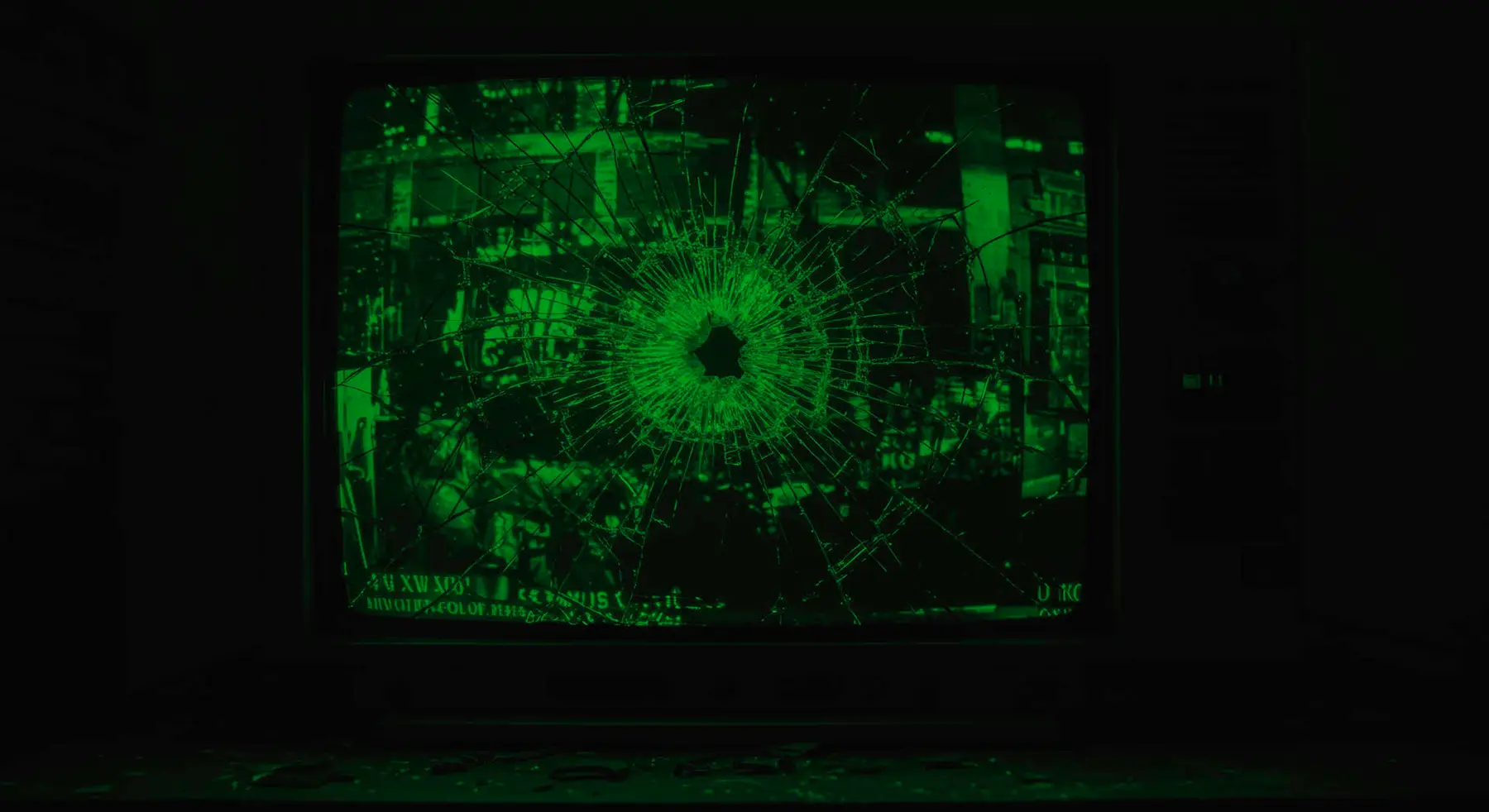
In Bob Shaw's short story Light of Other Days, a glass farmer sells slow glass, panes so thick that light takes ten years to pass through them. Most buyers want a waterfall to hang in a dim city apartment. The farmer keeps one window for himself. Through it, his wife and seven-year-old son, killed by a hit-and-run driver six years earlier, still move through the living room. "I'm entitled to keep something," he says.
That's fiction. Father Pellegrino Ernetti said he'd built something better: a machine that let you watch any moment of the past like television. Ernetti was a Benedictine monk, a trained exorcist, a musicologist and a physicist. He called his machine the chronovisor. By his account it now sits somewhere in the Vatican Apostolic Archive, a restricted underground vault with nearly 53 miles of shelves. The Vatican and a time machine had shared a headline before. A July 17, 1931, newspaper report on a bomb in the Vatican Gardens mentioned, in passing, a time machine found in St. Peter's and "removed to a safe place."
A voice on the tape
Ernetti was born in Rome in 1925, entered a Benedictine abbey in Venice at 16 and was ordained in 1949. He became an expert in Gregorian chant, the sung prayer Benedictines have used in worship for more than 1,500 years. That work led him to Father Agostino Gemelli, founder of the Catholic University of Milan and, like Ernetti, both a holy man and a scientist. The two studied the acoustics of music in a physics lab crowded with oscilloscopes and frequency filters.
On September 15, 1952, they were filtering harmonics out of a recorded chant when a wire on the tape recorder kept snapping. Exasperated, Gemelli did what he always did in a crisis and asked his long-dead father for help. This time a voice answered: "Of course, I shall help you. I am always with you." Gemelli broke out in a sweat, afraid it was the devil's trickery. Ernetti told him to calm down and run the experiment again. The second time, the voice was full of humor and called Gemelli "Zucchini", a childhood nickname no one had used in decades: "Don't you know it is I?"
The priests took the recording to Pope Pius XII, who was delighted and said it could strengthen people's faith. Gemelli never wanted to talk about it again. Ernetti couldn't stop thinking about it. Where had those filtered-out harmonics gone? Had they been destroyed, or had they joined the ether? That was the invisible substance once believed to fill the universe. To the theosophists, followers of the mystic Madame Blavatsky, it was also the way into the Akashic Record, a cosmic log of every word, deed and thought that has ever occurred.
A chat on the pier
Nearly everything known about the chronovisor comes from a chance meeting. In the early 1960s, a French theologian named François Brune was waiting for a water taxi in Venice when he got to talking with Ernetti. Brune complained about new readings of scripture that treated it as a collection of symbols with no relation to real facts. Ernetti replied that a very mysterious machine could silence those voices.
Invited over for a longer talk, Brune heard the rest. Ernetti had put together a secret team: physicists from Portugal and Japan, he said, plus Enrico Fermi, the Nobel Prize–winning architect of the Manhattan Project, and German rocket scientist Wernher von Braun. Their goal was to recapture the sights and sounds of mankind's past. Why argue over the Bible when you could watch it happen?
The principle was conservation of energy: energy can't be destroyed, only transformed, so the light and sound waves from every event are still rippling through space. Ernetti laid out the mechanics in a 1972 interview with the Italian magazine La Domenica del Corriere. Antennas made from an alloy of three exotic metals gathered the scattered waves. A process called electronic oscillography turned them back into sound and light. A cathode ray tube, the picture tube of an old television, displayed the result. For a first test, the team tuned in to a speech by Benito Mussolini, a man filmed so often they could check their work.
Then they went further back. Ernetti said he watched Cicero address the Roman Senate in 63 BC and noticed him pronouncing some Latin words differently from how schools teach them. He also dialed in 169 BC to catch a tragedy by the poet Quintus Ennius, a play almost entirely lost, and said he had since published the whole text.
One of the world's leading experts on Gregorian chant swore he watched the Last Supper on a TV screen picking up light from the past. He said the machine was then taken apart and hidden in the Vatican's archives, where no one can check.
Three days in January
What Brune really wanted to know was whether they'd seen Christ. The crucifixion was hard to pin down, because people were nailed to crosses every day and crowns of thorns weren't unusual either. So over three days in January 1956, the team watched the Last Supper and everything after it. "We saw everything," Ernetti said: the agony in the garden, Judas's betrayal, the trial, the climb up Calvary. The medieval church, he said, had changed the story. "Christ never fell." He carried only the horizontal crossbeam. Simon of Cyrene, held up to seminarians as a model of selfless service, was actually yanked from the crowd by Roman soldiers. The team even overheard words missing from the Gospels: "this hour is yours." They saw the resurrection too, in silhouette and not in color. They filmed it and screened the footage for Pius XII, a handful of government officials and members of the Pontifical Academy.
Then they took the machine apart. A device that could tune in to anyone's past meant "no more secrets": no state secrets, no private lives, and the door thrown wide open to the most fearsome dictatorship the world had ever seen. Brune was flabbergasted, and he believed every word.
Jesus in the gift shop
That 1972 magazine interview ran with a blurry photo: a close-up of a man's face, eyes raised, supposedly Christ dying on the cross. In August, the Journal of Mysteries received a letter from Alfonso de Silva with the same picture, only reversed. He'd bought it in the gift shop at the Sanctuary of Merciful Love near Perugia. It showed one of the sanctuary's wood carvings, made by a Spanish artist. In October the journal printed the two images side by side, and nobody claimed they were different.
Ernetti said nothing publicly for two decades. Brune kept defending him. The Vatican had forbidden him to speak, Brune said, and American and Russian spies shadowed him so closely that he couldn't leave his monastery without two bodyguards. On November 1, 1993, the old friends sat down again. Ernetti said that on September 30 he and two other team members had given the Vatican a presentation on the device. "We told them everything." They were the last words Brune ever heard him speak. Ernetti died in Venice on April 8, 1994.
Skeptics said Satan had tricked him, which is rich, since Ernetti was an exorcist who wrote a manual called Satan's Catechism. Some of his fellow monks whispered that he was too quick to mistake medical illness for demonic possession. On his deathbed he tried to get up for one last exorcism. Some say he also confessed there that he'd lied. He didn't do it to deceive anyone, they say, but because he hoped so badly that the chronovisor would work. If that's true, the machine was real. It just didn't work. And if it exists, it's collecting dust on one of those 53 miles of shelves.