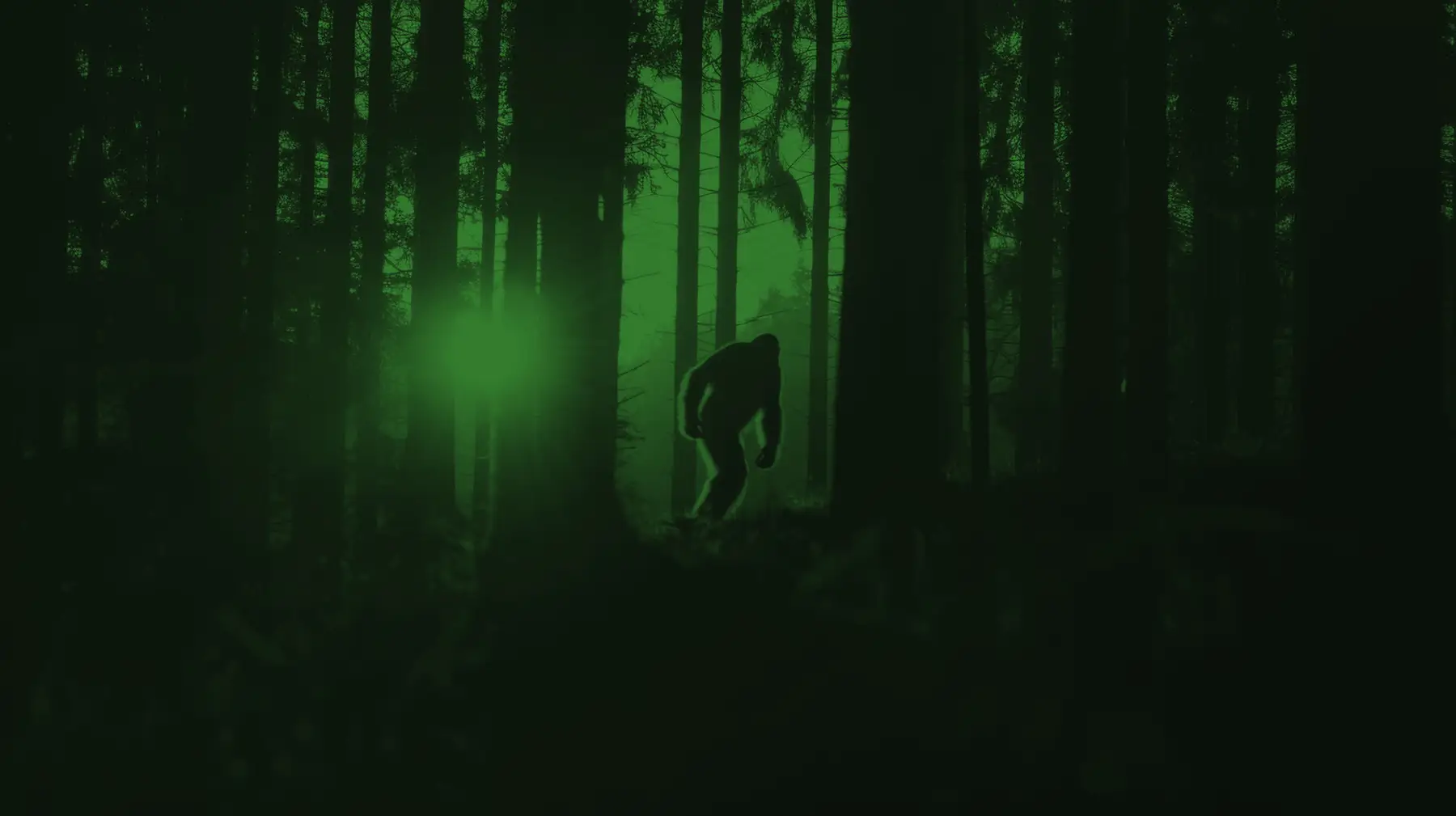
Case file 131Cryptids & MonstersThe 1800s

Gorillas in the Myth

Until 1847, gorillas were a legend like Bigfoot. Then came pickled carcasses, orphaned babies in zoos, and Colo, the first gorilla born in captivity.

Nov 8, 20251h 14m
00:00 / 1:14:21
Or listen to this episode onApple PodcastsSpotifyYouTube
Share this episode

In this episode

  • Why a missionary doctor stuck on the Gabon River ended up paying a fortune for bones he'd never seen walking around
  • Pickled gorillas, and what happened when somebody finally opened the barrel
  • The breakfast menu that finally kept a baby gorilla alive in Philadelphia
  • Warren Dean Thomas, the grad student whose morning at the Columbus Zoo took a turn he never saw coming
  • 321,000 gorillas left on Earth, and the very modern profession that outnumbers them four to one

“Once they were cryptids, then they were curiosities and now they’re in danger of dying out forever.”

The story

In 1847, the gorilla was a creature of legend, as believable as Bigfoot. Stories told of furred men deep in Africa, eight-foot monsters with human-sounding howls and impossible strength. Then a missionary doctor spotted a strange skull on a colleague's shelf, and within a few years the monster had become a trophy, a sideshow and a dead body in a barrel.

A skull on the shelf

Thomas Savage was a Yale-trained missionary doctor who had spent years in Africa. He collected insects and nature samples to ship home, even after malaria killed his first wife, Susan. In 1847, sailing home from Liberia, he got stuck for at least a month on the Gabon River. So he stayed with a fellow missionary, Reverend John L. Wilson, whose taste in decorating ran to oddities.

One of those oddities was a skull too big to belong to a chimpanzee, and Savage would know, having coauthored a paper on chimps with the Harvard anatomist Jeffries Wyman. This skull had enormous eye sockets, a bony ridge across the top like a mohawk, and a broad shelf at the back that looked built to anchor massive neck and jaw muscles.

Local hunters had the answers. They told Savage the animals lived in groups, each ruled by a single male, and that the old ones turned silvery gray. Savage never laid eyes on a living gorilla, yet his descriptions came out remarkably accurate. Word got around that he was buying, a bidding war broke out over gorilla bones, and he finally paid $25, a fortune for a poor missionary, for skulls and bones from two males and two females. Wyman bought the bones from him so he could get his money back and suggested the name Gorilla. A years-long fight over credit followed, after a British anatomist published the first description. Wyman's own journal eventually settled it in favor of Savage and Wilson.

Pickled, as in pickled

The early science was mostly melodrama. Gorillas were described as a race of troglodytes, "hairy cavemen, basically," and as "a libelous caricature of mankind." Hunters killed them without a second thought. One account from 1859 describes a mother gorilla cornered with her baby: "she waved her arm as if to beseech for mercy. But it was in vain, for a bullet was sent through her heart." The young one was wounded and captured.

Live gorillas rarely survived. They caught respiratory diseases, and the few that lived through the voyage to Europe often died within days of reaching port. The first live gorilla shipped to the United States, in 1897, died four days after it arrived. So people mostly saw them pickled: hunters crammed carcasses into huge casks of spirits, and the stench when the barrels were opened was said to be "strong enough to make a sailor's eyes bleed." Crowds paid anyway.

The survivors mostly made the news in their own obituaries. Dinah of the Bronx Zoo died in 1915: "Possibly it was loneliness, longing for a companion of her species." John Daniel, sold to the Barnum and Bailey Circus, pined in New York until doctors concluded "The gorilla died of a broken heart." A Pittsburgh paper called him "almost human." They were so close to getting it.

Babies without mothers

In 1928, the Philadelphia Zoo paid $6,000 for Bamboo, a year-old infant whose mother had been killed with a poisoned arrow. No insurer would write more than a one-month policy on him. Zoo director C. Emerson Brown gambled anyway: "If we can keep him alive for some years, he'll become invaluable." Bamboo squealed and tugged at his keeper's clothes whenever he was set down. "He has learned to pull a blanket over himself before he turns into sleep."

Why kill the mothers at all? William T. Hornaday, director of the New York Zoo, explained that adults could never be kept alive: "Only young specimens under two years of age can be captured and civilized." Nobody seems to have asked whether killing the mothers was the problem.

Bamboo pulled through on buttermilk, cod liver oil, zwieback crackers, fruit and all the lettuce he wanted, and grew into a handsome adult. N'Gi wasn't so lucky. A collector took him from his mother, raised him for two years in a private home in Trenton, New Jersey, and the National Zoo bought him with money from Walter Chrysler. At the zoo, N'Gi caught a cold that turned into pneumonia, and in 1932 he died. That he'd thrived with one devoted caregiver and died once he was put on display apparently "didn't trigger a single epiphany."

The weird part

The gorilla was a cryptid, as make-believe as Bigfoot, until 1847. Its first stop after becoming real was a cask of liquor, where hunters pickled the dead bodies so crowds could pay to see them.

A Christmas miracle in Columbus

It took more than a century after Savage's skull for a gorilla to be born in captivity. Colo arrived on December 22, 1956, at the Columbus Zoo in Ohio, weighing four and a half pounds. Warren Dean Thomas, an Ohio State zoology grad student, found her, carried her to the kitchen, cleared her mouth, and when she caught her breath and then lost it, gave her mouth-to-mouth. You just never know how your day is going to go.

"If she can go four days, I think we'll have it made," said superintendent Earl F. Davis. Researchers found she developed about twice as fast as human babies. By 1958, Davis said she thought she was human: "She regards her own parents as a couple of odd characters." Meanwhile her mother, Christina, kept trying to push food to her through the bars. When psychiatric testers declared Colo intellectually impaired, Davis fired back: "She's outwitted us time and time again."

Colo had three offspring with a male named Bongo, helped raise two of her grandchildren, and in 2016 celebrated her 60th birthday with squash-and-beet cake and cornbread frosted with mashed potatoes. Three and a half weeks later, after a day of being admired by more than 13,000 visitors, she was found dead in her enclosure.

Fewer gorillas than influencers

Roughly 321,000 gorillas are left in the wild, and there are four times as many social media influencers. Fewer than 300 Cross River gorillas remain. Mountain gorillas were down to 240 when Dian Fossey declared war on poachers. She was hacked to death with a machete in Rwanda the day after Christmas 1985, and the case remains unsolved.

Gorillas went from mythic monster to curiosity to endangered species in a historical eyeblink. Now picture a giant, hairy, shy ape that roars through the forest and protects its young in groups, somewhere in America's millions of acres of wild land. If Bigfoot turns up, maybe we'll do better this time. Or maybe Bigfoot is safer staying unfound.

The transcript

Chapters & full transcript10,527 words
Chapters
  1. 01:02Monsters that turned out to be real
  2. 03:34The skull on the shelf
  3. 12:17Pickled gorillas and broken hearts
  4. 14:50Bamboo and the orphans
  5. 28:28Colo, the Christmas miracle
  6. 41:05If Bigfoot turns up

This transcript was generated automatically from the episode audio and may contain errors. Times are approximate, since ad breaks can shift them by a minute or two.

00:00

Hey true weirdos, we owe you a big thanks. Because of you, we won two W3 awards for Best History Podcast and Best Host for the episode Cokie and Lucky. And we've won three Signal Awards, and I'm really excited about these, for the episode Doomsday Clock. We won silver for Best History Episode. We won silver for Best Craft Editing and Production. And Max also won a Listener's Choice Signal Award for his outstanding work on Doomsday Clock. His outstanding work on every episode, but that one was recognized.

00:33

None of this would be happening without you. We are so grateful for our community of listeners who come to this podcast every single week to hear these stories. We make it for you, we couldn't do it without you. We hope you'll stick around after the episode, because there's more to the story. Bonus content and conversation.

00:54

Welcome to You're Making It Up, the game show for people who no one believes. Our first category is, I Saw It In The Woods. Are you ready to play? I'm so ready, I've done my research. It's a monstrous beast with the head of a fox, the hands of a man, the tail of a monkey, and a bag it uses to carry its young. What is a kangaroo?

01:27

Name a giant lizard that fearlessly hunts human beings and can transform like magic into a saltwater crocodile. What is a Komodo dragon? They say it's a ferocious eight-foot-tall human-shaped monster inhabited by the spirit of a dead warrior, and it's impossible to kill. What is a gorilla? Great job! Three for three. And you know what they all have in common?

02:04

Once upon a time, these creatures were the stuff of men. They were cryptids like Bigfoot, the Loch Ness Monster, or the Chupacabra. And they got a small game of light again. Today, it seems silly to think that our ancestors once believed that that kangaroo, the Komodo dragon, and the gorilla weren't real animals. Just like, you know, maybe it'll seem silly to our descendants that we once believed that aliens came from outer space and not the deepest parts of Earth's oceans where they've been living for countless millennia. Longer than Homo sapiens. It could so happen that way. After all, we thought gorillas were make-believe up until the same year that the first postage stamp was sold.

03:15

The year the first ring-shaped doughnut was invented. And look, there's little Buffalo Bill Cody blowing out the candles on his first birthday cake just in time for gorillas to be discovered. In historical terms, that all happened about a minute ago. We have a missionary doctor from Yale named Thomas Savage, and a Harvard anatomist named Jeffreys Wyman, and a Reverend John L. Wilson, whose taste in decorating ran to oddities and curiosities, to thank for the discovery of the gorilla. Savage spent many years in Africa. His pastoral and medical work intertwined with his passion for nature. He studied insects and collected samples to ship home. And even after malaria took the life of his first wife, Susan, Savage's faith never wavered. And his obsession with the flora and fauna of Africa never lessened. In 1847, Savage was sailing home to the United States from Liberia. He barely got and settled aboard ship when he found himself detained. Unexpectedly stuck. Delayed for at least a month on the Gabon River. Luckily for Savage, he had a colleague, a fellow missionary named Reverend John L. Wilson, who lived nearby.

04:40

Wilson's home was decorated with all sorts of local curiosities. One in particular caught John Savage's eye. It was a skull, but it was unlike any skull Savage had ever seen. Too large to be a chimpanzee, and Savage would know. Because four years earlier, he'd partnered with anatomist Jeffries Wyman on a paper about the chimpanzee. And this skull wasn't just too large. It was all wrong. The eye sockets were enormous. There was a bony ridge running across the top like a mohawk. On the back of the skull ran a large, broad shelf. That, thought Savage, seemed to offer an anchor point for enormous and powerful neck and jaw muscles. Now, Reverend Wilson wouldn't much help. But the local hunters? Thomas Savage went looking for answers there. For the hunters, this was no mystery. They told Savage that the skull belonged to a monkey-like animal, but of a size and strength no monkey could match. Savage had questions for locals, and their answers convinced him that the skull belonged to an entirely new, as-yet-unknown species of orang. That was a catch-all term they used for any great ape. Savage must have had mad interview skills and a most trustworthy demeanor. Because instead of filling his head with wild fables and legends, the hunters told him what they knew. They described how the animal behaved, and told Savage that the creatures lived in groups, each of which was dominated by a single male. And oh yeah, the old ones? You can tell they're old because of the way their coat turns silvery gray.

06:40

Given that Thomas Savage himself never slapped even one of his eyeballs on a real live gorilla, his descriptions of them are surprisingly accurate. Word quickly got around Gabon that the missionary doctor staying with Reverend Wilson was in the market for specimens. Next thing you know, there's a bidding war for gorilla bones.

07:36

Because while Thomas Savage might have been collecting for science, others cared only about profits. Eventually, for the price of $25, which was a fortune back then, especially for a poor missionary doctor, Reverend Wilson coaxed the hunter into providing Savage with a few skulls and an assortment of other bones from two males and two females of this new species of ape. This is where Jeffries Wyman comes in. Savage wanted to donate the bones to Boston Society of Natural History, but desperately needed to recoup his investment. So Wyman paid for the bones and suggested that the new discovery be named Gorilla. What followed was a years long battle over who got to claim credit for the discovery. Wyman was like, it's all your Savage.

08:29

And Savage was like, Oh, I'm so modest. I don't care if I get the credit. Not true. Then British anatomist Richard Owens published the first description of the gorilla, suggesting it be called the troglodytes savage. The Savage being a nod to Thomas Savage. Jeffries Wyman politely stayed silent. But it was his own journal that later proved that it was Thomas Savage and Reverend Wilson who deserved credit for bringing this new species of ape to the world's attention, not Richard Owens. And so Gorilla it was. And gorillas were woefully misunderstood in those days. For starters, they were first described as being a race of troglodytes, hairy cavemen, basically. These creatures are exaggerated monkeys and combine the cunning and nimbleness of the tribe with the muscular power of at least three prize fighters. They eat fruit but are furnished with very long and sharp mandibles like a squirrel or woodchuck and could probably tear flesh as easily as a tiger. Dramatic, but they weren't even half right as to the strength of an adult gorilla.

09:43

A fully grown silverback can bench press 4000 pounds and all gorillas have jaws with a bite force double that of a lion about 1300 pounds per square inch. The general appearance of a gorilla is that of a libelous caricature of mankind. Some skeletons of the species would be easily mistaken on casual inspection for the framework of deformed human beings. People back then they viewed animals differently than many of us do today. The phrase animal welfare never even appeared in a scholarly paper until 1983 1983. The year Cindy Lauper burst onto the scene, the year Bob Ross started painting happy little trees on TV. Toto's Africa was the number one song in the country. It's not that long ago at all. And at the time of the discovery of the gorilla, people spoke of animal suffering with an almost casual indifference. The first laws protecting animals from cruelty in Great Britain weren't passed until 1876. That's nearly 30 years after Thomas Savage shipped his gorilla skulls back to Boston. And in this country, it wasn't until 1966 that President Johnson signed the Animal Welfare Act into law. Try to keep that in mind when you hear a story like this one from 1859. The gorilla exhibits a strong attachment to its young as an instance of which it was mentioned that a female and her two young ones having been seen in a tree, she snatched one up and ran with it into the woods and then returned to fetch the other.

11:29

Her retreat had, in the meantime, been cut off. And when the gun was leveled at her, as she held her young one to her breast, she waved her arm as if to beseech for mercy. But it was in vain, for a bullet was sent through her heart and the young one was wounded and captured. The tragedy of capturing gorillas was compounded by how poorly they fared under human care. They were vulnerable to respiratory diseases. The few that managed to survive the long sea voyages to Europe often died within days of coming to port. It took until 1897 to ship a live gorilla the vast distance to the United States. And that animal died just four days after arriving. Far more common in those early days were pickled gorillas. Pickled, as in pickled. Hunters would shoot gorillas and then cram their carcasses into these huge casks filled with spirits. They say the stench coming off these barrels once they were opened was strong enough to make a sailor's eyes bleed. But the novelty of the creature made it all worth it. People would pay for a chance to see these giant human-like monsters that had been creatures of myth a decade earlier the way we would pay to see an honest to God Bigfoot or Loch Ness monster carcass. With gorillas doing so poorly in captivity, the pickled version was the only version many people would ever see. The few live gorillas that managed to survive the ocean crossing to the U.S. did so only to become the subject of their own obituary.

13:13

Like Dinah in 1915. Dinah of the Bronx Zoo, the only gorilla in this country, is no more. She died Sunday. Exactly what caused her end cannot be said. Possibly it was loneliness, longing for a companion of her species. She never seemed able to thrive upon the food she got in this country. Certainly she was not sad over a captivity, for Dinah was scarcely a captive. She was more of a pet, almost like a child to the keepers. And poor Casey in 1917. Casey died here in Tampa following an operation for appendicitis. His brain will be dissected in the interest of science. Casey was a United States died today of pneumonia in his private room at Madison Square Garden, where he was appearing with a circus. John Daniel was four years old when he died. He was captured in the Congo and sold to the Barnum and Bailey Circus. When he arrived in New York, he began to pine and refused to take interest in anything. Doctors were called in and declared that he was because he considered himself friendless and alone. The gorilla died of a broken heart.

14:39

The headline that ran in one Pittsburgh paper called Gorilla John Daniel, quote, almost human. It's like people of the past. You're so close to getting it. Which brings us to Bamboo, the first baby gorilla to survive in an American zoo for any real length of time. Bamboo came to the US in 1928. The tale of his capture was pure European colonialism packaged and romanticized for the entertainment of the masses. It oozed with drama and the mystique of the African continent, teeming with exotic and savage mysteries. In the lush highlands where gorillas dwell, lived a race of dwarves who were rated the best elephant hunters in the world.

15:25

They use poison arrows in their sport of hunting. Big game. It was such a hunter who killed Bamboo's mother with a venom tipped arrow. The suckling babe found at her stilled breast was fetched by the hunter to a witch doctor. The witch doctor crooned over the infant as though it were human. Strange words, strange sounds. Yet the witch doctor seemed unsure of her own magic and so curried favor with a group of missionaries passing through. Those white men brought the captive by slow stages to the coast and from there departed across the sea to a fate unknown.

16:12

Bamboo's home in the new world was to be the very first zoo in the United States, the Philadelphia Zoo, which had been in operation for 54 years when Bamboo arrived. Bamboo, the baby gorilla, has begun his melancholy life at the Philadelphia Zoo. Robbed of his mother by the poisoned arrow of a black dwarf in the highlands of Central Africa, this year-old infant just spent his forlorn days in a 10-foot cell. Casual cruelty? Check.

16:45

Casual racism? Check. Casual random use of the word dwarf just to keep the whole dark continent mystique going to sell some newspapers? Check. So far as known, he is the only living specimen of his kind in America. He has been given one of his anthropoid cousins, a chimpanzee, for company. But whether her companionship will keep him alive is a doubtful speculation. No insurance company would write more than a single month policy for Bamboo, and only the Philadelphia Zoo was willing to take a gamble on the little gorilla.

17:23

The zoo paid $6,000. That's close to $114,000 today. But the zoo's director, C. Emerson Brown, believed it was a risk worth taking. If we can keep him alive for some years, he'll become invaluable. Crowds are already thronging to the monkey house, and it'll not be long before he will repay the zoo for its investment. Brown went on to describe Bamboo, and it's more than a little heartbreaking. He lives mainly on milk now, and gets an occasional egg, too.

17:59

We let him eat whenever he's hungry. He has a language and a grammar of which we do not understand, but his grimaces make themselves perfectly clear. He likes to be held in the keeper's arms, and when he's dropped to the floor, he squeals and pulls at the man's clothes until he's taken up in arms again. Because he was a baby, ripped from his mother's arms as she died.

18:29

A baby! A full-grown male gorilla is a dangerous animal, but the Infinite is an affectionate and somewhat pathetic creature. He has learned to pull a blanket over himself before he turns into sleep. Don't scream. Not only did the people of the past not know any better, they can't hear you. They often couldn't even hear themselves. We're that way, too. We're just not the people of the past yet. Bamboo's eyes are strikingly human. They are large and brilliant, and have a far greater appeal to human sympathy than the eyes of the other primates.

19:22

But why kill the mother, you might be screaming? Why not take them both, if you have to take them at all? Or drug them, knock them out, but don't kill them. William T. Hornaday, the director of the New York Zoo, offered this explanation. There is no reason to hope that an adult gorilla, either male or female, ever will be seen living in a zoological park or garden.

19:46

Large specimens cannot be caught alive in a condition long enough to survive. The savage and implacable nature of the animal is against it. Only young specimens under two years of age can be captured and civilized. And even when a specimen has been so taken and settled down, it is likely to die overnight and from no understandable cause.

20:07

Let me just answer the question. No. Apparently, at no time did anyone say, hey, maybe we shouldn't keep killing adult gorillas and taking their young only to watch the babies die. Bamboo somehow survived. And two years later, the director of the Philadelphia Zoo announced that they had at long last landed on the diet to help a baby gorilla in captivity thrive.

20:33

Buttermilk, cod liver oil and Zweibach crackers, oranges, bananas and all the lettuce he will eat. Apples and a slice of bread with a little honey. Philadelphia Zoo is definitely doing something right. Bamboo survived and grew into maturity. Photos of his handsome face gracing newspaper pages all around the country in 1930 as he what was believed to be his fourth birthday. Five years later, the Washington Herald ran this story.

21:08

Bamboo enjoys the distinction of being one of the most human looking members of his dangerous and powerful breed ever seen in captivity or out of it. The muscular development beneath his pelt is strikingly manlike. And more than one youngster gazing Popeye to Bamboo through the stout bars of his cage has wondered if he wasn't seeing a Tarzan in the flesh.

21:30

Bamboo was remarkable. His gorilla brethren, not so much like N'Gi in 1932. N'Gi, a six year old gorilla at the National Zoo in Washington, one of the few of its kind in captivity, caught a cold which soon developed into pneumonia, suffered a setback and his heart stopped beating despite emergency injections of adrenaline and strychnine. This heartfelt little obituary also included the story of how N'Gi had come to live at the Washington Zoo. Like Bamboo, he'd been taken as a baby and she was just a few months old when a hunter and wild game collector named J.F. Buck set his sights on him. Buck, aided by a tribe of pygmies, followed a group of gorillas through the jungle for several days until the great apes became accustomed to the presence of men and grew careless. Finally, a female, N'Gi's mother, dropped behind with her infant and was shot by a poisoned arrow. Buck secured the young gorilla and taught it to drink milk from a bottle. Buck brought the baby gorilla to the States and spent the next two years caring for it at his home in Trenton. Eventually, the National Zoo acquired N'Gi with money donated by Walter Kreisler, as in Kreisler Automotive. The fact that N'Gi had thrived in Trenton, New Jersey in a private home with a dedicated caregiver only to fall sick and die once installed at the zoo apparently didn't trigger a single epiphany. It seems that no one, absolutely no one, looked at the whole gorilla problem and thought, hmm, what if gorillas, like humans, are social animals who live in families and require nurture to thrive? What if it's not the climate or the food that they can't adapt to? What if it's being ripped away from their family group that they can't adapt to?

23:39

Left to their own in the wild, gorillas can live roughly 35 years. They're peaceful and intelligent animals, vegetarians, though some species might occasionally munch on an ant or a termite nest. Gorillas do have to keep an eye out for predators like crocodiles and leopards, but there's really only one living creature that's a threat to the gorilla.

24:02

Us. There are two different species of gorilla, the western gorilla and the eastern gorilla. Each of those species has two subspecies. Western lowland gorillas, like baby bamboo, they tend toward larger and more complex social groups. Western lowland gorillas are also the most abundant in the wild with a population of about 300,000 animals, but that number doesn't tell the whole story. Their natural habitat is shrinking and their slow rate of reproduction doesn't bode well for the future. As for the other subspecies of western gorilla, the cross river gorilla, they're almost gone from this world. Fewer than 300 are left in the wild and extinction is an imminent possibility. Now the wild population of the eastern lowland gorilla has decreased by more than 77 percent since the mid-1990s, mostly due to human activity encroaching on their habitat. The mountain gorilla is a subspecies of the eastern gorilla, one that nearly vanished from earth. There were only 240 mountain gorillas left in the wild when primatologist Dian Fossey took up her life's work in gorilla conservation. Fossey declared war on the poaching of mountain gorillas, their bodies taken for bushmeat, body parts sold for traditional medicine, skulls and bones and hands hacked off for collectors. Dian Fossey was murdered one day after Christmas 1985 in her cabin in the mountains of Rwanda, hacked to death with a machete, presumably in retaliation for her fight against gorilla poachers. The case remains unsolved to this day.

25:44

Add up all species of gorillas left in the wild today and you come up with roughly 321,000 animals. To put that number into perspective, there are four times as many American high school kids participating in marching band as there are gorillas on earth. There are four times as many social media influencers as there are gorillas on earth. Heck, there are probably twice as many costumes in the world than there are real gorillas. And of course this isn't now. We know all of this now. Back then, back when hunters were pickling gorillas in barrels of whiskey and hacking off their hands and feet as souvenirs, no one gave any thought to protecting or conserving them.

26:30

Gorillas went straight from being mythic monsters a la Bigfoot to trophies and curiosities in the blink of an eye. Gorilla babies stick very close to their mothers for the first eight months or so of life and then stay in tight proximity for the next several years. Although paternity is generally unknown in wild troops, mature male gorillas participate in caring for and helping to socialize the young. Data collected over six years of study of gorillas in the that look a lot like human extended families. Mountain gorillas live in smaller groups, typically dominated by a single male silverback. All of the early legends and myths about the hairy giant troglodytes in deepest Africa got almost everything wrong. Unfortunately, those myths and legends blinded humans of the time to the facts of the real animal that was right in front of them.

27:36

The fragility of orphaned young gorillas in captivity was obvious to those early 20th century zookeepers and hunters and even the general public. The cause of that fragility, though, well, it seems they never quite saw it, never grasped the complex social bonds operating in a troop of gorillas. They didn't know and didn't seem to be in any way curious as to the relationships between gorillas, between mothers and their young. There's no thought given to the possibility that these great apes might be intelligent and aware, sentient, that they were not merely beasts, huge, dangerous and terrifying, but no match for a hunter's bullet.

28:28

It took more than a hundred years from Thomas Savage's discovery of the gorilla for Colo to be born. It was December 22nd, 1956, at the Columbus Zoo in Ohio. Colo, a western lowland gorilla, was the first ever to be born in captivity and that made Colo a real Christmas miracle. She weighed just four and a half pounds. Her parents, Christina and Baron, had been captured separately and were brought to the Columbus Zoo five years earlier in 1951. The premature infant was under the 24-hour watch of attendants who fed her a bottle and cared for her just like a human baby. If she can go four days, I think we'll have it made, said zoo superintendent Earl F. Davis.

29:16

Every single detail about Colo was thought to be a novelty. Earl Davis said that the gestation period for the pregnancy was just 250 days, which seemed short to him, and Colo's birth weight seemed low. But since Colo was unique in the history of the world, there wasn't anything to compare her to. What Davis didn't know was that Colo was perfectly typical. Gorillas are pregnant for around 257 days. Average birth weights range from three to five pounds. Baby gorillas have a high mortality rate in the wild. Forty percent of all newborns die. And in the wild, Colo would have likely suffered that same fate. But at the Columbus Zoo, Colo had an unexpected savior who whisked Colo from the floor of her mother's enclosure straight to an improvised incubator.

30:09

The birth was discovered by Warren Dean Thomas, a graduate student in zoology at Ohio State University. Thomas took the embryonic sack containing the newborn gorilla to the kitchen, where he removed the sack. Removing the mucus plug from the mouth, he tried to stimulate breathing by slapping it on the back. When it caught its breath and then lost it, Thomas breathed into its mouth, since carbon dioxide is a stimulant for respiration. Grad student Warren Dean Thomas woke up that morning never dreaming that he'd be giving mouth to mouth to the first baby gorilla born in captivity in history. You just never know how your day is going to go. But thanks to his quick thinking, Colo survived. At seven weeks, Colo had gained a couple of pounds, grown two new teeth, was eating baby formula supplemented with rice cereal. She was still in her incubator. Zoo officials feared that her parents might harm her if she were to be placed with either of them.

31:10

The sad truth there is that gorillas in captivity never learn how to parent. Just one more tragic consequence is severing the social ties that these animals depend on for their survival. Colo's development was also being studied for insights into human infant development. Colo is proving to be a particular goldmine for a famous husband and wife psychiatric team. Dr. Benjamin Passamanek and Dr. Hilda Kobloch, formerly members of Yale University's Child Guidance Clinic, in crude terms, they place Colo's motor behavior at a level equal to human babies twice her age.

31:55

There were big questions swirling around this study of Colo. How do the larger primates compare with each other? Which of these primate cousins is closer to human? How many ways was Colo capable of learning and could Colo unlearn any of her gorilla ways? After 18 months of study, the team reported that baby gorillas developed about twice as fast as human infants when it came to sitting, toddling, walking, and standing. And that despite clear-cut and obvious differences from human development, the simple truth was that the similarities between the species were far, far greater than the differences. In 1958, the director of the Columbus Zoo said that Colo thought she was human. Other gorillas are just plain gorillas to her.

32:50

She regards her own parents as a couple of odd characters, said Earl Davis, zoo superintendent. We've got five nurses for her and she cries when they leave the room. Aw, so sweet. And at the same time, so horrific. Davis went on to say that while Colo had no particular feeling for either of her parents, her mother, Christina, seemed fixated on the youngster and was always trying to offer her food through the bars of her cage.

33:22

If that doesn't hurt your heart, you might not have a heart at all. Superintendent Davis was insanely protective of Colo. When in 1959, Dr. Passamanic and Dr. Koblok announced that Colo was, quote, somewhat mentally retarded, close quote, Davis blew a chip. In a letter published in the Columbus Zoo's magazine, Davis furiously denied that Colo had any intellectual impairment. She's outwitted us time and time again, he said. Davis contends the scientist should have consulted the zoo staff instead of depending on psychiatric tests for their conclusions. He said that gorillas are shy, not responsive to strangers, and that the tests given to Colo involving extensive paraphernalia were sometimes administered when she was already tired from play. All our efforts were bent to raise a good, healthy gorilla, Davis asserted, and she is.

34:26

Thank you, Superintendent Davis. And also, folks, pick a lane. If you're going to capture gorillas by killing them and stealing their babies, treating them like dumb, insensate animals, then you don't get to later apply human standards of behavior to them and decide that they're intellectually impaired. Because that's gross and appalling and really bad science.

34:50

When Colo was two, the zoo introduced her to Bongo, a 19-month-old male gorilla from Africa. It was love, or whatever gorillas call it. The first of their three offspring was born in 1968. A contest to pick a name was held for local schoolchildren, and 10-year-old Denise Given was the winner. The baby gorilla would be called Emmy, in honor of Columbus Mayor M.E. Sensenbrenner.

35:17

This little Denise thought he was a good mayor who liked children and animals. Could you just about die from the wholesomeness? Then, Emmy gained a brother named Oscar the following year, and then a sister in 1971 named Tony. Colo didn't raise her own children. That was a job for the zookeepers and veterinarians. But Colo eventually became a grandparent and raised two of her own grandchildren.

35:43

She became the oldest living gorilla in captivity in 2008, and went on to celebrate her 60th birthday in 2016. By that point, she had 16 grandchildren, 12 great-grandchildren, and three great-great grandchildren. Colo was the miracle who just kept going, living proof of the progress that had been by zoos toward conserving her kind. At 60, she'd already lived decades beyond her life expectancy.

36:17

Hundreds gathered at the zoo to celebrate Colo's big birthday. Her enclosure was decorated with brightly colored construction paper chains. She had a couple of kinds of birthday cake to choose from, squash and beet, and even cornbread frosted with mashed potatoes and decorated with parsley. Happy birthday to you, happy birthday to you, happy birthday dear Colo, happy birthday to you.

36:56

Colo has sent shockwaves through the field of gorilla conservation since the day she was born. Columbus Zoo President and CEO Tom Stauf said, before her, a gorilla had never been born in a zoo, and before her, so much less was known about gorilla care and welfare. They say that elderly people will sometimes hold on to life, waiting to clear a big milestone, birthday or holiday, and then die soon after. Maybe that was Colo's plan too.

37:32

Just three and a half weeks after her 60th birthday party at her zoo home, Colo passed away. Her keeper found her dead in her enclosure on a gray and cold Tuesday morning. The first of her kind born in captivity, the oldest known member of her species at the time of her death. She'd spent her last day on earth being admired by the more than 13,000 visitors who'd come to the zoo that day, Martin Luther King Day. Schoolchildren crowded the glass, waving at Colo and calling her name. Colo showed no signs of being unwell. She was her usual self, her deep brown eyes meeting the gaze of her visitors, her thoughts unknowable.

38:19

We share over 98% of our DNA with the gorilla, proving Charles Darwin right when he theorized that human beings are closer from an evolutionary standpoint to the great apes than to anything else. Humans and gorillas both have unique fingerprints and opposable thumbs. Gorilla young are bonded to their mothers like human infants, and their slow growth and development to maturity mirrors our own. It's not hard to understand why early European explorers on the African continent mistook the gorilla for some kind of hairy and powerful tribe of people.

38:56

The furred men, they called them, ferocious man-eating monsters with human sounding howls and unthinkable fruit strength. The reality of the gorilla, peaceful and social, intelligent users of tools, protective of their young. It took us humans a long time to comprehend that. Though, the very first King Kong did give us the story of a giant ape with extraordinary strength and fury, who at the same time was noble and protective and capable of love.

39:33

It's almost like deep, deep down on some subconscious level, we always knew that the we called a monster was more like us than not. Some scary video from the San Diego Zoo shows the moment a gorilla sprinted towards the viewing glass and cracked a thick pane of glass right in front of visitors. The zoo said this 10-year-old western lowland gorilla named Denny damaged one layer of a three-layered tempered glass panel. Denny wasn't injured but will now be cared for behind the scenes until the panel is replaced. That happened on October 13th, 2025. It's far from the first time a gorilla has reacted negatively to spectators. Zoo life may be the only life most of these animals have ever known but it's still an unnatural life and as living beings they are in immune distress, fatigue and the frustrations that come with being watched, hollered at and like this gorilla at the Dallas Zoo who'd had enough and lunged at the glass like a melodramatic Hollywood villain.

40:58

Once they were cryptids, then they were curiosities and now they're in danger of dying out forever. It makes you wonder just what we would do, how we'd behave if another of our mythical and legendary creatures was proven to be real. Like maybe that great North American ape, the Sasquatch, Yeti, Bigfoot. The sightings and stories have a familiar ring, a giant hairy man like beast bashful of humans, a deep growling roar that echoes through the trees and makes the back of your neck stand up. Sometimes spot it traveling in groups, the adults encircling the young. We've heard all of this before. Yes, you say yes but it's different now. The African continent is huge and back when people thought gorillas were make-believe, that land was largely unexplored. This is the United States of America in 2025. We have interstate highways and electricity and a gazillion people everywhere. We know everything there is to know. We found everything there is to find. We're done with all that. But you know what? Actually, we don't know everything.

42:15

We haven't found everything and we aren't anywhere close to being done with all that. There are at least 15 million or more acres of federal and state-owned undeveloped and forests and valleys and canyons, uninhabited lands stretching for miles. Next time you're on a cross-country flight, open the window and have a look below at the vastness that is America.

42:47

Of course, with some of our public lands now being tossed to the greedy wolves for drilling and fracking and exploitation of our precious natural resources, there's always the chance that we'll just sort of stumble into our first encounter with everyone's favorite forest cryptid. Now hopefully we've learned from our mistakes with the gorilla and this time we'll do better.

43:11

And if we haven't learned, which would be right on brand for people, wouldn't it? Then maybe we'll get eaten or captured and put on display at the Sasquatch Zoo. Next time on True Weird Stuff. He was the biggest star in Hollywood until one wild weekend at a hotel in San Francisco. To this day, no one knows the truth of what really went down in that room.

43:45

A woman died, a career was ended, and the movie business was never ever the same. The fall of fatty on the next True Weird Stuff. Special thanks to our voice talents on this episode, Erin Cox, Sam Moore and Don Morgan. I know I've said this before on an episode of True Weird Stuff, but what is striking is how recent our discovery of the gorillas are and how recent our understanding of how they socialize and how they interact with one another. All of these things, that's really not all that long ago. It's not. I mean, they were mythical until a minute ago. And there's something here, people, that we need as meat creatures, ourselves as mammals, we need to hang on to. Are you ready? They were an unknown mythical creature and then we discovered them and we've been just killing them at such a clip that they're nearly gone in a blink of an eye. You really think that as human beings, you think homo sapiens is immune to those same forces that can render an entire species extinct? Do you really think we're special?

45:05

Because we're not. We are as dependent on each other, on our environment, on our food supply, on our safety as the gorillas. There's no difference here, not really. And as we degrade our physical environment, as we plow over cornfields for data centers, we have to ask ourselves, well, what were we thinking we were going to eat?

45:32

What were we thinking we were going to eat when drought made it impossible to grow food and when farmland was co-opted by AI? What do you think is going to happen? Do you think that the sky will part like a set of drapes opening up and God will stick his face down and go, all right, that's enough of this craziness. Y'all are nearly killing each other. We should be learning from the mistakes that we've made with other living things and we kind of really don't. And I want to say for all of my fellow open-minded believers who are like, look, I don't know if there's any such thing as a Bigfoot or a chupacabra, but I'm here for it if you find one. The people who thought gorillas were make-believe, they were every bit as mocked as you are. They really were. Nobody took them seriously either until they had no choice. And there's so many things in this story that make you just go, okay, wait, they did what? Like pickling whole dead gorillas in barrels of booze?

46:41

I mean, that was horrifying. The other thing that was really horrifying is their treatment of the gorillas when they had them in the zoos, when they first would get them, reminded me of my treatment of tent worms or the box turtle, which I found in the wild, put in a shoebox and then poked holes in the top for air. I had no earthly idea how to care for it, but I felt like it needed air.

47:07

That was, that was, then I was like, what do you, what do you feed it? But they, they seem to have no idea that these were social creatures who relied on that social interaction for their very survival and how to pick up cues on, like you were saying about the being able to parent. It, it seems cruel and it seems short-sighted that they didn't understand that.

47:35

There were so many things in this that were just heartbreaking for me. Like I really struggled. I was in my feelings a lot because, and I give grace to the people of the past because they are the people of the past. They were living in a different time with different, everything, different understanding of the natural world, different beliefs about the role that they occupied in society. You know, I give them some grace, but they're stalking these gorilla troops and they know, they have learned that they can't bring the adults. So they need the babies.

48:13

And the only way to get the babies is to get the mother pulled, separated enough from the They knew that. Their own words. This is why I try so hard to find the actual people saying the actual things so that you don't think I'm just like, Oh, here she, this lefty rainbow animal lovers has an agenda. I look for people's actual words and the hunter in this story saying the mother holding her arms as if beseeching for mercy. That's the hunter saying that not me. Now, how do you, how do you hear that? And, and give them all the grace of they just didn't know they did know. They may not have known to the degree of sophistication that those of us who've grown up with PBS and you know, Nat Geo do. And Diane, the amazing Dian Fossey, they may not have known to the degree that schoolchildren today know about the social makeup of guerrilla troops, but they could see with their eyes that that was a mother protecting her young and they killed her. So when you think about some of the stuff that's been in the news just recently, there have been a number of incidents. We had a couple of them in the story, but there have been a number of incidents, like a good number of incidents of guerrillas kind of getting like hitting their breaking point in zoos, being taunted, having things thrown at them, being shouted at. And, and they react, you know, they charge the glass, they, they demonstrate their fatigue and their frustration. And there have also been and this isn't in the story. There have also been a number of really wild incidents where children have fallen into guerrilla enclosures at zoos. And the guerrillas have protected those children. I just watched a video of a child tumbled into the enclosure and the guerrilla picked up the child and hoisted it up so that the parents could get the child. I was watching this and I was going, I can't believe this. There was a, there was a famous gorilla, Coco, was that her name?

50:32

Coco. And I, I saw a video of Coco and Robin Williams and Robin Williams. Oh my gosh. Oh my God. When you see that, there's so many things I'm struck by. One is Robin Williams' ability to connect with anything, anyone. That was part of it. And the other thing is you realize that these are creatures who are a lot closer to us than you might want to recognize. That these creatures aren't sentient and that they do, and they are social and they, they have capacity for kindness and capacity for language. I mean, Coco had learned a sort of sign language. Yeah. Able to, to utilize. So I think that you realize that these are powerful, but majestic creatures that need to be protected at all costs.

51:34

So much of, um, so, you know, you, you have to like, guerrillas are not, you know, hairy versions of people as they were once thought to be. Guerrillas are their own separate, unique and species. Um, but they are the way that we have so badly misunderstood them. And as a result, have so badly mistreated them is something to feel grief about. And, you know, just, just to grieve because, but you know, the saying, when you know better, you do better. And we have tried to do better thanks to the extraordinary work of people like Dian Fossey, who was murdered by guerrilla poachers. And the fact that that case remains unsolved makes me insane. We, part of the reason that we're still losing guerrillas at such a clip isn't because of zoos. And it isn't because, you know, you took your kid to see a gorilla. We're losing them because their habitat is being disappeared. And they are being heavily poached. Um, in their native environment, like the mountain gorillas in Rwanda, you know, and it's against the law, but you know, criminals, the whole thing about being a criminal is you, you don't obey the law. So the fact that we have laws and, and protections in place doesn't help a gorilla that finds himself or herself, you know, facing a poacher. And there's all sorts of like, the, the meat they, you know, gorilla meat in some circles is thought to possess magical properties and all that bush, bush meat.

53:12

Well, of course, somebody, somebody, somebody's gonna capture the gorilla and then go, well, what can we do? Oh, let's say it has magical qualities. And yeah, we'll sell a lot of money, you know. Um, you know, for a long time, you couldn't, a poor gorilla couldn't dare stick its head out of the trees because there was such a demand, such a demand on the European continent for gorillas, for zoos and circuses and menageries. And of course, then eventually that came here as well. We, we took so long. Like when you hear it laid out, you know, fact after fact, after fact, you go, well, why wasn't it more obvious to people? Well, it wasn't. I mean, it took us so freaking long to go, you know what? Um, they, they don't survive in captivity. How many more are we going to kill before we agree that this isn't really, we can't bring wild gorillas into zoos, which was what made Colo such a remarkable and miraculous animal. And she was smart and, um, but there are things about Colo that are so tragic. You couldn't have gotten better care than she got at the Columbus Zoo. The veterinary team at Ohio State University is heavily involved in the Columbus Zoo.

54:33

That was where the graduate student that gave her mouth to mouth. Um, he was a grad student at Ohio State, go Buckeyes. And this, she had everything, but what she didn't have was this like fundamental light bulb moment where we went, oh, she doesn't care about her parents. She's only into her human caregivers. Um, we chuckle about that. Oh, she just loves her human caregivers instead of grieving that. Right. Because her parents didn't have the first clue. They were yanked out of their social groups and they didn't learn. They didn't know. Although the detail about, um, Colo's mother, constantly trying to feed her through the bars. I had to stop and go lie down. Like, I was just like, I'm going to just cry. I can't even with this. I cannot. And then Colo proved to be so maternal with her grandchildren. Yeah. Despite having not been, um, it's very, when I say zoo life is unnatural, this is what I'm talking about. It's unnatural for a gorilla to be, um, severed from its troop and its mother and raised by human caregivers. That's no matter how beautiful the habitat is folks, that's unnatural. So on the one hand, you can say, well, she wasn't socialized and didn't get a chance to learn, but some of that seems like it's innate. And so, um, it's, that's kind of an interesting part of that as well. And what we don't know is what did she learn from those human caregivers and the child psychologists that decided that she was mentally retarded.

56:15

Folks, she's a gorilla and you're holding her to a human child standard after everything this animal has been through, it makes you crazy. And that wasn't that long ago because Colo died in 2016. That wasn't that long ago. I was fascinated that there was a law president Johnson signed. Was that correct? Is that what you said? The animal? Yeah. The animal welfare act. So that was really, I mean, when you think about it, it really wasn't all that long ago. I mean, 55, 56, something like that years ago, something like that. So it really was not all that long ago that that law was passed. You, you would think that that would have been common sense before then you wouldn't need a law to pass that, but apparently you did. Well, that's why I was so struck by the fact that animal welfare as a term didn't appear in, in these papers about animals until 1983. It was like, oh, let's coin this phrase, animal welfare. Of course, this is long before Sarah McLachlan and the arms of an angel SPCA TV commercials.

57:24

I mean, the SPCA, the, the, the Royal SPCA in the UK came first and then the American version of the SPCA. But we have an episode coming up in a few weeks about roadside zoos, which most people didn't really pay much attention to until tiger King in 2020. When you kind of went behind the at some of these roadside animal attractions. We're going to, we have an episode coming up on that, that kind of digs into these, these laws around protecting animals that just simply did not exist. And the problem with the animal welfare act. So here's the deal with that.

58:02

It's a federal act and it's what's called a model law. So that act exists and it's up to the states, each state we hope is inspired by this law. But there's no like, it's a state by state basis, which made these roadside zoos are really thorny, not to untie because the laws were very different in Montana versus Florida, California versus Texas. So when we leave things up to the states, which some people are, they get such a hard on for, I don't know how they can stand it. But when we leave things up to the states, we have to understand that you're going to have a patchwork of laws and regulations that are going to vary from place to place. And that was definitely the case with animal welfare. And a lot of it was just ignorance too. Like people just didn't, again, in defense of the people of the past, they didn't know what we know. They didn't have the benefit of the research and scientific advances and all that. And the other thing I want to say, there are a lot of people that are really down on zoos, like big commercial zoos.

59:13

Next, compared to these one-off menageries and animal attractions and roadside zoos, let me just tell you, a big commercial regulated zoo like the Philadelphia Zoo or the Columbus Zoo is a haven for an animal. Because modern zoos, like in our lifetime, our day, modern zoos are about protection and conservation. In the beginning, in the early days, were zoos kind of like crazy ass free for all? You betcha, in a lot of places. But now you can hate on a zoo.

59:52

But there are species that we have because of the conservation work being done in zoos. And if gorillas have no home where they're supposed to be, then we have a choice to make. We let them go extinct and we say, well, that's the way the cookie crumbles. Or we practice these conservation efforts. And I don't know where you're feeling on that is. I don't know where you come down on that. Well, I mean, I think that you have to take a look at it and say, what is the animal's quality of life? What is the value of having them in a zoo? And there may be a value for not only research purposes, but for people to have an understanding of what these animals are and what they look like, and perhaps have some sort of compassion for them rather than just. But, you know, you have people being people that want to torment and tease and whatnot with a lot of these animals. I'll tell you what I kept on thinking about as you were going through this whole story was I was thinking about stuff we've done before and true bird stuff with elephants, because it's a similar situation. They're hunted for what they can get from them.

1:01:17

They're sentient creatures that seem to have great intellect and they reach a breaking point, you know, and they become so powerful that they end up charging people and killing and all that sort of thing because of the situation. But that was the thing that I was thinking about as you went through that, that they they seem very similar in a lot of ways, while obviously a different species, nonetheless, in similar circumstances. It's the same. It's the same story in terms of these animals are so complex. And the way that they live and navigate is so complex. And, you know, to treat them as like simple minded beasts with no awareness, you know, one elephant's the same as any other one gorilla's the same as any other. I mean, it's a mistake that we made. And you know what, ideally, you make mistakes and you learn and you get better. And over time, things just keep improving. Except that doesn't seem to be how humans roll. Like we make mistakes and we learn and then we make fresh new mistakes. And then we annihilate ourselves. We just don't seem, we don't seem to be good students of this.

1:02:36

The gorilla, you know, there are some people like my daughter, my daughter has a friend who since she was a little girl, like she opened her eyes in this world and was like, I'm obsessed with primates. I want to be a primatologist. Gorilla gorillas for me were always just these magnificent animals that I knew about as much about as you knew about a gorilla.

1:03:02

I was aware of what was happening to the mountain gorillas, again, because of Dian Fossey's incredible work. But until you really like take the dive, you don't know how terrible those early days were when they were discovered to be a real animal and not a myth. They were bad. It was bad for the gorilla. Although the story of how the gorilla was discovered is pretty fascinating.

1:03:35

Thomas Savage, the missionary slash doctor, he had no desire. He was going to donate these bones. And, you know, this was his contribution to humanity, to human knowledge. And his buddy, the anatomist, same thing. We're doing this for the greater good. That was the first and last time for a long time that anybody did anything for the gorilla's greater good. Like they had a strong start and a rough middle. And we can only hope now that there's some hope at the end. I'm bothered by the fact that there are four times as many social media influencers on earth as the regular. I'm bothered by that. And that's no slam on anybody that works as an influencer. I am so easily influenced and I follow a bazillion people and I take your recommendations all the time. I'm not saying we should put you in zoos.

1:04:37

But what does it say about us that there are four times as many people telling you what hair conditioner to use as there are gorillas on the whole planet? It says that we really need to take care of these gorillas and try to get more gorillas than influencers. That's what it is. There's a story. We're going to tell it in this Roadside Zoo episode that's coming up.

1:05:06

There's a zoo that closed in the UK. It was an old Victorian zoo. It was one of the first. Not one of the first zoos because no shock here, but the ancient Egyptians invented the zoo like they did everything else. But this was an old zoo and very, very outdated. The habitats were small and the habitat didn't seem to connect to the animal living in it. Nobody went, boy, giraffes are tall. Maybe the ceiling should be tall. It was just not.

1:05:43

They are building a new zoo by today's zoo standards where we understand that animals need extraordinary amounts of area to move around in. You'll hear people complain sometimes when they go to a big habitat zoo that, oh, the elephants were so far away we couldn't even see them. Well, I mean, okay, yeah, I too have been frustrated with a three-year-old who couldn't see a rhinoceros. I get it. This zoo in the UK is building an enormous, more appropriate facility, but they left their gorillas behind in the old, empty, abandoned zoo.

1:06:26

Nobody knew for a very long time that that was the case. Now, they didn't abandon the gorillas. They're taking care of them, but the gorillas are alone in that whole property because their new habitat isn't ready yet. The zoo is like, well, what do you want to do? What are you going to do with your new home? But we have these extraordinarily intelligent, beautiful social animals that have been living by themselves for years now. That is haunting, isn't it?

1:07:02

It is very haunting, yes. So that's coming up in that next episode that we're doing in a couple of weeks. Max, I just don't know. People are so tired and stretched to the breaking point, and people feel like you're asking them to care about so many things at a time when a lot of us are like, crap, I'm not sure I can survive losing my health insurance, my job. We're asking people to care so deeply about something that's very easy to backburner.

1:07:44

It's just, do you want to lose a whole species like this? And a species so wondrous and, as I said before, majestic. And so kind of like us, really, to the point where in the mythic days when we treated gorillas like we treat Bigfoot and the Loch Ness Monster, we didn't think they were animals at all. We thought they were savage, uncivilized cavemen. That's how much, like us, the people of the past thought they were.

1:08:26

And so when I was hiking this past weekend in the mountains, you know, Bigfoot sightings up near there, and I was on a really desolate trail, and hunters came along, and the dogs were tracking something, and I went, they found Bigfoot. Oh, if only. But then, working on this story made me rethink some things, because like, you know, I want them to find Bigfoot, except now I kind of don't.

1:08:55

Yeah. Bigfoot's safer being unfound. And I'm okay with people thinking I'm a kook, because I believe in something we haven't found yet. I believe it's, I mean, and I don't, like, I don't believe in, you know, in Bigfoot wearing like a trucker cap and a plaid shirt and, you know, smoking a doobie. I believe in, I believe there's a remnant gray ape species on the North American continent.

1:09:22

That's all. You know, there's so much that is undiscovered, and I believe that this is possible. And one of the things from doing this, this podcast with you, the one thing that I was always a little bit unsure about was like a Bigfoot, but, you know, when you realize that the gorillas have been discovered really very recently, that there is a possibility of something that is out there that we haven't discovered yet. And I don't know, that's kind of exciting.

1:09:49

Max, it wasn't that long ago that people thought kangaroos were make-believe. Like this is a story about the gorilla. So we just kind of skated past in the beginning of the episode, we skated past the kangaroo and the Komodo dragon, both of which were mythical monsters, cryptids, Mothman, the kangaroo. Yeah. And the kangaroo, the kangaroo, it cracked me up because it's actually a pretty good description of a kangaroo. The head of a fox, okay, yeah. If you think about a kangaroo's face, okay, I can kind of see that. The hands of a man, yeah. The tail of a monkey, all right.

1:10:32

A bag to carry its young. I mean, what did we know about marsupials back then, right? What did we know about a kangaroo's pouch? And we've joked about like how mean kangaroos look. Those bitches are ripped and aggressive. If you saw one of those copping towards you, yes, you would think you were seeing a monster. And you go back to the pub and tell your buddies and nobody believes you, right? Yep. So there's a lot more to discover.

1:11:04

Yeah. And the Komodo dragon, he's a monster that can transform. What are you talking about? So how many more things that we think or make believe could possibly be real? My guess is that the two that are the closest are the Loch Ness monster, which looks a lot like a plesiosaur and Bigfoot. And maybe that what we should hope for, Max, is that they're never, ever found.

1:11:32

Yeah. Or ever proven. I would love for them to be found, but I understand why you're saying that. Maybe it's best that they remain a mystery, because if the gorilla had been able to remain a mystery for maybe even just a little bit longer, you know, if the gorilla could have gotten past the great white hunter phase of Victorian culture, we might not have been pickling them in barrels of whiskey, which is one of the craziest damn things we've come across here in a minute. And that's saying something. So that is this episode of True Weird Stuff. Thank you for joining us. Next week, we're going to Hollywood.

1:12:13

And you might have heard a little something something about this story. It's an extraordinary true crime story. The man who lost his career, reputation, and everything over it was actually acquitted, like he was found not guilty. And the woman who died, she was dragged through the mud, and basically recast as like a like a drunken slut.

1:12:44

And the movie ratings that you look at now to decide what's clear and good and okay for your kids, all of these are connected. This story has all of these pieces in it. And we will probably never, ever, ever know the truth of what happened that Labor Day weekend in San Francisco, the fall of fatty on the next True Weird Stuff. We'll see you then.

1:13:08

And if you listen to us on Apple podcasts, hit the plus button in the top right corner. And now it helps an independent podcast like ours to get discovered. And we really appreciate it. If you subscribe, rate and review True Weird Stuff, hit our website TrueWeirdStuff.com for show notes and photos and videos when we have it and bonus content. Everything True Weird is waiting for you at TrueWeirdStuff.com.

1:13:34

And follow True Weird Stuff on Instagram. True Weird Stuff is a Now! Media production. Our executive producer is Anthony Garcia. The show is written and hosted by me, Sheri Lynch, along with my deeply weird director, Max Sweeten. Our equally odd producer is Kary Bowser. Additional production by the mysterious Stephen Call. Our digital witch and social media cult leader is Heather Furr.

1:13:58

Original graphics by Kevin Nash. Original artworks by Olivia Axland. True Weird original music composed and performed by Jack Griffin and Zane Nash. Copyright 2025, Now! Media. All rights reserved. All wrongs remembered.

Creative Co-Conspirators

One new weird tale a week.

The strangest true stories in history, in your inbox.

Unsubscribe anytime. Privacy policy.