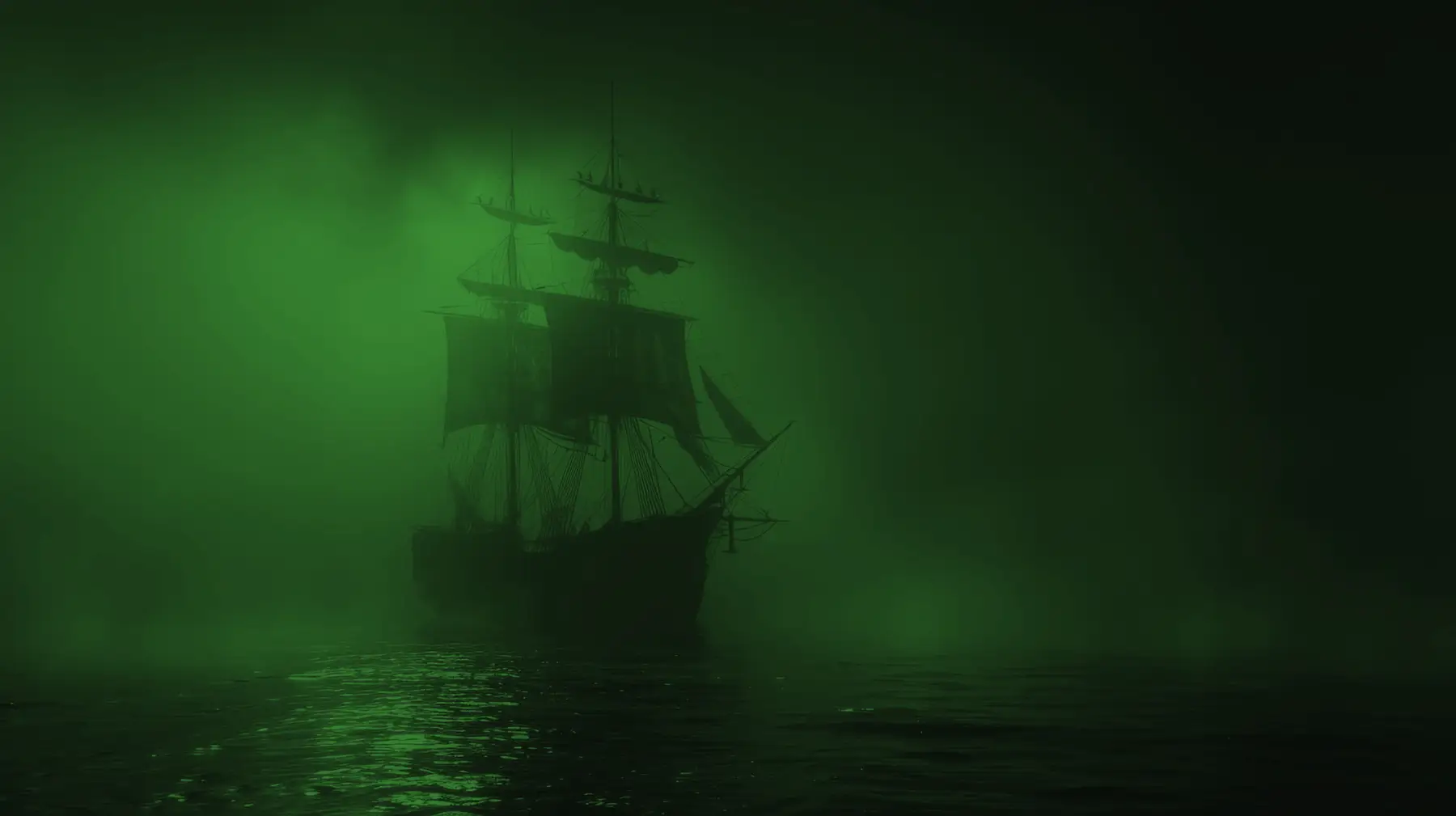
Case file 076Cryptids & MonstersTimeless / Spans the Ages

Here Be Sea Monsters

Royal Navy officers, a prince with a hold full of pigs, and the Titanic's rescuer all swore they saw sea monsters, in an ocean we've barely explored.

Aug 2, 20241h 20m
00:00 / 1:20:13
Or listen to this episode onApple PodcastsSpotifyYouTube
Share this episode

In this episode

  • A 15-foot, three-ton head bone on a Miami dock, and the theory scientists had to throw out right away
  • Why Royal Navy officers took it as an insult when anyone said they'd only seen seals
  • What the Prince of Monaco packed into the hold of his yacht to lure the Great Sea Serpent
  • The scientist who blamed the size of whales on a seafloor full of radium
  • Captain Arthur Rostron, the hero of the Titanic rescue, and the man in the rowboat who saw the same thing he did

“There are people who laugh when talking about the sea serpent, but I tell you, no one in the world knows what strange creatures live in the depths of the ocean.”

The story

In the spring of 1921, two experienced anglers from New York were fishing off Soldier Key, a few miles south of Miami, when they spotted a school of sharks thrashing around something enormous. Elsner Garretson and Charles Moller figured it was a dead whale and motored closer. What they towed back to the dock was a head bone 15 feet long, seven feet wide and just over three tons, and nobody in Miami could say what it had belonged to.

When mapmakers of old reached the edge of the known world, they had four words for the open sea: "Here, there be monsters." A century of sailors, scientists and naval officers set out to learn whether the mapmakers had it right.

A skull on the Miami dock

It took ten men and heavy lifting equipment to get the bone onto the dock. The sharks had stripped away the flesh on the trip in. Scientists guessed it came from a giant squid, which can't be right, since squid have no bones. A sperm whale is the likelier answer. A mature male averages 52 feet, about a third of it head, and one had been found 68 years earlier with a head 20 feet long. Sperm whales are the largest toothed predators on the planet, and they usually win a fight with a great white. If that's what the sharks were eating, the two fishermen snatched away their one chance to dine on their mortal enemy.

People back then had no trouble believing in a sea monster, though. They knew even less about the ocean than we do, and we don't know much. Oceans cover about 70 percent of the planet, and only about 20 percent of the seafloor has been mapped. Crushing pressure, cold and total darkness guard the rest. In June 2023, the privately owned submersible Titan imploded on its way down to the wreck of the Titanic, killing all five men aboard, one of them a teenager. In 2019, explorer Victor Vescovo made it almost seven miles down to the Challenger Deep, the deepest known spot on the seabed. He found three unknown species and a plastic bag, which is as tragically poetic as it is gross.

Officers who knew a seal from a serpent

Sea serpent sightings go back to Aristotle, who claimed to have seen one himself. In 1826, Captain Henry Holdredge of the ship Silas Richards and six passengers watched a dull black creature about 60 feet long glide past with its head four feet above the water for eight minutes. All seven signed a sworn statement. In August 1848, officers of the HMS Daedalus near the Cape of Good Hope saw something roughly 100 feet long racing along at an estimated 15 miles an hour. Months later, officers on the HMS Plumper saw an 80-foot black something with a sharply pointed head. When skeptics suggested seals or whales, the Royal Navy men were outraged, as politely as only British officers can be.

These were no gullible rubes. In 1856, when a Western explorer first saw gorillas in the wild and called them monsters of the jungle, people mocked him, because gorillas were supposed to be a myth. The platypus, a venomous, egg-laying mammal with no stomach, was once called "God's joke."

In April 1922, fishermen eight miles off Long Beach, California, fought for hours to land a 17-foot, 1,500-pound fish that appeared to have an extra set of ribs in its mouth. Experts who knew the basking shark perfectly well agreed it was an unknown species. A few years later, something 37 feet long, with the head of a duck and the body of a snake, washed up in Santa Cruz, and the stench drove even the most curious off the beach.

The weird part

For centuries, the sea serpent sightings didn't come from cranks. They came from Royal Navy officers, veteran fishermen and the captain who saved the Titanic's survivors. With about 80 percent of the ocean still unexplored, nobody can prove them wrong.

Pigs, harpoons and a radium sun

People wanted proof. In 1925, millionaire Harry Payne Bingham sailed his yacht, the Pawnee, loaded with harpoons, rifles and a speedboat meant for "leaping away from an enraged Leviathan." Aboard was Charles Thompson of Miami, who in 1912 had towed in a toothless, boneless 38-foot giant the Smithsonian named Rhineodon typus, and preachers declared he'd proved the story of Jonah and the whale. Bingham wanted one of his own. He came home with no Rhineodon typus and went back to the golf course.

William Beebe of the New York Zoological Society took a steamship fitted with aquarium tanks to the Sargasso Sea, the stretch of Atlantic matted with brown seaweed that sailors believed hid a graveyard of shipwrecks. Beebe, who never seemed to take off his pith helmet, suspected giant octopuses were behind many serpent stories. The remains of one with a 27-foot arm had already turned up.

Then there was Dr. William H. Ballew, who announced: "The ocean in brief is one gigantic radium bathtub." Radium, he said, made whales grow huge and sharks hard to kill.

Prince Albert I of Monaco, considered the father of oceanography, paid for his research with casino profits. He went hunting the Great Sea Serpent off Norway, where a Norwegian crew had shot at a 100-foot creature that blew two 50-foot jets of water from its nostrils. A Russian captain named Ostrovsky claimed one of his cannonballs bounced right off another. The prince's yacht, the Princess Alice II, carried miles of steel cable, a hook weighing more than a ton, and a hold stuffed with fattened pigs, since sea serpents were supposedly crazy about pork. How anyone knew that, when no sea serpent had ever been caught, is anyone's guess. He searched for a year and caught nothing.

The captain of the Carpathia

Five years before he raced the Carpathia to the sinking Titanic and saved 713 people, Captain Arthur Henry Rostron spotted what he took for a tree trunk off the coast of Ireland. "I saw that the thing was alive," he said. Its head rose about eight feet out of the water, darting side to side "such as you see a blackbird make when hunting for worms on the lawn." When he docked in Liverpool, the town was buzzing about a man found drifting in a rowboat in the Bristol Channel, who said he'd lost both oars and his boat hook fighting a sea monster. His description matched Rostron's exactly.

The sightings never stopped. Nova Scotia has logged more than 31 of one kind of sea serpent over 140 years, the most recent in 2007. Now the talk is of USOs, unidentified submerged objects. Retired U.S. Navy Admiral Tim Gallaudet points to a 2019 video, verified by the Pentagon, of an object flying around the USS Omaha and then dropping into the waves. He warned that it "jeopardizes US maritime security, which is already weakened by a relative ignorance about the global ocean." Maybe it's a surviving dinosaur, an octopus, or something nobody has a name for. Nobody knows.

The transcript

Chapters & full transcript11,349 words
Chapters
  1. 00:09Here, there be monsters
  2. 02:03The skull off Soldier Key
  3. 10:58Sworn statements and Navy logs
  4. 18:25Millionaires go monster hunting
  5. 30:31A radium bathtub and a prince's pigs
  6. 38:23The captain of the Carpathia

This transcript was generated automatically from the episode audio and may contain errors. Times are approximate, since ad breaks can shift them by a minute or two.

00:00

Hey, true weirdos, at the end of this episode, stick around if you want for a little bonus content and conversation. Humans have always had an uneasy relationship with the sea. In our earliest days on the water thousands of years ago, we christened our boats with blood as an offering to the gods of the deep. We named our boats for women and sent them into the waves as symbolic brides for those gods, Poseidon and Neptune.

00:33

Cultures all around the world have myths and legends about the terrifying creatures that inhabit the ocean, from massive sea serpents to sirens and merfolk. Even the Bible tells the story of the fearsome Leviathan. It makes the depths churn like a boiling cauldron and stirs up the sea like a pot of ointment. It leaves a glistening wake behind it. One would think the deep had white hair. Nothing on earth is as equal a creature without fear. It looks down on all that are haughty. It is king over all that are proud.

01:18

When the makers of ancient maps came to the edge of the known world, they chose four words to describe the vastness of the unknown sea. Here, there be monsters. Were they right? In the spring of 1921, Elsner Garretson and Charles Moller were fishing off Soldier Key in Florida, just a few miles south of Miami. The two men, both from New York, were experienced anglers. Moller worked as a ship's captain, so they weren't startled or much alarmed by the sight of a school of sharks thrashing and churning at the surface. The sharks were tearing at what looked to the men like an enormous piece of flotsam. Turning their boat, they carefully motored a bit closer, deciding that it must be the carcass of a whale that had driven the sharks into a feeding frenzy. That carcass had to be at least 80 feet long, the men thought. But as they drew closer, they were stunned by what they saw in the water. The exposed bones of the creature's head looked like nothing either had ever seen before. Sharks or not, the pair made the decision to tow the carcass back to shore for a better look. This part's kind of gross, but not exactly surprising. As they dragged their prize toward the dock in Miami, chunks of flesh tore away until at last, all that remained was that massive, odd head bone.

03:21

It was 15 feet long, 7 feet wide, and weighed in at just over 3 tons. It took 10 men using heavy lifting equipment to get it onto the dock. All who saw it were mystified. Even scientists were unable to identify it. They theorized that it was the head bone of a giant squid. Although we know now that neither squid nor octopus have bones, so we can go ahead and pull that out. Could it have been the head of a sperm whale? A mature male sperm whale can average 52 feet in length and about a third of that is its head. While sperm whales are common in the Gulf of Mexico, they're far less likely to cruise the Florida coastline. But less likely doesn't mean impossible. Sperm whales are so huge that they make jaws look like a little aquarium fish. In a cage match between great white sharks and sperm whales, the whales typically win. And sperm whales are toothy predators, easily capable of gobbling down a great white. In fact, sperm whales are the largest tooth predators on the planet. Something even a shark has to respect. Their only true threat comes from orcas, killer whales, who, when they're not ramming yachts and trying to eat the rich, will happily hunt a pod of sperm whales. 68 years before Garrison and Moeller towed their massive mystery to Miami, a sperm whale was found sporting a head 20 feet long. Seems reasonable to guess that the fisherman had snatched a sperm whale dinner from that school of sharks, which must have really pissed those sharks off, since they finally had a chance to eat their mortal enemy for a change. But it wasn't any kind of stretch for people at that time, to believe that the men had snagged a sea monster. They knew even less about the oceans than we do. And we don't know very much at all.

05:31

About 70% of the Earth's surface is covered by ocean. Ours is a water world. And that water is mostly unexplored. Arrogant little primates that we are, we forget that we've only checked out the tiniest fraction of our oceans. 80% or more of the world's oceans are still a mystery to us. We've only mapped about 20% of the seafloor. We gaze at the stars and dream of colonizing Mars. But there are places right here at home that we can't visit. Crushing pressure, extreme temperatures and total darkness help the sea keep its secrets. It's a place we don't belong. We're not built for it. For just one recent and horrible example, look at what happened in June 2023. When five passengers boarded a small submersible called the Titan, operated by an underwater exploration company called OceanGate. Titan was the first privately owned submersible to reach a depth of 13,000 feet. In 2021 and 2022, OceanGate had taken multiple paying customers down to the wreck of the Titanic. The expedition scheduled for June 18, 2023 was the first that year. Maybe it's because I'm a complete kook or whatever.

06:54

But Titanic tourism seems to me like a way of just asking for trouble. A tempting fate, you know. What's left of Titanic has rested nearly two and a half miles down on the bottom of the North Atlantic since 1912. It's a grave for the 1517 souls who went down with that ship on her maiden voyage. And on June 18, 2023, five more souls joined their number. A desperate search by air and sea for a missing submersible in the North Atlantic comes to a grim conclusion. The Coast Guard confirming tonight that debris from the sub found near the wreck of the Titanic is consistent with a catastrophic implosion.

07:39

The company that operated the sub says all five men on board are dead. KTLA's Sandra Mitchell joins us now with the latest development. Sandy. Share, Micah, it really is a devastating end to the story that has gripped the world. The wreckage found on the ocean floor. The investigation now begins on what caused the implosion with officials saying it is likely those victims died in an instant. I offer my deepest condolences to the families. All hope for a miracle rescue for the five on board the Titan was dashed when a remote operation vehicle discovered debris now confirmed to be from the missing vessel. I can only imagine what this has been like for them. The US Coast Guard today announcing the loss of all five on board, saying they died during a catastrophic implosion. Pieces of the vessel hauntingly found just 1600 ft from the bow of the Titanic. The initial thing we found was a nose cone. Searchers believe the implosion likely happened because of a loss of pressure, and they've already found five major pieces of debris. We found the front end bell of the pressure hole. That was the first indication that there was a catastrophic event. The Coast Guard says it appears the Titan imploded on Sunday as it approached the Titanic hours before the explorers were reported missing and the desperate multi agency search began. We had listening devices in the water throughout and did not hear any signs of catastrophic failure. Ocean Gate, the company that owns the Titan, issued a statement saying these men were true explorers who shared a distinct spirit of adventure and a deep passion for exploring. We grieve the loss of life. You could say, yeah, but they were civilians.

09:38

One of them was a teenager. Ocean Gate got sloppy and out on replacing the parts of that submersible that have been stressed by the earlier dives. What about the Navy? The Navy knows the ocean. True, the Navy knows more about the ocean than we do. But even the Navy can't get around the fact that we're land mammals. We're smart and handy with tools, which is how we've built submarines and submersibles. We're also curious. Tell us something is off limits, and we will prove you wrong. We went to the moon on that fuel. And back in 2019, Explorer Victor Vescovo climbed into a submersible and headed for the deepest known point on Earth's seabed. It's in the Western Pacific Ocean, and it's called the Challenger Deep, almost seven miles beneath the water's surface. Vescovo made it. He found three unknown species of marine life there and a plastic bag, which is as tragically poetic as it is gross. Imagine dipping a teaspoon into the ocean. That's about how much we know, compared to how much we don't. The unknown parts are where legends and stories are born. There are reports of sea monsters and sea serpents dating back to ancient times. Aristotle himself claimed to be an eyewitness. In 1826, Captain Henry Holdredge of the ship the Silas Richards, along with six passengers, stood on the deck and watched a dull black creature, roughly 60 feet long and 10 feet in circumference, slowly gliding through the water. Its enormous serpent like head remained about four feet above the surface for eight minutes. All seven witnesses signed a sworn statement describing the encounter. In August 1848, the HMS Daedalus was sailing near the Cape of Good Hope when the captain along with several officers and crew members spotted something unusual. They estimated that the creature was about 100 feet long, holding its head four feet above the surface and moving an estimated 15 miles per hour. Just a few months later, another group of British Navy officers aboard the HMS plumper were shocked by the sight of an 80 foot long something in the water.

12:15

It was black with a head they described as sharply pointed and held above the surface. The men stared in disbelief as the creature moved with slow grace across the wake of their ship. Both of these accounts were met with skepticism. Oh, those were probably seals or maybe whales you boys saw. These witnesses were outraged in exactly the kind of seethingly polite manner you'd expect from officers in the British Navy.

12:49

My good man, I have sailed the world many times over at the pleasure of Her Majesty Queen Victoria and I can assure you that I have seen any number of whales and a prodigious number of seals. And this would most certainly be unlike any seafaring animal I have yet encountered. Good day, sir. I said good day. At the rate the British Navy was spotting unknown sea critters. It's a wonder there was anything left for anyone else to see. Like in 1877, when the HMS Osborne was in the waters off the coast of Brazil. The officers and crew got a good long look at something they'd never seen before. They described it as having a head shaped like a bullet with appendages on either side of that huge head, like flippers maybe or, or paddles running the length of the creature's back or a row of fins. And just a few years later in Brazil, members of the Royal Zoological Society spotted off the coast what they described as a monster with an enormous body, one gigantic fin and an oversized head resembling that of a turtle. How adorable right? It seems almost childlike the way people so easily believed in monsters. Here's something to think about. Many of these sightings in the world's oceans were happening at a time when people firmly believed that gorillas were a mythical animal. You know when the first gorilla was spotted in the wild by a Westerner? Like 1856. Explorer Paul de Chagliot, the very first person to see gorillas up close, described them as monsters of the jungle. People mocked de Chagliot, accused him of just making up stories because I'm so sure that gorillas are real, Paul. Of course, gorillas are real. We know that now. And it probably never even occurred to you to wonder about it. Gorillas are a fact of life for us. A surprisingly recent fact of life. In April 1922, the crew aboard a fishing boat eight miles off the coast of Long Beach, California, found themselves in an hours long battle to land whatever massive fish was fighting them on the other end of their line. When they finally succeeded in their catch to the surface, they were stunned. None of the men had ever seen anything like it. It measured 17 feet in length and weighed in at 1500 pounds. It had large powerful fins and a huge mouth as wide as a cavern. This is a truly bizarre detail.

15:47

But this thing appeared to have an extra set of ribs in that mouth. If you're thinking, oh, that's a basking shark. They averaged 22 to 29 feet in length. And when you look in their mouth, it does sort of look like they have a set of ribs in there. Mystery solved. Not so fast champ. The basking shark was discovered in the mid 1700s. The scientists and professors who gathered on the dock and agreed that the fishermen had hauled in an unknown species were very familiar with the basking shark. These marine experts and professional fishermen knew perfectly well what whales and sharks were. And this was neither. Not long after, the San Francisco Chronicle printed a letter to the editor.

16:40

Sir, it is the fashion to jeer at any mention of sea serpents. But strong evidence of the existence of unclassified sea The writer went on to describe what the crew of the HMS Daedalus had witnessed in 1848. And then he pointed out that just in the last year, a similar monster was found dead off the Florida coast with a head 15 feet long by seven feet wide and weighing three tons. Three years later, and about 365 miles north, a giant sea creature washed ashore in Santa Cruz, California. Some said it was a sea serpent. Others said it was a sea monster. Whatever it was, it was 37 feet long with the head of a duck and the body of a snake. People crowd at the beach trying for a glimpse of the decomposing Hulk. The smell grew worse by the hour. It was so awful that even the most curious in the crowd couldn't take it. Experts were summoned to try to identify it. All sorts of theories were tossed around. Could it be a bottlenose whale? Or a shovelnose shark?

17:52

One scientist thought it was just a plain old regular whale that had been dynamited and then drifted. Theories flew in every direction. Because the whole idea of giant monstrosities cruising the deepest depths was taken very seriously. The fact that so many of these mysterious beasts have been seen by professional fishermen and naval officers and crew made the whole thing more credible. But of course, people want it and need it. Proof. Enter millionaire sailor and explorer Harry Payne Bingham, who set out in 1925 on his sleek black yacht the Pawnee to capture as many specimens of sea monster as the could hold. Those were the days when rich people spent their money pushing the frontiers of knowledge. Today, Harry Payne Bingham would probably be an insufferable tech bro billionaire, too busy firing workers and doing stock buybacks to even think about hunting for sea monsters. But then he was a dashing man of the high seas, his yacht equipped with every possible seagoing weapon, from harpoons and rifles to coils of the strongest rope. He even brought along a speedboat capable, he said, of leaping away from an enraged Leviathan that speeds up to 50 miles an hour. His crew included an artist famed for their paintings of fish, an expert taxidermist who trained the rest of the crew in mounting the giant monsters, whom he described as having an appalling bulk, and the most famous fisherman in the whole world, Charles Thompson of Miami.

19:41

Thompson had not only led fishing expeditions for American presidents, European royalty, movie stars and prizefighters. He himself had captured a mammoth fish of unknown species in 1912. 38 feet long, weighing in at more than 40,000 pounds, its jaw measuring five feet across the Smithsonian Institute named it Rhineodon typus. Whatever it was, it was still alive, though barely when Thompson towed it into Biscayne Bay. Thousands of people lined up to see it. Preachers and pastors gave ringing sermons about how Thompson had proven that the biblical story of Jonah and the whale was true. After all, three or four men could easily move through the creature's throat with no problem. Weirdly, it had no teeth, and no bones. It was all cartilage. Its eyes were tiny, the size of silver dollars. Harry Payne Bingham just had to have a Rhineodon typus of his very own. Off they sailed for Swan Island, about 300 miles south of Cuba. It was an adventure for sure. One crew member was knocked off the speedboat while trying to land a 16 foot sawfish. They discovered giant shrimp with pincers more powerful than lobsters. A manatee was dragged aboard after much struggle because the poor sea cow just really wanted to be left alone. The yacht returned to the mainland, and in no time, Harry Payne Bingham returned to the golf course, a place where he was much more at home. The elusive Rhineodon typus had successfully eluded capture. Sea monster for the win! There were a lot of arguments about just what these sea monsters might actually be. The Plesiosaur was a favorite, but even then it was thought to be a long shot. A remnant dinosaur species? Still alive in the modern era, hidden and protected in the world's oceans? Plesiosaurs were wildly plentiful in their day. That was 7 million years ago. Fossil evidence shows that they grew to a length of 30 feet. One scientist described them as looking like a tortoise pulled through the body of a snake with an incredibly long neck and four flippers like those of a whale.

22:19

Which does sound very much like the creatures described by witnesses on the British Royal Navy ships, doesn't it? The first Plesiosaur fossil was described like this. To the head of a lizard, it unites the teeth of a crocodile, a neck of enormous length resembling the body of a serpent, a trunk and tail having the proportions of an ordinary quadruped, the ribs of a chameleon and the paddles of a Yeah, that sounds pretty make believe. It's not hard to see why it was a hard theory to swallow. But have you ever really looked at some of the animals that are alive right now and walking the world? Like the platypus?

23:03

The platypus is an aquatic egg-laying mammal with a broad flat tail where fat reserves are stored. The animal has neither teeth nor stomach. It is covered in dense, waterproof fur and sports webbed feet. The male platypus has a horny spur on each ankle, which is connected to a venom gland. The female platypus generally produces one to three eggs and suckles her young from large fan shaped mammary glands that lack nipples and shrink outside the breeding period.

23:32

A venomous egg-laying nippleless mammal with no stomach. They used to call the platypus God's joke. And for the longest time, no one believed they were real either. The first scientific description of the platypus wasn't published until 1799. What a time that was to be alive. Poisonous duck-billed beaver-looking varmints were discovered. Gorillas turned out to be real animals, not mythic beasts. And weird as hell sea life was biting on fish hooks, following Navy ships and washing up on beaches. As for the plesiosaur, we're still looking for that. Some believe that the elusive Nessie, the Loch Ness monster, is a remnant plesiosaur. And did you know that in 1997, a Japanese fishing boat off the coast of New Zealand hauled up a carcass in their nets that might just be a plesiosaur? A carcass, not a fossil, meaning that whatever else the plesiosaur was, it wasn't nearly as extinct as it was supposed to be. The searches for sea monsters didn't come up totally empty. New species of marine life were discovered this way. And in one case, a completely unknown tribe living on the banks of an uncharted river in Panama was discovered.

25:02

The tribe was described by explorer F.A. Mitchell Hedges and his companion, Lady Richmond Brown, as being of Chinese origin, occupying the river home for thousands of years. Hedges, a member of the Royal Geographical Society, said the people thought he and Lady Brown were gods. So the pair hung out with the tribe for about seven months and experienced the convinced Hedges that he now had proof that America was first settled by the Chinese. Sadly, he did not have proof of a sea monster, even though he did come across a 60 foot long swordfish and the vertebrae of something he declared must have weighed at least 70 pounds when it was alive. The New York Zoological Society was up next, this time focused on the mysterious Sargasso Sea. It's a vast patch of the Atlantic Ocean that has a totally unique feature, brown sargassum seaweed covering its calm blue waters. Sailors known for their superstitions feared the Sargasso Sea. They believed that beneath all that slimy seaweed was a graveyard of wrecked ships prowled by strange mysterious deep sea monsters. Christopher Columbus wrote about it in his journals. His crew assumed that the seaweed and the crabs scampering across it meant shallow water. They feared the Nina, the Pinta and the Santa Maria could run aground. More modern superstitions involved the Bermuda Triangle, the southwestern area of the Sargasso Sea between Bermuda, Florida and Puerto Rico. Far far too many ships and airplanes had vanished there for any sailor to love the place. The New York expedition outfitted a custom steamship with aquarium tanks and wells designed to keep fish alive. There were cages for any reptiles or birds or animals the team wanted to bring home.

27:12

Leading the trip was William Beebe, author of Galapagos World's End and the director of the society's Tropical Research Station. He was a man with large soulful eyes, a porn mustache, and an honest to God pith helmet, which seems to have been bolted to his head because it never came off. The depths of the ocean have never been explored with up to date apparatus. The most remarkable fish brought up from the great depths have been torn to shreds by the expansion of their bodies upon reaching the surface. But I have hopes of catching them intact and perhaps alive. We know that many of these fish come to the surface at night when they ascend in their own way, they do not explode. Stories of sea serpents and sea monsters have been reported on evidence that seems credible, but has never really been investigated. Then Beebe said something very reasonable.

28:09

We're likely to fish up some extraordinary specimens of the octopus family which undoubtedly have breeding places in the unfrequented parts of the ocean. The remains of an octopus with an arm 27 feet long have been discovered. The monster must have had seven other arms in a body. Therefore it must have been over 54 feet across. And now for the money shot. It is probable that some of the best substantiated stories of sea serpents and inexplicable monsters were based on glimpses of these creatures.

28:43

That's a theory that persists to this very day. The giant Pacific octopus is a real animal that grows bigger and lives longer than any other species of octopus. The biggest specimen we know of weighed 600 pounds and measured 30 feet across. That's the height of a two story building. So yeah, definitely monster size. Yet even that's smaller than what many witnesses claim to have seen. Still, it was a promising lead thought William Beebe. Given that there were many accounts of fishermen either seeing giant octopus thrashing in the waves or actually being attacked by giant octopi. It seemed like Beebe was on to something. Like for example, a group of fishermen off the coast of England returned to shore with a wild tale of how they watched as two huge tentacled arms suddenly reached up from the sea. One arm wrapped itself around the mast of their boat, the other around the leg of a man named Frank Demel. The men declared that they were frozen in terror until Demel's screams snapped them out of it. The massive arm was dragging the screaming Demel across the deck. The fishermen grabbed axes and knives and frantically hacked and chopped at the monstrous arms until the creature withdrew. If an enormous man eating octopus seems as unlikely as a leftover aquatic dinosaur, then you're really going to love this theory. It brings together the Prince of Monaco and an underwater earth sun. Here goes. We'll start with the earth sun and then get to how a depraved lust for gambling somehow led to this idea. So 100 years ago, science with a capital S decided that radium had been collecting for eons on the ocean's floor.

30:40

All those tons and tons of radium explained the ghostly glow that sailors and fishermen reported seeing way down in the depths. Scientist Dr. William H. Ballew explained it like this. The ocean in brief is one gigantic radium bathtub. It is radium that causes weird flashes in the track of ocean liners which we call phosphorus. It is radium that gives the tingling bracing restorative quality to see air. It is radium that produces brilliant lights around the heads and the mouths of deep sea monsters. It is radium that makes whales grow so big turtles live so long octopuses wax so strong and sharks so hard to kill.

31:30

So how'd all this radium get into the ocean? Originally, the seas of the world were freshwater. During uncountable centuries, whether fresh or not, they received all types of salts and other elements conveyed to them from the land by the rivers that emptied into them. Among the deep sea deposits were boundless quantities of uranium, the ore from which radium is extracted. Radium does not mix with any other known substance. Hence, whatever amounts of radium in the ocean have remained separate and distinct from the water, slime and growths.

32:08

As proof of this interesting hypothesis, Ballew pointed to the size difference between elephants and whales, which honestly makes zero sense, but let's hear it. Whales grow from nine to 25 times bigger and heavier than elephants. They're about 10 times more playful and active and live nearly five times longer. Why? Because scientists believe the whale frequently drops from the surface hundreds of feet into the depths, where it enters a greater and more powerful radioactive field that has its vitality recharged proportionally.

32:48

Ballew really enjoyed comparing wildly different animals to make his point. Like, why was a 62,000 pound shark captured in nets in the San Diego Bay, when a beef steer weighs in at only 1300 pounds? That's like the most unserious scientific take ever. As for how in the wide world the Prince of Monaco was involved in any of it comes down once again, to the trend of really rich guys casting themselves as intrepid explorers.

33:21

Although in this case, it's legit. Prince Albert I was obsessed with the ocean. He traveled the world on his royal yacht, the Iondel, which was more oceanic research vessel than luxury cruiser. Over the course of 28 expeditions, the Prince had fished all sorts of peculiar creatures out of the sea. Not bad for a guy who reigned over a principality smaller than New York Central Park. But Prince Albert I was the real deal, and an early visionary in understanding that the ocean's resources weren't unlimited. He talked about overfishing, which no one back then even believed was possible.

34:06

And he advocated for protected marine areas. He's considered the father of oceanography. He financed all of his research with the profits from Monaco's biggest business, gambling. We could spend an hour just untangling the man's personal life. Like so many European royals, courtship and marriage for Albert was a complicated mess of politics, religion, and cousins. Anyway, one of Albert's expeditions brought him to Norway in search of the Great Sea Serpent. He outfitted his new yacht, the Princess Alice II with special gear, including several miles worth of steel cable, allegedly strong enough to restrain any creature. Also aboard was a massive hook weighing more than a ton with four barbs, bound to snag anything that it. Since sea serpents were said to be insanely fond of pork, the hold of the yacht was stuffed full of fattened pigs. Don't ask me how they came up with the idea that sea serpents loved eating pigs, since no sea serpent had ever been captured.

35:21

And pigs don't live in the ocean. So how a sea serpent knew a pig will be delicious is anyone's guess. And besides, the backup plan, they just catch a porpoise and bait the hook with that if the pig idea failed. There have been enough credible sightings of a sea serpent in the waters off Norway to make the expedition worthwhile. The captain and crew of a Norwegian ship reported not just a sighting, but a violent encounter with a creature that rose out of the water before them. It had a flat serpent like body roughly 100 feet in length.

35:58

It moved in an undulating fashion with black skin covered in spots. The enormous head was at least 16 feet above the surface and looked a bit like a turtle with gigantic scales. As it moved slowly through the water, the crew decided to shoot it. It was unclear whether or not they actually hit it since the creature seemed unfazed by the commotion. It sprayed two jets of water out of its nostrils, jets that soared 50 feet in the air and headed out to sea disappearing from view. A Russian cruiser in those same waters reported a similar encounter just one year later, this time with two of these mysterious animals. That captain named Ostrovsky immediately opened fire and missed. This, by the way, is why the aliens don't land. They've seen how we react to anything unfamiliar. A few months later, Captain Ostrovsky spotted two of the creatures again, maybe the same ones, and chased them for an hour and a half, firing at them every chance he got, missing every time, though he claims that at least one cannonball bounced right off the animal without doing any damage. Like the Norwegian crew, Ostrovsky insisted that the creature undulated through the water, flexible in ways that no whale could ever be. Between the confirmed sightings and encounters and centuries worth of Norse legends about giant serpent monsters in the water, Prince Albert I was confident enough to commit a year to the search, which, as you can guess, didn't succeed, which didn't prove anything either way. As the saying goes, absence of evidence is not evidence of absence. If you're thinking that the modern world put an end to the stories of sea serpents and giant monsters, it didn't.

38:07

The arrival of the 20th century meant nothing to whatever lurked in the deep. The sightings didn't stop. Even the most experienced sailors continued to have inexplicable encounters at sea. Five years before he became famous as the captain of the Carpathia, the ship that responded to the distress call sent out by Titanic after she struck an iceberg and began sinking, Arthur Henry Rostron confirmed that he too had encountered an enormous monster in the water off the coast of Ireland. I saw something about two miles ahead, which at first I thought was a great tree trunk. On coming nearer to it and keeping my glass trained on it, I saw that the thing was alive. Its great head was reared about eight feet out of the water and was darting from side to side with sudden movements such as you see a blackbird make when hunting for worms on the lawn. There were two protuberances where eyes might have been, but I could see no eyes. This is the man who upon hearing Titanic's distress call, steamed toward the spot pushing his ship to the limits to cover 58 miles of frigid North Atlantic Ocean. Carpathia's crew located 20 life saving the lives of 713 passengers and crew. Captain Rostron's decision to turn the Carpathia and race to the site of the disaster is the only reason that there were any survivors of the Titanic at all. I don't care how much of a skeptic you are. Rostron was an outstanding experienced seaman and the furthest thing from a kook. Its neck was fully 12 to 14 feet long and although only part of its body was out of the water, it was plain that the complete length of the monster must have been very great. It had small ears in comparison with its enormous bulk. Fish do not have external ears, though a few marine animals do. Baleen whales, seals, and sea otters do. Is it possible that what Rostron saw was a southern elephant seal? The males can reach 20 feet long and weigh nearly 9,000 pounds. They're incredible divers and can stay under for up to 20 minutes. So, sure. Okay, maybe. Maybe that's what Rostron saw. Even if it seems doubtful that a sea captain with his experience had never come across a seal before.

40:54

I mean, really? Rostron defied his family and went to sea as a cadet at age 13. By the time he retired, he'd commanded eight ships, was knighted, and received a congressional gold medal. Rostron was as salty a sea dog as they come. When it came within the wash of our propellers, it dived rapidly and presently came to the surface again some distance away, still moving its head in that queer way. Then it submerged and nobody saw it again. When Rostron docked in Liverpool, it was a buzz with the talk of a man who'd been found drifting in a rowboat in the Bristol Channel. The man sounded insane.

41:43

He claimed he'd been in a terrible battle with a sea monster and had lost both oars and his boat hook to the creature. Rostron was shocked to learn that the man's description of the monster was identical to his own sighting. There are people who laugh when talking about the sea serpent, but I tell you, no one in the world knows what strange creatures live in the depths of the ocean. Rostron by that time had clocked 25 years at sea and was about as credible a witness as you could find. One in a long line of officers, Navy sailors, and professional fishermen who each described something that simply could not be possible, and yet there it was. Even now, the possible existence of a massive sea serpent continues to be a puzzle. For the Nova Scotia Museum of Natural History points out that there have been more than 31 sightings of that particular kind of sea monster in the region over the last 140 years, and the most recent sighting, according to Hebda, was reported in 2007. For all our technology and nuclear submarines and satellites spinning around the earth, watching, recording, able to see more than ever before in human history, the oceans are still a vast mystery, and we're still seeing things in the deep that we can't explain. Although today, it seems like you're far more likely to hear about a USO sighting, that's an unidentified submerged object, than you are sea serpent. These USOs have been spotted flying at high speeds and plunging into the waves and disappearing, not a splash, and no wreckage, which sounds like complete BS. And yet, there it is. Retired US Navy Admiral Tim Gallaudet doesn't think it's BS. He calls USOs an urgent national security concern with world-changing scientific ramifications. According to Admiral Gallaudet, there's proof, a video captured in 2019 by the USS Omaha, a video that's been verified by the Pentagon. You got a lot of 12. It's getting close. Yeah, we have a 31 knots of sustained wind, topside gust of 40. It's splashed. It's splashed. Mark bearing range. The video is grainy, black and white and shows an object flying around the USS Omaha and then suddenly dropping into the waves and vanishing. Gallaudet pulled no punches in March 2024. He wrote, the object jeopardizes US maritime security, which is already weakened by a relative ignorance about the global ocean. The fact that unidentified objects with unexplainable characteristics are entering US water space, and the DOD is not raising a giant red flag is a sign that the government is not sharing all it knows about all domain anomalous phenomena. When pressed, could these objects belong to a foreign power? China maybe? Gallaudet was as skeptical as anyone hearing a tale of a sea serpent might be.

45:28

Pilots, credible observers, and calibrated military instrumentation have recorded objects accelerating at rates and crossing the air sea interface in ways not possible for anything made by humans. Whatever is down there, a species of dinosaur that somehow survived a mass extinction event. An unknown serpent like Leviathan that makes its home in waters so deep that no human made vessel can reach it. A ship that can fly and dive and maneuver in ways that defy the laws of physics. No one knows. We're not so far removed from the days when people theorized that the floor was home to a massive radium sun. All this time, and we barely know anything. And how cool is that? Most of our world is water and most of that water is a mystery. So much to explore and discover at a time when our every movement is tracked. When cameras watches 24 seven, when privacy is a of the olden days, we can still get lost. We can still be astounded. And best of all, we can still set out to see and wonder if here, there'll be monsters. Next time on true weird stuff. They called her the poison pen. They called her a murderer. They turned her into the boogeyman of Santa Barbara.

47:14

And then she disappeared. The wild true tale of Ida Addis on the next true weird stuff. Special thanks to our voice talents on this episode, Don Morgan and Kary "Doc" Bowser. So, Sherry, can we go back to what you just talked about? That was in March of 2024. That he made this observation. Yeah. Oh, yeah. So retired Navy Admiral, not your kooky Uncle Wayne, right? Retired Navy Admiral. You know, when, when I heard him talking about this, I was thinking about some of the people who have made claims in the past, notably renowned pilots who were seeing UFOs and stuff. These are people, there's nothing in it for them to make up stuff. There's to be able to make any money or anything else off this stuff.

48:13

They're simply pointing out what they're seeing. And it's, it's not kooky after all. Well, that's what is so interesting about a lot of these sea monster sightings. These a lot of these sea monster sightings were made by officers in the British Navy. Not by drunken coots, you know, not by crazy people looking for attention. And I'll remind you something that retired Admiral Gallaudet said, that I think is really powerful is he said, this object jeopardizes US maritime security, which is already weakened by our relative ignorance about the global ocean. I know that it's comforting to think that we, we know everything there is to and that somebody, the government, the military, somebody does know and they're keeping us safe. But when you when you see something, and it would be an easy for it would be an easy comment to miss, right? Our relative ignorance about the global ocean. When you see something like that coming from a retired Admiral of the United States Navy, it sits you down.

49:32

Oh, or the captain of the ship, the Carpathia, you know, Captain Rostron. Yeah, I mean, you know, when you were talking about this, the thought that I had that went through my mind was that Mars is almost a more hospitable place for us to explore with, you know, the rovers that we have up there. Yeah, then our own ocean floor, which is right here on this planet. I mean, we can, you know, Victor Vescovo did get to the bottom of Challenger Deep, and it was pretty heartbreak heartbreaking that he found a plastic bag down there, the deepest part, the deepest part of the Pacific Ocean. Why is that not surprising, though? Oh, God, it's so disappointing.

50:22

You know, yes, Victor Vescovo did get to the bottom of Challenger Deep, but these, these submersibles that are going down to this depth, it's not like you can go down there and set up a base camp and do like significant research. The bottom of Earth's oceans is a place we are not built to visit. And even with technology, we are not built to stay down there.

50:52

I did, and there's a lot of stuff, it's so hard to understand, like, if you're not, I don't know, some sort of engineer or whatever. But I read so much about like the different classes of nuclear subs. And some of them, some of the information is classified about, you know, how far down they can go and how long they can stay. But I can tell you this, unless we and or the Russians or the Chinese or whatever, are hiding submarine technology, that's so next level. None of them are really built to go as far down as the bottom of Challenger Deep and stay for any length of time.

51:31

It's almost impossible to imagine the pressure at that depth, and the cold and the dark. It's just, it's so forbidding and impossible to explore. So given all of those factors, are you not shocked to find that there are some creatures who are living at that depth? I mean, the pressure, the darkness, the cold, what, you know, that is just incredibly surprising.

52:03

And there are, I mean, it's, that's what feeds my belief that we just, we don't know. We just don't know. Because there was a discovery, it's just been in the, it was in July of 2024, it's very recent, of dark oxygen in the deep ocean. For the, you know, for, we've been operating on the belief that oxygen was created by photosynthesis, right? You remember fifth grade biology and science, right? So that's where we thought, you know, oh, the only way to get oxygen is photosynthesis. But it turns out they've discovered in very punishing depths, what they call dark oxygen, structures that are capable, and I can't explain it any better than this, because not only is it brand new information, but I was a liberal arts major. But these structures that can create dark oxygen, and so immediately, you know, there were a lot of industrial hands that went up in the air, this is something we could exploit.

53:08

Well, before we exploit it, we just don't even understand it. We don't understand what's happening at the deepest parts of Earth's oceans. And when you look at the classic photo of Earth as seen from space, doesn't show you the other side of the planet, which is all blue, all water, right? Like we are water world. And we're completely ignorant about almost all of it. When even scientists and like, NOAA, the National Oceanographic, you know what I'm saying?

53:50

Yes, NOAA. We know. When even NOAA says, yeah, dude, I mean, like, we got maybe 20%. Mapping and knowledge, maybe 20%. 20% ain't nothing. I mean, that's an 80% sized question mark. And so I think that it's possible that there is marine life down there that exists in these unreachable areas that we have no idea of. And does that marine life occasionally surface? Maybe.

54:32

I mean, the reports of these giant sea serpents that date back a couple, three, 400 years, all the way back to Aristotle, if you want to go into the ancient world, right? But, you know, if you want to keep it just with contemporary navies and militaries and commercial fishing vessels, you know, we can go back three, 400 years. Those accounts are all so strangely similar, aren't they?

54:57

They are. And coming from people who not only are credible, but who have everything to lose if they're thought to be insane or liars. Right. It makes you wonder how many people saw stuff and just said, I don't want to be labeled a kook. I'm not going to say anything. Did you see that? Yeah. I think that happens a lot today. And to be fair, you know, sometimes a remnant, like a carcass, would be hauled up and people would go, it is a mighty sea monster. And then it turned out to be like, you know, a whale, you know, sperm whale or what have you. But that's not every case, right? Like you can a certain percentage of cases where you go, well, that was a giant octopus and that was a sperm whale and that was a devil fish. And that looks like what's left of a basking shark. But once you rule all those out, you're left with a pretty big pile of sightings that are inexplicable. And I don't know how I feel about the plesiosaur hypothesis. Could there be a dinosaur species alive in the great oceans in the greatest depths of the oceans after the mass extinction? Well, okay, yeah. Would they not have been protected from the worst of the so let's go back. Asteroid hits the earth, right? It flings an enormous amount of matter into the atmosphere, which then, you know, blots out the sun and causes temperatures to plum to plummet. And now plants can't survive. And so the herbivores have nothing to eat. And when the herbivores are gone, the carnivores have nothing to eat. Isn't that how you basically learned it? Sure. Yeah. Okay. So that's the really hyper super simplified version. But if you were living in the deepest parts of Earth's oceans, you would have been protected from a lot of that, wouldn't you? Yeah. What difference would it have to you if it was cold at the surface, when you're used to living in an incredibly frigid, dark, low oxygen environment anyway? So yeah, I suppose, you know, that we could have a handful of remnant plesiosaurs. And what that Japanese fishing boat found off the coast of New Zealand in 1997 is very intriguing. What was that? So that's one theory. But then there's this whole other idea. If you can't swallow a remnant dinosaur, there's this whole other idea that well, in that 80% swath of water that we know nothing about, there's all kinds of stuff that we haven't figured out, that we haven't discovered, because it doesn't come to the surface. And speaking of that, didn't you find it adorable when the scientist was like, they know how to come to the surface without exploding? I mean, they understood about pressure. And you know, animals that dive to those deep depths and are able to come to the surface, whales and so forth, they do have structures, they're built for that, you know, they're built to go down and come back. So who knows? What do you think? I'm saying this again, if we can, it's hard for us to be able to with 100% certainty build anything that's going to go down there that we know is going to be fine. I mean, you had the one guy that went down and they've had these Titanic things, but the one Titanic one collapsed in, you have to figure they were pretty strong. These creatures that are down there. I mean, that's, that is just amazing to me. That is the thing that is most amazing. So when you think about that, it is it's not a

59:02

stretch to say that there's creatures down there, perhaps prehistoric, perhaps something that we're not aware of, we don't, we haven't put a species on it, they haven't been tagged, we keep on finding new animals all the time, new things that scientists are saying, yeah, this is a new species of something that we hadn't noticed before. So it's not out of the realm of possibility. Didn't we fairly recently find yet another unknown tribe of people that had had no contact with civilization? Yeah, and had didn't know what an airplane. I mean, these people are on the land where we can move around.

59:40

There, there's so much of the world that's unknown to us and no part of it more profoundly so than the oceans. And I, like I, I'm constantly people skeptical, debunkers just and they come find me like I could be at the CVS and one will hunt me down in the shampoo aisle. And it's like, I understand that you need for the world to make sense. And you need to be at the top of the food chain and the top of the knowledge chain. Like I understand that without those comforts, it does feel like you're walking a tightrope over an abyss, right? And it can be terrifying. And I get that you need to feel sure about everything from what's in the ocean to what's in the sky. You just need to be sure, completely understand that. But the other side of that coin is, why don't you want to live in a world that's just like teeming with mystery? Why do you want everything to be so limited and small? In what way does that make you feel better to think that everything is so limited?

1:00:58

Most people operate from a place of fear. And so there's the things they know, and if there's any challenge to that, they're afraid of whatever it is. And so it's better to say no, it doesn't exist. Because that way I can't be I, if it does exist, then I'm afraid of it. Do you see what I mean? Yeah. And I feel just the opposite. Like, if the world is as simple as you make it out to be, I don't know. I don't know how to make sense of that. Like we, we talk about things like the Big Bang. Like we have evidence of the Big Bang, we really don't understand. We really don't understand where anything came from, how we're here, or where we go next. And we don't know anything. And I kind of like that. I like all those possibilities being open. And we keep learning new things all the time. I mean, you know, what was status quo 20 years ago is not today. I mean, there's so many different things that we keep on learning about. Well, Mars, they're learning about the possibilities of life that has existed there, you know, and that seemed like all that that's not a possibility before.

1:02:18

Yeah, just like a dead, dusty rock, right, floating in space. One of the things I really love about this, like the historical sea monster thing, are the ways that the threads of history and humanity overlap and weave themselves in and out of a true weird stuff episode called the sea demon. And it was about this enormous, terrifying shark that was that had a taste for sailors. I mean, this shark killed and ate so many people.

1:02:59

Do you remember that show? Yeah, this, this shark would stalk fishing vessels, naval ships, commercial ships. And it was very distinctive. It had like this milky white, it might have been injured at some point, because it had this sort of milky white, very distinctive bulge on its head. So researching the sea monster sightings for this episode, I came across descriptions of the sea demon, which I left out of this one, because we did a whole episode based on that. But people were like, it was a monster. And it had the strangest white bulge on its enormous head. And I was like, I felt I felt kind of like, Oh, that's the sea demon. We know him. That's our old friend, the sea demon. So I removed all of the reports, I set all the reports aside, where they described that specific shark that was eventually taken out by a British Navy vessel. Because if there's one thing you can count on the British to do, it's travel the world looking for things to conquer and keep and steal. So they were always on the high seas. So I removed all of the descriptions of anything that looked like the sea demon, and boiled it down to this handful of really credible documented sightings that were documented in ships logs and signed off on with affidavits by witnesses. And I love the way that things woven and, and overlapped and tied together, like Captain Rostron, who saved the people in the lifeboats when Titanic sank. How much of his career at sea, kind of weaved in and out of these stories of giant sea monsters and sea serpents. And there's Titanic, right? For a ship that only had one voyage, isn't it fascinating how often she shows up in these different ways? When you're when you're doing any kind of work on the ocean? Don't Yeah. And I loved his description of the quirky movements. You could see that the way he described the way that the head moved around on that. And, you know, I mean, that's pretty distinctive. And he's the real deal. By the way, this guy is so legit. Like he does not deserve your mockery.

1:05:28

No, you know, he was a hero. And not just with the Titanic rescue. This was someone who ran away to the water at age 13 and gave his whole life to that. And was so served with such distinction, that even he's British, even the US Congress gave him a medal. Does that sound like what we do with you know, there's Cletus in the backwoods seeing an outer space man? I mean, does that strike you that way?

1:06:01

No, I mean, obviously, he is a guy, you know, how many of these people that we've had that have described different things, the guy that the episode where we were talking about Bigfoot, that was a guy that had top secret government clearance, top secret government clearance at one point along the line. So these are all reputable people that are telling us these things. And I guess that people just in general just are like, don't tell me. Let me cover my ears. I don't want to know. Well, there you go. Because not only sea serpents, but there's that, you know, there's a lot of this, as I said, that you that aliens from, you know, other places have set up bases under the sea because they know they won't be found there. And that's kind of what retired Navy Admiral Gallaudet was talking about, like, hey, this is not our technology. This is not the technology of a foreign power. I don't know what it is. But it's a threat to US maritime security, because of our global ignorance of the oceans. And I also liked how the Bermuda Triangle made a brief cameo appearance to wave at its fans in this episode. Because the Sargasso Sea, it's so fascinating because of that bed of seaweed, that thick mat of seaweed that floats at the surface. You know, it's a, the Sargasso Sea is the subject of many legends and sailors are very superstitious. And a good chunk of it, you know, is where what we call the Bermuda Triangle. And, and because of, you know, currents and whatnot, there have been a lot of ships that have gone down in that part of the world. But that mat of brown seaweed, had sailors convinced that it was there to conceal some terrible thing underneath. And you can see how a superstition like that develops, right?

1:08:02

Or maybe not a superstition. Or maybe not a superstition. The thing about the sea monster sightings, a lot of them are very recent. I mean, you heard the zoologist in Nova Scotia, who's like, the last sea serpent sighting we had in Nova Scotia was 2007. Yeah, you know, like the internet was invented. The people that had the bony head that they dragged with them Oh, to Miami.

1:08:36

Where did the head go? That's what I was wondering. I was like, well, where is it now? Somebody's got it. There, you know, back in the day, it's the same, you could ask the same thing about the, the sea monster that washed up in Santa Cruz. You know, they, like the thing was rotting and decomposing in the sun, like the stench. And, you know, they don't, they didn't preserve, they didn't preserve it. And you could say, well, why didn't anybody take a picture? Well, you know, we didn't have iPhones in 1848, when the British Navy was, we barely had photography at all at that point. Yeah. So I think it's important and healthy to have some skepticism. You don't want to just be, you don't want to be me. You don't want to be like, sounds like something I could believe, but I want to challenge it.

1:09:32

But at the same time, you want to be open to whatever it is that's there, whatever these mysteries are. Because there's a lot that are unexplained. To the possibility and, and you have to remember to like, like look at, look at the people telling you this. Who are the people telling you this? A retired admiral in the United States Navy, an entire squadron of officers in the British Royal Navy, acclaimed sea captains, who are recognized the world over for their skill and knowledge and credibility, commercial fishermen, the father of oceanography, Prince Albert the First. I don't know if he's the one that was in the can, but Prince Albert the First.

1:10:23

Yeah. I didn't know that story at all. I had no idea about that story. I do think it's the, they're taking out the ship and all these poor pigs that are going out on the ship. Was that not the craziest thing? That is really nuts because they said the sea monsters like pork. I mean, who doesn't, right? But where that came from, who even knows? But Prince Albert the First, the amount of, we could do a whole episode on the father of oceanography and it would be super fun. But his contributions to science and to our understanding of the world's oceans is vast and massive.

1:11:06

Because back then, it was like a badge of honor for a rich person to contribute to human knowledge. Now today, we have rich dudes who think it's a badge of honor to try to control history by, you know, buying social media sites and turning them into machines, you know, hypothetically, not really thinking of anyone in particular. We don't have the same collective pioneering spirit today that people did, you know, 200 years ago.

1:11:44

Now you could say, well, what about Jeff Bezos going to space? Well, yeah, what about it? Can you tell me one thing that Jeff Bezos has done with his rocket ship to the outer atmosphere? And you could point to SpaceX. Yes, SpaceX is definitely testing and pushing the bounds of human knowledge. And that would be, I guess, an argument in favor of the tech bro who I will not name. But for the most part, what are the rich doing now with their wealth? They're just hoarding it like dragons.

1:12:23

Well, it's interesting that with Bezos and the other fellow, that the competition of that with space may be good. But at the same time, can you imagine how much better it would be if they combined forces? You know, I mean, that would be better. But you're right. A lot of these rich guys, well, Andrew Carnegie, I mean, the main library where I live, that library was started by a grant from Andrew Carnegie. So there were rich guys that were certainly contributing a lot back then. It used to be that that was like, part of what you wanted to buy with your wealth, you wanted to buy yourself a place in history. And, and a lot of these guys also kind of wanted to be Indiana Jones, you know, swashbuckling bold explorers. One, there was a super rich guy in the episode we did called the Baroness. Oh, yeah, who, you know, went headed out of Los Angeles on his specially fitted yacht, you know, to explore the Galapagos, right? This was a common thread back in the day of extreme wealth being used in for this, right, for the pursuit of knowledge. Now, the Prince of Monaco, it will be so easy to roll your eyes. Monaco is tiny.

1:13:44

Like I said, it's smaller than Central Park. Most of their revenue comes from their casinos. And if you've seen a James Bond movie, you know what I'm talking about. Right? Um, it would be so easy to go, Oh, what a dilettante. But, but he wasn't. He was a serious, serious scientist who contributed so much. And in fact, because we know so little about the ocean, we're still operating on a lot of the knowledge that the freaking Prince of Monaco fished up, which is interesting. When you think about it like that.

1:14:21

I don't know that that was one of the most surprising things that you had in there. I don't know. And my other favorite thing in this one, I just could not resist it was the the ocean is a radium bathtub. Oh, that and it's radium that gives sea salt. It's freezing quality. What's his name? Oh, yeah. Blue. Yeah, blue. I mean, that sounded like some crazy made up stuff. Because I think, you know, it might have been some crazy. The other thing I loved about blue when he was like, radium is why whales are so big and elephants are so small. I'm from a science from a rigorous scientific standpoint, you can't compare the two like that. Like that makes no sense at all. But he was so committed, man. He was in it to win it. I loved his confidence and his enthusiasm. But But here we are, right? Here we are about 100 and some years after, you know, we thought the earth was a radium bathtub with a hidden sun. We don't know much more today than they did then. Well, and look, it may be I mean, it's flat. Oh, yeah. I mean, who can say right? Alien bases, talking squid, I know underground suns like look, there's just so much we don't know. It's so unexplored. It is really such an unknown. I love that. I love that it's an unknown. I love that we're not really sure what reality is or what consciousness is. Because if we're not living in a world that is such an impenetrable and enormous mystery, then then what are we if you want for people of faith who believe you know, in a God who created an all knowing God who created all of this. If you really believe that, then why don't you believe that there's a gazillion unknown mysteries that we can't begin to fathom with our small human minds? Why would you think God is such a simple team with only like five crayons in the box?

1:16:45

If if you believe in God, you should be the first people lining up to go. This is an amazing kaleidoscope of wonder this world that we live in. We don't know anything about anything. We're just lucky to be here for a minute. That's the part that confuses me, Max. Yeah, that's, that's the part right there. And I want to tease. So next week, we're going to, we're going to take a look at this incredible story of just, I don't even like this person's life. And, and completely forgotten, and shouldn't be because this person is an amazing human being and so talented and gifted. But you know, when you get accused of being the boogeyman, people have a way of overlooking your professional accomplishments. But after that, we have an episode coming up. That's not a sea monster. It's a land monster. And just for all my skeptics and debunkers out there, we're going to tell you this story through the eyes of the, and ears of the police who investigated it. So instead of me going, yeah, you know, the Sasquatch is totally real, man. And it's like in the Pacific Northwest and people hear it at night. We're going to tell you the story of this monster. And we're going to let the law dogs do the heavy lifting. Because it's so unusual to have an incident like this, as heavily investigated as this one was.

1:18:21

And I cannot even wait to get there. So thank you for joining us for this episode of true weird stuff here. There'll be monsters. And hey, if you're headed, you know, to the beach. Enjoy. You know, maybe don't go out too far. Because you don't know. Even if you think you do. And the more skeptical and the more convinced you are that you know, the more likely you are, I to brush up against something that you can't explain. So y'all be careful out there. Wear your sunscreen and your tinfoil hat.

1:18:59

And we'll see you on the next true weird stuff. And if you listen to us on Apple podcast, hit the plus button in the top right corner. And now it helps an independent podcast like ours to get discovered. And we really appreciate it. If you subscribe, rate and review true weird stuff, hit our website true weird stuff.com for show notes and photos and videos when we have it and bonus content. Everything true weird is waiting for you at true weird stuff.com and follow true weird stuff on Instagram and Twitter. True weird stuff is a Now! Media production. Our executive producer is Anthony Garcia. The show is written and hosted by me, Sheri Lynch, along with my deeply weird director, Max Sweeten. Our equally odd producer is Kary Bowser. Additional production by the mysterious Stephen Call. Our digital witch and social media cult leader is Heather Furr. Original graphics by Kevin Nash. Original artworks by Olivia Axland. True weird original music composed and performed by Jack Griffin and Zane Nash. Copyright 2024 Now! Media. All rights reserved. All wrongs remembered.

Creative Co-Conspirators

One new weird tale a week.

The strangest true stories in history, in your inbox.

Unsubscribe anytime. Privacy policy.