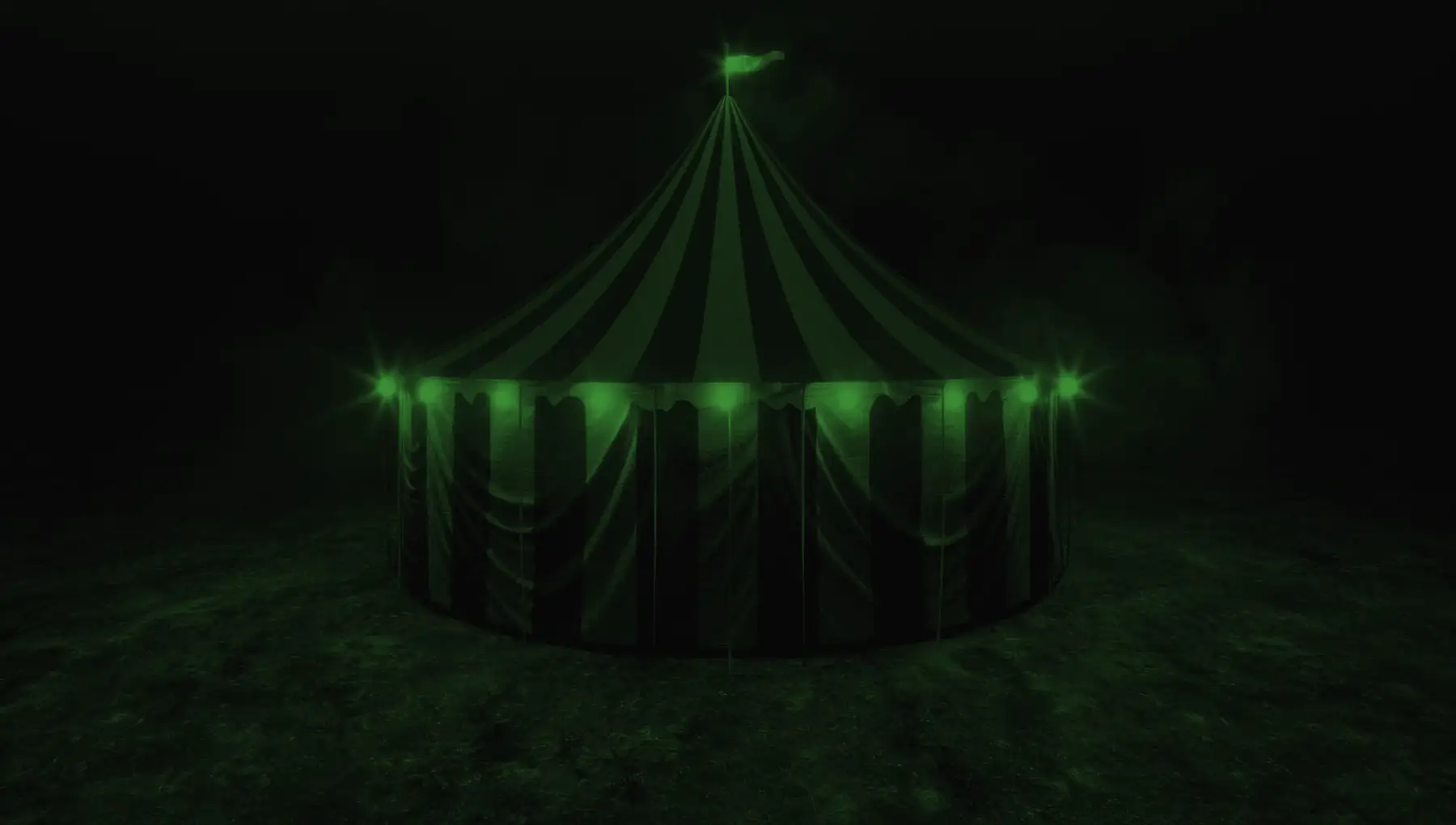
Case file 072Sideshows, Stardom & Spectacle1900–1945

Deadly Circus

A five-ton circus star killed three men, got a new name and went back on the bill. Then came one terrible night in Valdosta, Georgia.

Jul 5, 20241h 5m
00:00 / 1:04:35
Or listen to this episode onApple PodcastsSpotifyYouTube
Share this episode

In this episode

  • Why a circus elephant can never truly be tamed, and what the mahouts did instead
  • Olathe, Kansas, 1884: a locked room, a loose lion, and the one guest who escaped through the ceiling
  • The coroner's jury that took four days to decide her third killing was an accident
  • Quinine, whiskey and a wrong turn: Gypsy's last walk through Valdosta
  • T.G. Powers, the trainer who told the press what Gypsy never forgot

“you simply cannot tame an elephant. All you can do is break an elephant.”

The story

She weighed five tons, learned to blow the harmonica, and drew crowds by the thousands as the single biggest animal attraction in the W.H. Harris Nickel Plate Circus. Gypsy was one of the largest and most famous elephants in the world. She had also killed men, more than once. On a November night in 1902 in Valdosta, Georgia, she killed one more and became a fugitive.

Wild animals came late to the circus. A Frenchman named Henri Martin kicked off the craze in 1831 by stepping into a tiger's cage in Germany and walking back out. American trainer Isaac A. Van Amburgh topped him by sticking his head into a lion's mouth, and so dazzled a 19-year-old Queen Victoria that she commissioned a painting of him with his lions. In America, though, the elephant became the circus icon. An American circus without one was no circus at all.

Taken, not tamed

Elephants are not domesticated animals. They are too big to feed and too slow to breed for humans to reshape them over generations the way we reshaped wolves into dogs. Every circus elephant had to be taken from the wild, and her will and spirit broken.

People have captured elephants for more than 4,000 years, using stockades, female decoys, nooses and pits. Trapped herds were starved of food and water until they were too weak to fight. Trainers, called mahouts, worked them with an ankusha, better known as a bullhook: a steel or bronze rod about three feet long with a curved hook at one end. Gypsy, an Asian elephant first known as Empress, would have been pulled from her mother, chained, marched mile after mile under the hook, and shipped across the ocean in a ship's dark hold. In November 1870 she was sold at auction for $5,000, more than $124,000 today. Then she was sold again, and again.

A lion loose in Olathe

Harris ran a showy operation, with the mysterious Camel Girl in the sideshow and big cats billed as "brain possessing lions." On January 30, 1884, at the circus's winter quarters in Olathe, Kansas, a trainer opened the cage of Prince, the largest African lion in captivity, in front of a small invited audience behind barred doors. Prince sprang out, sailed over Mrs. Harris's head, and landed in the lap of a local physician, Dr. Kelly.

Guests flung themselves out the windows. Mrs. Harris scrambled up a hyena cage and pulled herself through a hole in the ceiling into the loft. A strongman called Monsieur Joseph the Human Hercules hurled an iron bar at the lion, missed, and splintered a wooden partition. Out came a prized trick pony, and Prince locked his jaws around its throat. Clubbing him did nothing, and neither did a pitchfork. From the loft, the men finally lowered chloroform-soaked sponges on poles until the lion, drunk on pony blood, drifted off. The wire services carried the story nationwide. You couldn't buy advertising like that.

Empress becomes Gypsy

On October 12, 1885, in Philadelphia, a man named Robert White insisted he could handle the feared Empress and unshackled her to drink. With no warning and not a sound, she struck him with her trunk and sent him flying 20 feet into a brick wall, disemboweled him with her tusks, and stomped on his chest. He died in the ambulance, the third man she had killed. Just four days later, a coroner's jury called it an accident. She was regarded as the finest performing elephant in America, and "Empress was too valuable and too famous."

When Harris bought her in 1892, he renamed her Gypsy, "her past wiped clean." In Chicago on March 25, 1896, trainer Frank Scott jabbed his iron bullhook into the flesh above her right eye and slid to the ground. She seized him with her trunk, hurled him at the barn doors, blew those doors off their hinges, and went charging through the West Side with a small army of police behind her. Harris offered huge sums to anyone who would shoot her. There were no takers. Tired and hungry, she was eventually coaxed back to the barn with her favorite treats. Scott, like White, died in the ambulance.

The weird part

Empress was known to have killed three men, but she was too valuable to retire. So circus owner W.H. Harris gave her a new name, Gypsy, and kept her on the bill until she killed again.

The last show in Valdosta

On November 22, 1902, the Nickel Plate was closing out its season in Valdosta. Gypsy's trainer, James O'Rourke, was feeling ill and dosed himself liberally with quinine and whiskey. He rode her toward City Hall, though she apparently expected to go to her own train car. On the street, O'Rourke tumbled from her head. Gypsy stopped and looked down, as though weighing her next move. Then she knelt and crushed him, rolled his body more than 50 yards with her trunk, and began grazing.

A clown named Barney Shea tried to lead her back to the depot, but another train blocked her car. Gypsy tore a light pole from the ground and flung bricks and wood. Shea fired a revolver at her, which only enraged her. Police Chief Dampier decided capture was too dangerous. His rifle shot in the dark did no better than Shea's bullets, and she crashed through a high wooden fence and vanished. At dawn the posse tracked her to a creek, and Dampier put a bullet in her temple.

Some 3,000 people came to see her body, many walking more than seven miles. Six horses couldn't drag it, so it was cut apart with axes.

Never forgot an injury

Another trainer, T.G. Powers, told the press that Gypsy was 65 years old. She never forgot a kindness, he said, but she never forgot an injury either, and she waited each time for the moment when she held every advantage. Isn't that exactly the kind of memory and planning people like to reserve for themselves?

O'Rourke was buried in Valdosta's Sunset Hill Cemetery, and circus employees put flowers on his grave every year until the Nickel Plate went out of business. Georgia is now home to ERNA, the Elephant Refuge North America: 850 acres where retired zoo and circus elephants may recover what founder Carol Buckley calls their elephant-ness. Six people died, and so did Gypsy. It was a darker time, and one that shows how far things have come.

The transcript

Chapters & full transcript9,339 words
Chapters
  1. 00:38Breaking an elephant
  2. 01:36How wild animals joined the circus
  3. 12:09Prince the lion gets loose
  4. 19:51Empress kills, and gets a new name
  5. 26:36The last night in Valdosta
  6. 53:49Sheri rides an elephant

This transcript was generated automatically from the episode audio and may contain errors. Times are approximate, since ad breaks can shift them by a minute or two.

00:00

Hey true weirdos, at the end of this episode, stick around if you want for a little bonus content and conversation. She was the most famous of her kind in the whole world. As clever as she was magnificent, she even learned to blow the harmonica and what other creature like her could make that claim? Weighing in at five tons, Gypsy was one of the largest elephants in the world and one of the most famous.

00:30

Gypsy was a star, the single biggest animal attraction in the W.H. Harris Nickel Plate Circus. People lined up by the thousands to see her. She was used to crowds, used to noise, used to traveling by train, used to parading through the streets of big cities and small towns. And then came one terrible night in Valdosta, Georgia.

00:56

A man lost his life and Gypsy became a fugitive. Was it all animal instinct or was Gypsy capable of murder? True Weird Stuff. Wild animals weren't always part of the circus. It took a Frenchman named Henri Martin to kick off a craze that would become a circus tradition right up through the early part of this century. Legend has it that during a performance in Germany in 1831, Henri Martin boldly entered a tiger's cage and lived to tell.

01:59

The crowd, as they say, went wild. It didn't take long for an American animal trainer named Isaac A. Van Amburgh to up the ante by sticking his head into the mouth of a lion. What a showstopper that was. In 1838, Van Amburgh took his act across the Atlantic to Great Britain, dazzling 19 year old Queen Victoria. She was so captivated by Van Amburgh and his big cats that she commissioned a painting of the man and his lions, horses, monkeys, even bears soon found themselves in the ring and sometimes on the stage, a big draw in theatrical melodramas.

02:37

In America, though, another animal very quickly became a circus icon, the elephant. Elephants had long featured in circus entertainment going all the way back to 99 BCE, when the Romans pitted elephants against each other and against human gladiators. The people of the past knew only that the elephant was enormous and exotic.

03:04

They didn't know how sensitive an animal was or how intelligent. They didn't know that female elephants live in family groups. The calves remain with their mothers for as long as three years or that elephants forge strong social connections and maintain those bonds over years. In just the last decade, scientists have piled up evidence showing that elephants are big brainiacs. Elephants use tools.

03:32

They solve problems through cooperation. They demonstrate empathy in their social groups. And best of all, it now seems clear that elephants are self-aware. They think, therefore they are. Today, there are fewer than half a million elephants left in the world. But in Gypsy the Elephant's Day, there were more. Estimates go from a low of three million to a high of 26 million elephants worldwide.

04:02

There are Asian elephants and African elephants. Gypsy was an Asian elephant born in the wild. Before she was called Gypsy, she was named Empress. Her early life's unknown because Gypsy didn't make her debut in the record books until November 1870, when she was sold at auction to the Poggey O'Brien Circus. The owner, John O'Brien, paid a fortune for the elephant, $5,000.

04:27

That's more than $124,000 to you and me. O'Brien knew that an American circus without an elephant was no circus at all. But maybe he overextended himself because less than two years later, Gypsy found a new home, this time with the Dan Rice Circus. There were rumors that Gypsy was temperamental. Call it a mean streak.

04:58

They called her a bad one, which would have been an ideal trait in earlier times, back when elephants were used in war. Did you know about that? The ancients saw the elephant as a weapon of war. I mean, imagine being on the ground armed with only a shield and a sword. And here comes the enemy thundering toward your ranks, mounted atop a herd of trumpeting elephants.

05:23

It was meant to be as intimidating as it was terrifying. Ancient China, ancient India, ancient Persia all deployed elephants in battle. It's a practice that continued well into the 19th century in a handful of places like Thailand, for example. The spread of guns and the invention of gunpowder fired weaponry pushed elephants off the battlefield, but not out of war.

05:47

Elephants were drafted for their strength and labor and, of course, could always be counted on to make a big impact at parades and ceremonies. Unlike human soldiers who go to war in their youth, elephant soldiers had a lot more years on them. The most prized war elephants were older animals. Sixty was an esteemed age, an age of maturity and wisdom.

06:11

All that life experience and native elephant intelligence coming to a near perfect point, which makes sense when you learn that elephants hit their prime between their mid-20s and their early 40s. A seasoned war elephant was both a prize and a powerful weapon. It's difficult even now to breed elephants in captivity, so circus elephants like Gypsy had to be taken from the wild.

06:38

For those of us who've grown up with Dumbo and Horton Hears a Who and a collection of sweet-faced stuffed elephants in our toy boxes, the truth of how elephants actually come to the circus hits hard. These are in no way domesticated animals. Every performing elephant you have ever seen is a creature whose will and spirit had to be completely broken.

07:05

See, a domesticated animal is one that's adapted at the genetic level over generations to life with humans and life in a captive environment. Think about dogs. We don't just haul a wolf pup into the house and give it a name, right? The dogs we call family have been bred in captivity. From their food, to their behavior, to how and when they reproduce, humans are calling the shots.

07:27

But we've never been able to do that to the elephant. They're just too big for us to feed and they take just about forever to birth new young. As species go, they're almost immune to large-scale human exploitation. Almost. Because people always seem to find a way to take what they desire, regardless of the cost. And the cost to elephants, like Gypsy, was higher than anyone in those early circus days understood.

07:56

People have been capturing and training elephants for more than 4,000 years. There are ancient Sanskrit texts that spell out the methods. First and best was the elephant stockade or pen. Next was the use of female elephants as bait or decoys. Third was noosing. This involved the hunter riding atop a trained elephant, noose in hand, lassoing a wild elephant from behind.

08:22

The fourth method used nooses concealed in the ground and sprung like traps. And the fifth was a pit dug in the ground. While some sound worse than others, all were bad. The stockades were traps, huge open areas encircled by trenches with the only entrance a wooden bridge hidden under piles of dirt and leaves. Female elephants would be driven into the stockade, then left as bait for passing wild herds.

08:50

When the pen was full, the bridge would be destroyed. The elephants would be left without food and water, guaranteeing they'd be weakened and less able to put up a fight. It was savage and terrible. The way mother elephants would desperately try to shield their young as older males battled each other and younger males tried to mate with females.

09:13

Rough ropes were tightened around their necks and legs. Sometimes the trainers would cut deep gashes into their necks so that the ropes would dig into their bodies. It was believed that the pain would bring them into submission that much faster. Elephant trainers were called mahouts, a name that stuck to the present day.

09:33

The tool they used was called a nankusha, picture a steel or bronze rod about three feet long with a curved hook at one end. Another name for it is a bull hook or an elephant goad. It's an ancient tool, though contemporary versions have gotten all modernized with fiberglass or plastic handles. Gypsy would have been taken from her mother, from her social group.

09:58

She would have been noosed and chained, driven from her forest home, forced to walk mile after mile, prodded by the mahouts, the goads stabbing at her over and over, then to a town and a wharf where Gypsy was crammed into a small enclosure in the hold of a ship. Days at sea turned into weeks, the ground beneath her feet pitching and rolling with the motion of the water.

10:26

She would have known terror in that murky darkness, surrounded by unfamiliar sounds and smells, and then abruptly blinding daylight, the sharp bite again of the bullhook, stumbling down the gangplank into an alien world of chaos, people, carriages, shouts and roars, nothing familiar, everything threatening and strange.

10:53

This was the new world for Gypsy the elephant. It was overwhelming. And then, ready or not, she was sold to a circus and then sold again and again and again. The W.H. Nickelplate Circus was not the first. P.T. Barnum beat Harris to it by several decades. And it wasn't the biggest, but W.H. Harris understood the power of stardom.

11:20

His human sideshow featured some of the biggest names in the freak show game, including the mysterious Camel Girl. There were acrobats and jugglers and magicians and aerialists. The animal menagerie was just as impressive. The Nickelplate Circus had horses, lots of horses, along with Shetland ponies and mules trained to do tricks.

11:42

The people wanted to see fierce lions and tigers, and Harris delivered that too. Posters advertised the big cats as a national concentration of feline brilliance. Harris claimed his lions were brain possessing lions, promising that their daily deeds would surpass a ticket holder's wildest imagination. And in at least one instance, those lions surpassed everyone's wildest imagination.

12:09

It happened in Kansas on January 30th, 1884. It was a private show for a handful of special guests, all of whom had gathered in a modest frame building in the town of Olathe, Kansas, that served as winter quarters for the Nickelplate Circus. W.H. Harris had acquired an African lion named Prince, the largest African lion in captivity.

12:33

Among the guests were Harris's wife, a local physician named Dr. Kelly, and a gentleman named Monsieur Joseph the Human Hercules. The doors were barred to prevent any member of the general public from entering. The circus animal trainer, Charles M. Curran, entered the room carrying only a small rod made of iron. The plan was for Curran to demonstrate the first steps in training a wild animal to obey the commands of a human master.

13:07

Curran pulled open the bolt on the cage containing the lions, and that's when Prince saw his chance. The massive cat sprang through the open door, knocking Curran aside. Prince leapt into the audience, sailing right over the head of Mrs. Harris and landing with a meaty thud, his giant paws slamming into the lap of Dr. Kelly.

13:29

The spectators panicked, stumbling and falling in their frantic attempt to get out of the locked room. Windows were forced open. Men flung themselves out into the ground below. Only two in that room remained calm. The first was Mrs. Harris, no stranger to the unpredictability of circus life, and Monsieur Joseph the Human Hercules.

13:53

Mrs. Harris didn't bother racing to either door or windows. Instead, and with what was described as astonishing grace, she flung herself at the cage containing the hyenas. In a single fluid motion, Mrs. Harris pulled herself to the top of the cage. A hole in the ceiling above led to a loft space, and the woman grabbed at the edges of that hole and pulled herself through the opening to safety as though she herself was a circus acrobat.

14:22

As for Monsieur Joseph, he was trapped with the door barred and the windows too small to squeeze his giant brain through. The Human Hercules had only his acclaimed strength to call upon. He seized a heavy iron bar that was lying on the floor and in one hurling motion hurled it at the lion. He missed his target and the heavy bar slammed into a wooden partition that separated the wild beasts from the tame ones.

14:52

Dr. Kelly scurried toward Monsieur Joseph, maybe thinking he could hide behind the giant. But Prince the Lion bolted past both men, a blur of tawny fur and gleaming claws. The lion was indifferent to his human audience. The big cat had other plans. When that iron bar hit that wooden partition, the board splintered. Into the mayhem came a pony, a valuable pony famed for its many tricks.

15:23

The lion dropped, crouching low, its tail flicking once and twice. The little Shetland pony either didn't recognize the threat or was too distracted by the screaming and shouting to understand that it was a mortal danger. Prince let out a roar, shook the glass and the window panes, and in a single move that was almost too fast to see, sprang on the pony and locked his enormous jaws around the creature's throat.

15:52

Monsieur Joseph grabbed the iron bar again, this time clubbing the lion in the head, which made absolutely zero impact on the cat. The circus trainer, Charles Kern, was suddenly at Joseph's side wielding an enormous pitchfork. Kern plunged the pitchfork into the lion, which also made zero impact. Prince was too busy devouring the pony to even notice.

16:20

But Kern knew the men needed to get out fast before Prince turned on them. Meanwhile, a crowd had gathered outside the building. There were shouts of. Men in the crowd had pulled out their own revolvers and waving them around. W.H. Harris knew he was facing a potential calamity. If Prince escaped the building and began feasting on townspeople, well, that'd be bad for business.

16:54

He gave his permission for the lion to be killed. But Dr. Kelly was shouting something else. Very rarely does a panic crowd listen to anything, much less reason. But somehow Dr. Kelly's voice cut through the madness. Up into the building's loft, they clambered, finding a rumpled but intact Mrs. Harris watching the scene below with wide, shocked eyes.

17:24

The men carefully maneuvered to the floor above the lion. They cut two holes. Two large sponges were attached to two long poles, and the sponges were soaked with chloroform. It's a wonder everyone didn't pass out when you think about it. They slowly lowered the poles with the sponges down, down, down. They needn't have worried about spooking Prince.

17:50

The lion was drunk on pony blood, happily gnawing away at his prize as the sponges descended. It didn't take long for the chloroform to subdue the cat. His eyes grew glassy. The tense, bunched muscles under his coat slowly relaxed. The grip of his jaws on the pony's carcass eased. He drifted into unconsciousness. With the lion out cold, the men were able to drop ropes down, looping them around the cat's legs and binding them tight.

18:21

Within minutes, the snoring Prince was hauled into his cage and locked down. His muzzle and paws were soaked in blood. And when he came to, he was furious, roaring and flinging his mammoth body at the bars of his cage. Every other animal in the building was in a state of panic. The noise was hellish. Every human within earshot retreated indoors, barricading themselves inside.

18:54

People were priming pistols and shotguns and reaching for long, unused weapons, convinced at any moment that the blood-crazed lion would burst through the bars of its cage and go on a mad killing spree. Now, you might think this was a bad day for W.H. Harrison, the Nickel Plate Circus. It wasn't, not really. Injuries were minor, except for that poor pony, and damage to property was fairly minimal when it was all said and done.

19:23

From a publicity standpoint, not bad. It made for an excellent and thrilling story that Wire Services picked up and published all around the country. You couldn't buy advertising like that. All in all, Harris knew the circus had gotten off easy, something that wouldn't be true just a few years later with a different member of the Nickel Plate Menagerie, Gypsy the Elephant.

19:51

Let's go to October 12, 1885, Philadelphia. The elephant belonged to the Poggey O'Brien Circus then. They called her Empress, and she was in her stall, heavily shackled, when a gentleman named Robert White, who was in charge of the circus's winter quarters in Philly, offered to release Empress, you know, take her out of the stall to be watered.

20:11

White was insistent that his skill with elephants was up to the task of managing the feared Empress. Unlocking her shackles, White led her to a nearby water trough. Empress, seemingly relaxed and docile, drank and drank. And then, with no warning and not a sound, the elephant wheeled on White, striking him with her trunk, a blow that sent him flying 20 feet, his body slamming against a brick wall.

20:40

Empress bent her massive head and with her tusks disemboweled Robert White. Then she lifted her forefoot and stomped it down on his chest, crushing the man's sternum. Empress loomed over her victim, trunk swinging from side to side. White, believe it or not, was still conscious. It took another circus employee named Dan Taylor to back the animal away.

21:08

He was using a spear, his voice low and calm and soothing. As for Robert White, he died in the ambulance en route to the hospital. He was the third man Empress had killed. There was an investigation into White's death. Just four days later, a coroner's jury found that it was an accident. Despite her track record of killing three and injuring dozens more, capitalism and celebrity weighed in her favor.

21:38

Empress was too valuable and too famous. She was regarded as the finest performing elephant in America. It was unthinkable that she would be retired, much less put down. So when W.H. Harris acquired her in 1892, he decided that a name change was in order. Empress was gypsy now, her past wiped clean. In 1896, to Harris's horror, if not surprise, the elephant killed again.

22:13

This time it was her trainer, Frank Scott. It's March 25th, 1896 in Chicago. Frank Scott had taken Gypsy into an alley to give her some exercise. Up and down the alley, the pair went. Scott riding astride her back until it was time to return to the barn. Witnesses said that Scott jabbed his iron bullhook into the flesh above the elephant's right eye, then slid down her forehead to the ground.

22:43

His feet had scarcely touched the floor. When Gypsy sees Scott with her trunk, raised him high in the air and then hurled his body at the barn doors. The wood splintered like matchsticks. Scott's mangled body lying so still. His blood pooling on the earthen floor of the barn. Gypsy swung her enormous head into the barn doors, blowing them off their hinges and headed out, pausing only to once again hoist Scott's body aloft with her trunk, slamming him into the ground.

23:19

Then she was charging through the streets of Chicago's West Side. Crowds followed. Every window was crammed with faces. Small boys leapt from fences to rooftops, racing along in pursuit of the furious animal. What was described as a small army of police officers spent hours trying to corral and contain the rampaging elephant.

23:43

Many only narrowly escaped injury and death. It was chaos. W.H. Harris offered anyone in earshot huge sums of money in exchange for shooting Gypsy, but there were no takers. In desperation, Harris pleaded for help from James Sweeney, the animal keeper at Chicago's Lincoln Park Zoo. Ultimately, though, Gypsy, probably tired and hungry at this point, was coaxed back to her barn.

24:11

Nibbling on her favorite treats, she was placid as the chains were looped around her ankles and bolted securely to the floor. And Frank Scott, like Robert White, died in the ambulance on the way to the hospital. We live in an era of liability insurance and lawsuits. We hear stories like this and think, what in the everloving hell?

24:37

How is this allowed to happen more than once? It's like everyone knew that this elephant was, at best, unpredictable and, at worst, dangerous. Yet still, these circus owners were able to trot her out in public and expose their employees and customers and anyone nearby to the risk of terrible violence. That's how we see it.

25:01

Because we are from the future. We know things about elephants and animal welfare in general that these folks didn't. We watched as this elephant was snatched from her family group and basically tortured and tormented for years. We're appalled by how she was treated, shocked that it was allowed to continue for so long.

25:27

We grieve for all the ways this sensitive and sentient living thing was kept in bondage, subjected day after day to a bewildering reality that could not have been more alien to her. But remember, true weird time travelers, when we visit the past, we're powerless to change it. We're just observers. Even as we watch gypsies trainers, such a long line of trainers, punish and control her in all sorts of cruel ways, like cutting slits in the tender flesh of her ears, chaining her so tightly that the metal links bite deeply into her ankles.

26:10

We watch with the sick feeling that the worst is surely yet to come, that there's just no way this story has a happily ever after. And that's the problem with time travel, the helpless feeling of knowing how it all ends. November 22nd, 1902, Valdosta, Georgia, the W.H. Harris Nickel Plate Show was in town. Two spectacular shows daily.

26:47

A team of magnificent Siberian camels trained to work in harness. Gypsy, the largest elephant that walks the earth. A $10,000 den of baby and performing lions. Mr. Albert Costello, the fearless founding jockey. Miss Amaletto, the greatest wire walker in the world. Mr. Claude Orton, America's only four horse rider. Leapers and gamblers of established fame and a host of funny clowns.

27:29

The Nickel Plate had just completed a successful run all over the state of Georgia, entertaining delighted crowds in towns like Macon, Tifton and Cordele. The two shows scheduled for Valdosta were the last of the season. The circus would head for their winter quarters immediately after. Saturday, November 22nd, dawned clear and bright, a perfect day for a show.

27:57

Gypsy's trainer, James O'Rourke, had the elephant under perfect control, though he himself wasn't feeling well. Shortly before it was time to mount Gypsy and ride her to the performance, O'Rourke began liberally self-medicating with a mixture of quinine and whiskey. A little unsteady on his feet, O'Rourke managed to navigate himself and the elephant to the Georgia Southern Railroad Depot, where his show clothing awaited him in one of the circus train cars. It took O'Rourke a while to get dressed and return to Gypsy, where once again he mounted and steered the elephant towards City Hall. But something was clearly amiss. Later it was said that Gypsy had expected to enter her own train car, and when O'Rourke instead steered her in the opposite direction, she became angry. The pair made their slow way through town, turning at one point onto the wrong street. Valdosta's chief of police happened to be wrong turn. The trainer mumbled a reply the damper couldn't hear. Man and elephant continued on, making their way to Tomb Street. There were two young men following Gypsy and her trainer, witnesses to what happened next. O'Rourke slowly tumbled from Gypsy's head, falling to the ground.

29:26

Gypsy immediately halted and looked down at O'Rourke. It was, the men said, as though she were considering her next move. Then she knelt above her trainer, and with almost a lover's gentleness, crushed the man beneath her. Seizing his body with her powerful trunk, Gypsy rolled O'Rourke's body for more than 50 yards. Then she began grazing, munching away in what appeared to be complete contentment. Police chief Dampier, who heard the commotion, had sprinted to O'Rourke's side, but it was clear that nothing could be done for the man. Dampier called for any employee of the Nickel Plate to please come help, and it was a clown named Barney Shea who answered. Shea approached Gypsy, coaxing her to follow him back toward the train depot and her waiting car. A crowd gathered around, behind and in front of the elephant, and they've discovered another train sitting on the tracks, blocking access to Gypsy's car. The elephant, already agitated by the crowd, and now this new obstacle, corrupted. With her trunk, she snatched a light pole from the ground and shook it. Then she began seizing bricks and wood and flinging them in all directions. Barney Shea was shouting her name, trying to get her attention, and when that failed, he pulled a revolver from his coat and fired at her. She was unhurt, but the sting of the bullets only infuriated her more. After more than an hour, the elephant stormed up and down the streets, the crowd surging in her wake. Then she broke into a gallop, bolting toward the nearby state fairgrounds, Chief Dampier and the police in pursuit. Dampier had made the decision that the elephant was too great a danger to make capture a risk worth taking. The decision was made that Gypsy must be put down. Even Mrs. Harris, who had seen much in her days with the circus, declared that she couldn't rest until Gypsy was dead. Barney Shea climbed to the top of the It was full dark now, the moon concealed by clouds, and the hulking shape of the elephant was only a silhouette.

32:00

Chief Dampier raised his rifle and took careful aim. The shot found its mark, but like Shea's bullets, did nothing but enrage Gypsy. She bolted, crashing through a high wooden fence like it was made of toothpicks, disappeared into the night. The search resumed at dawn, Dampier and Posse following the signs of Gypsy's progress, trampled greenery, the impressions left by her huge body where she had laid down to rest.

32:31

When they found her, she was standing near a creek, her body swaying ever so slightly, sighting the humans she took off and then finally stopped, evidently fatigued. Chief Dampier crept as close as he dared, exhaustion and adrenaline causing his hands to shake slightly as he once again raised the rifle and took aim. The bullet entered her temple. Gypsy was down, this time forever.

33:08

Chief Dampier and his posse returned to the city and reported the death of the elephant, and the announcement came as a great relief to the circus people. They had been uneasy all night long and were really glad to know that the great brute had been killed, even though it was a big financial loss to them. The tragedy of the night before and the excitement of the chase after the big animal made it the most sensational event that Valdosta has ever known. The body of the dead elephant was buried a short distance from where she died. A half dozen horses were meant to drag the remains to the grave, but were unable for the task, and the body was finally cut to pieces with axes and moved apart at a time. Gypsy's death by execution proved to be a windfall for Valdosta. As many as 3,000 people came from outside to view the spot where she'd fallen and to eyeball her massive corpse. Many of those people walked more than seven miles just to get a look. Another trainer at the Nickel Plate Circus, T.G. Powers, told the press that Gypsy was 65 years old, among the first elephants ever brought to the United States, and had been a star in nearly every big circus in the world. It was her temper, he said, that made it difficult for her to stay long with any one show.

34:28

Powers talked about her intelligence and her incredible memory. She never forgot a kindness, but she also never forgot an injury. She killed half a dozen trainers. She waited, in each instance, for the moment when she held every advantage. She would harbor an unkind act for years and a vengeance. Something we think of as a human trait. Something that requires intelligence, memory, planning. Things we hesitate to ascribe to an animal. Things we hoard for ourselves, happy in our delusion that we alone are aware. That we sit atop the food chain with dominion over all the beasts of land and sky and sea. We don't like to think that we share these traits with animals, because then we would have to drop the bullhook and the chains and the certainty that we have the power and the right to confine and consume and exploit the creatures we share this world with. The killing of an elephant in the woods near Valdosta will be a story told to generations yet unborn. Even now, it is almost hard to believe, but the bones and white ivory tusks will form relics that will be kept for years by many who desire to keep such trophies. James O'Rourke, Gypsy's last victim, was buried in the Sunset Hill Cemetery in Valdosta.

35:56

For years, until the Nickel Plate Circus went out of business, its employees would return each year and place flowers on his grave. Today, the state of Georgia is home to ERNA, the Elephant Refuge North America. Three elephants call it home now, with room for up to 10 retirees from zoos and circuses. With 850 acres to roam in a climate that allows the animals to be outdoors 24-7, this is a place where an elephant may recover his or her elephant-ness, as the founder Carol Buckley puts it. It's a struggle for most captive elephants, taken from their mothers at such a young age that they never develop the skills to bond with other elephants. These are traumatized animals in many cases, but lucky ones too, because the sanctuary in ERNA gives them a second chance.

36:52

Their human caregivers see them as autonomous beings, smart, sensitive, sentient, beings that think, therefore they are. Gypsy, an elephant from a different and darker time, could only dream of such a fate. They called her bad, not realizing the part they played in her tragic and violent story. Six human beings dead, and Gypsy, the elephant, dead too.

37:23

The kind of story that can only end in grief. The kind of story where the only comfort to be had comes from knowing that with time and bitter experience, we learned, and now we do better. Next time on True Weird Stuff. Payphones used to be everywhere, and now they're mostly gone. And you'll be shocked to know how much money the phone company made off of payphones.

38:00

I can't wait for you to meet a legendary figure, the Robin Hood of quarters, nickels, and dimes, the payphone bandit, on the next True Weird Stuff. Special thanks to our voice talents on this episode, including Kary "Doc" Bowser. So, Sherry, I actually had heard this story before. Now, I hadn't heard it in the detail.

38:28

I mean, I heard that an elephant was put to death and had rampaged through town, and I had heard that before. I'm guessing you stumbled upon this when you were doing the research you had for the camel girl in the previous episode. Well, there's another famous elephant, infamous, let me say, elephant execution story where the elephant was electrocuted. Remember? Yeah.

38:52

And I thought in my childlike innocence and naivete that that was the only time that that happened to a circus elephant, and that turned out to not be true. So, I just assumed when I, because I was doing the research for Ella Harper, the camel girl, and you can find that episode if you haven't heard it yet. We just released it. And I knew that W.H. Harris had a killer marauding elephant. I was like, I didn't think the elephant belonged to somebody named Nickelplate Circus.

39:24

And that's when I discovered that Gypsy was a completely different elephant than the one that got executed. And that Harris, Empress, was widely known to be dangerous. Widely known. And Harris just changed her name and squeezed a few more dollars out of her. And I want to say, like, you know, you never are happy to see any person suffer, much less be killed. But damn, if this elephant wasn't like the trainer T.G. Powers said, capable of remembering and holding a grudge. They were so cruel back then. They were so very cruel.

40:05

And you know what? I will say in their defense, it's not like they knew better, except for the part where, don't we as human beings, can't we feel when we're behaving badly? Like, don't we know that sticking a spear into an animal's eye is bad? Like, even if we're from 150 years ago, don't we know that? I would think you would have. You've seen Water for Elephants, the movie.

40:31

Oh, yeah. And and that was a that was a movie that I watched and I fell in love with the elephant that was there. How could you not? And I think that probably was a fairly good representation, if you want to see it visually, of what the elephant's life was like. And also the cruelty that went into the training, the hooks. When you I have to tell you, when you would explain that, I sat here and cringed. I mean, any kind of cruelty to an animal, it just I can't listen to it. But the idea that these creatures are our ascension, they are thinking and they remember to kindness, as he said, you know, the one guy that was talking about it, they do remember those kinds of things over a long period of time. I guess that's why they say memory like an elephant.

41:24

They're very, very it's beyond being smart, right? It's this other level that we think belongs only to humans. The emotional intelligence that they have and the ability to retain memory, to make plans, to make to synthesize information, you know, to make connections. That wasn't really widely understood until very, very recently, because we have different.

41:52

First of all, we come at the world differently. Now we have a different perspective and approach to wildlife. But also we have technology now that allows us to watch a brain light up as it receives inputs. And we can see now the ways that parts of the elephant's brain that relate to memory and all are active in the same way that the human brain is.

42:18

The thing for me that was so gutting was the realization I'd never spent a lot of time like diving into this before the realization that you simply cannot tame an elephant. All you can do is break an elephant. Did that not hit you like a truck? Yeah, it did. Because that's almost like a human. You know, that's almost like something you would say about a human. Yeah, you can. You can break a human spirit. You can subjugate a human being.

42:57

The idea that these animals, these wild animals, I mean, look at Prince the Lion. Right. You know, these wild, they really thought people back then really believed that by caging them and feeding them and disciplining them, you were somehow turning them into oversized house pets. They're going to be wild animals regardless. You're right.

43:26

That incident in Olathe, it is a wonder that that poor Shetland pony is the only thing that lost its life that day. Right. And if Prince had not, so if the human Hercules had not, and he didn't do it on purpose, had not accidentally shattered the partition, one of those people would have died. You know, it's anybody's guess which one was going first, but one of those people were going to be taken down by that lion. A little bit more of a more modern version of this was what happened Siegfried and Roy out in Las Vegas. I mean, the two of them on stage, they raised these, I guess it was tigers. I know they're big cats, white tigers, tigers. Right. So they raised them from the time they were little until they got older. And still you would think, oh, well, they're they're all OK. You know, they're not nothing bad's going to happen. They do this all the time.

44:23

It's a Las Vegas show. They wouldn't let them do it if something bad was going to happen. And then Roy got attacked by one of the cats and, you know, they're just wild animals. You don't know what's going to happen. I mean. That's such a great point, because not only was that an incredibly contained environment and Siegfried and Roy were incredibly experienced and skilled at handling those animals and those animals were not suffering the way these circus animals of the 19th century were. Those animals lived in as much comfort and splendor as could be managed.

45:05

And still that wild instinct that you cannot tame in a in a wild creature. It's there. It's just always, always there. It's like what I'll tell you, a funny story that happened. You know, we have a miniature schnauzer named Mojo, right? And Bridget always goes up to his face and who's my little girl? She always does that and has her little doggie voice.

45:30

Well, there was one day he had had enough and she went and did it and he growled at her. Now, I've never seen him growl ever. And she tried it again and he growled again. And it's like, you know, sometimes they've just had it. That's enough. Not going to deal with that. That's enough of that. Because I kind of freaked out a little bit because he's just a sweet little miniature schnauzer, you know. But who among us has not had a moment where you're like, I'm not your little kissy man. The hell away from me. I'm not. Stop touching me.

46:05

There's some there's a lot of there's a lot of sad. There's a lot of sadness in this episode, but it's not the sadness of what happened in the past. Here's the sadness in this episode. When Gypsy when Gypsy made the Atlantic crossing, there were somewhere between three and twenty six million elephants in the world. And today there are less than 500000. That's sad.

46:28

The poaching of elephants is still a major problem. It's still a major problem. I don't know what it is about us, the human animal. We we are the embodiment of you can't have nice things. We are never content until everything has gone to shit. I don't know why that is about us. We are cruel. We are greedy. We are selfish. We are just monstrous. And yet there we are, you know, with dominion over the beast and we behave terribly. Now, of course, not all people, but people with a capital P are the reason that there are only half a million elephants left in the world. It sure as hell isn't, you know, wild turkeys taking them out or cicadas.

47:18

It's people. Well, it's poaching. It's hunting. It's trophy hunting. It's just being an asshole. Like we are the reason that this magnificent sentient creature is in danger of leaving the world. Let's hope that the awareness of this and the laws prohibiting certain things and let's hope that maybe this will rebound much like the bison did in this country.

47:46

Maybe maybe maybe things will get better. I'm I'm optimistic that that could happen. I mean, I just am. There are places in the world where where elephants are indigenous, where they're native and people are trying so, so, so hard. One big problem that the elephant has is habitat. You know, they need a lot. Elephants need a lot of room to roam and they need a lot of feeding area. And as cities sprawl and spread in the parts of the world where elephants are native, you can see how their territory, it's like deer, you know, in the southeastern United States.

48:29

There are a lot of deer living in landlocked suburban neighborhoods because they that's where they were and they can't get back out. People, again, without meaning to are making it really hard for the elephants to survive for for a lot of reasons. And not all of them are malevolent, right? Right. Some of them are just like, you know, the march of progress. And I want to confess, I started off this this one feeling like, oh, my God, these poor human beings that were killed by Empress Slash Gypsy, the elephant. And by the end of it, I was like, well, be like that sometimes. Mess with the bull, you get the horns like by the end of it, my sympathies were like, so with the elephant, it's terrible, isn't it? But I couldn't help it. Do you know something that I did not know until I don't know, maybe just a few months ago, and that is there were elephants in North America at one time.

49:33

Oh, a gazillion. I mean, yeah, that's an amazing thing to think about. Apparently, they came across like the land bridge, the land bridge. Yeah. No idea. I had no idea that there were elephants living in this country at one point along the line. And I guess they died out so many thousands of years ago. But anyhow, I just think that's a fascinating thing.

49:56

Don't know our own history because we are not taught our own history. We're taught myth making and propaganda. We are not taught our own history. And also so much of the so many things in the archaeological record conflict with our story of how things were that when they conflict, we just go, Oh, that's probably nothing. And we push it to the back of the closet. Right. And, and that that's a great the fossil remains of ancient elephants in North America are part of that. Yeah, this is probably just something weird that we don't want to look at. Because it, you know, it would make us have to rethink the whole story of us and the planet and what we've been taught. And now, of course, you know, it's hard to I don't think there is a circus left in the US that has There may be I know that when I live, when I live downtown, where I at that time, the arena where the Ringling Brothers was, and I had to wait in traffic for the elephants, because they they were still traveling with the wild animals at that point along the line. And the elephants had their trunks connected to the tail of the one in front of us. And I'm right in front of me. It was it was surreal. It really was.

51:32

Well, here's my elephant story. The very beginning of my radio career. I mean, like, within the first couple of months of me starting in this industry, with no experience and no clue and absolutely no sense. The management came to me and said, the circus is going to do the elephant walk. And I I did that sentence. I had no idea what that sentence even meant. I'd never been to the circus. And what they were talking about is what Max is describing. The circus travels on trains or they used to. I'm sure they still do. But with all the animals, they had like they had like car after car after car for performers and wranglers and animals and trainers and supplies.

52:20

And they would come into town on the train and then the elephants would would have to walk from the train station to the performance venue. And it might be a couple of miles, right? It wasn't like an onerous walk, but it was through the city with traffic and cars and noise and all of that. So management goes, yeah, the the elephant walk and we would like you to go to the elephant walk. And I was like, OK. And then I got there and I found out that Sherry go to the elephant walk was management speak for you'll be expected to ride on an elephant for the elephant walk. And I did not want to do that because I was scared to death.

53:11

If you've ever been up close to an elephant, I mean, standing in front of the elephant and it has that big, giant, wise eye and there's its trunk. There's nothing separating. There's no fence. There's no rope. They are so very big. They are so much bigger than you think they are. And the trainer was this very gruff. The Mahout was this very gruff sort of man who had seen everything and was done looking at anything, you know, that type. Right. Right. And he's like, up you go. And I was like, yeah, no, I'm just let somebody else. And he's like, nope, says right here, you're Sheri Lynch, you're the one. And he basically he and another guy basically grabbed me and flung me onto the elephant. And in cartoons and in my imagination, when you rode on an elephant, I don't know. I've ridden horses. I don't know what I thought it was.

54:11

My fellow humans, you sit on the elephant's head and you don't have anything to hold on to. And the elephant starts doing its thing. And the elephant is covered in coarse, prickly hair, which you can't see from the audience. Okay. And that hair I was wearing. I remember I was wearing I was wearing like jeans and Doc Martens and T-shirt.

54:40

That elephant here pierced through the denim and it was stabbing me in the flesh. When I got home and got in the shower, I was covered in marks from the elephant fur. So I'm on top of the elephant's head. I'm scared to death. I'm trying to smile. They're like, wave, wave to the hoots down. They're yelling at me. You're supposed to wave to the crowd. And I'm trying not to cry, throw up.

55:04

I'm desperately like clinging to anything and there's nothing to hold on to. And the mood was like because I was like, what do I hold on to? And he said, you don't need to. The elephant knows what she's doing. Well, they had those bullhooks and they would take those bullhooks and they would. I want you to picture an elephant's leg and kind of the tender spot behind your knee. Yeah. Give that elephant a little jab right around there because there were other elephants with other people on them. And so even though I didn't dare, I couldn't see what my Mahout was doing because the elephant is so freaking gigantic when you're on top of it that you can't really look down on the ground without tipping over. But I could see what the other hoots were doing to their elephants and the elephant. She's shambling along and I'm up there on top of the elephant's head on its head saying, God, I know I'm a heathen, but my grandma will not survive me being killed by an elephant. Please let me let me come out of this alive like my grandma will not be able to get that phone call. And the elephant radiated hostility.

56:12

Which only made me more terrified, Max. You know how like you can sense when a person is angry, right? Like they've got that tight smile that doesn't go to their eyes, right? You know, and they make this elephant was not at all interested in having this bitch on her head. I'm just telling you not at all. And it was a couple miles moving, moving at a pace.

56:35

When we got where we were going, I was as scared to get down as I was to stay up because I just couldn't imagine how I was getting off of this massive animals head. And, and the moods, they have no patience. Like they've done this a million times and it's just pain in the ass for them. You know, it's just, it makes their job harder and their day longer. And he's like, he's just like, turn around, get on your belly and just slide and I'll catch you.

57:03

Oh my God, I was so scared. I got home. I smelled like you would not believe. And I had to leave my clothes out on the back steps and I was covered in puncture marks from the elephant hair and had nightmares for about six months afterward where I would relive that experience. It was not pleasurable. And I did not feel that the elephant wanted any of us sitting on their heads. They simply did what they were made to do and you could feel it.

57:34

And this is not like, you know, retrospective memory. Like, oh, up until, you know, now I thought I was riding Horton. Here's a who, huh? I told anyone that asked, did you have fun riding the elephant? No, I was terrified. I was in tears the entire time. And I have, I have marks on my body where the hurt, the hair pierced me. I was so scared. I would never do that again. I wouldn't do that again. I just knew people's, you just knew sitting on her head that she was not happy.

58:05

None of the other animals looked happy either. And now you'd be hard put, I think, to find a big circus that travels with that kind of show. I mean, Ringling Brothers, Barnum & Bailey, they ended that, right? They did. And they didn't do anything for a while. I think they are rebooting it without any animals. Because, you know, Cirque du Soleil has shown that you can do it without animals, I think. I'm pretty sure I went to. Although Cirque du Soleil does something with horses. So I'll take that back. Sorry. Yeah, I think you can't find like the big cats and the elephants anymore. Although I did go to, I forgot what it was called. It was a crazy circus where they had a motorcycle man riding inside a big metal cage. I forgot what it's called. But it was a, it was a super like, stunt heavy, like, like stuntman, Evel Knievel-y vibe kind of heavy circus. No animals. No animals. And I know there are a lot of people that were sad. Because I remember, like, it was all over the media when Ringling Brothers ended that version of the show.

59:21

And there were people, you know, awash in nostalgia and sad and, oh, you know, political correctness, can't have anything, blah, blah, blah. But folks, it's not, it's not political correctness that makes you realize that maybe we shouldn't be snatching wild animals away from their mother and torturing them and terrorizing them for our entertainment. Is that being politically correct?

59:44

Or is that just saying, hey, I'm trying, you know, as we've learned and evolved and become more enlightened, I'm trying to not be a dick. Which is it? I think it's something from a bygone time. I really do. I just think that it is something that's time passed. And if you want to see animals in zoos, there's a lot of zoos that have more natural habitats for the animals, if you would like to see them live. But I think taking them around, putting them in railroad cars and taking them to different locations to perform is it's just something from a bygone time.

1:00:18

Oh, I mean, and the people, the people of the past, your ancestors were some bloodthirsty. Because if you think that these men that Gypsy killed, if you think that was slept under the rug and kept the hush hush, you need to think again. Sure. That sold tickets. My ancestors were not bloodthirsty. They were just thirsty for alcohol.

1:00:48

Well, they have less to atone for. There you go. Yeah, like this was people like the circus has never come see the man killing elephant, because that's not going to sell tickets. But the idea what they did was even more diabolical and classic marketing technique. Instead of saying come see the man killing elephants, they kind of pushed the skill of their trainers into the foreground.

1:01:18

This is these dangerous wild animals obey so and so with a flick of his eye, you know, they, they kind of went that way with it. I'll tell you what, whatever else we are good at in the United States. We like in the advertising business to say it's the truth well told. Oh, my gosh. Yeah. So that is, um, that is the end of our back to back visits through time to wh Harris's nickel plate circus. And it really does make you real make you think like, wow, in a very short amount of time, 130 years, 140 years, how radically we've progressed and changed in some of these areas? You know? Yeah, don't you think? Yeah, for the better? Yeah.

1:02:19

Yeah. So that, that ends our trip to the circus. On the next episode of True Weird Stuff. We're going to meet a guy. He's one of those people, like he's a genius. But he never played by the rules. He I mean, he had a really great job. And he was an incredibly skilled artisan. But as you'll discover, from the beginning of his adult life, he was looking for a way to beat the man at the man's game. And the story we're going to tell you next week on True Weird Stuff, you're going to see that you can beat you can get caught and still beat the man at the man's own game. And you're going to understand why a whole lot of people thought the payphone bandit was like Robin Hood. And that's on the next True Weird Stuff.

1:03:16

And if you listen to us on Apple podcasts, hit the plus button in the top right corner. And now an independent podcast like ours to get discovered. And we really appreciate it. If you subscribe, rate and review True Weird Stuff, hit our website, true weird stuff.com for show notes and photos and videos when we have it and bonus content. Everything true weird is waiting for you at true weird stuff.com and follow true weird stuff on Instagram and Twitter.

1:03:44

True Weird Stuff is a Now! Media production. Our executive producer is Anthony Garcia. The show is written and hosted by me, Sheri Lynch, along with my deeply weird director, Max Sweeten. Our equally odd producer is Kary Bowser. Additional production by the mysterious Stephen Call. Our digital witch and social media cult leader is Heather Furr. Original graphics by Kevin Nash. Original artworks by Olivia Axland. True weird original music composed and performed by Jack Griffin and Zane Nash. Copyright 2024 Now! Media. All rights reserved. All wrongs remembered.

Creative Co-Conspirators

Voice talent

One new weird tale a week.

The strangest true stories in history, in your inbox.

Unsubscribe anytime. Privacy policy.